Saturday, April 16, 2016

वक़्त | जावेद अख़्तर

ये वक़्त क्या है?
ये क्या है आख़िर
कि जो मुसलसल[1] गुज़र रहा है
ये जब न गुज़रा था, तब कहाँ था
कहीं तो होगा
गुज़र गया है तो अब कहाँ है
कहीं तो होगा
कहाँ से आया किधर गया है
ये कब से कब तक का सिलसिला है
ये वक़्त क्या है

ये वाक़ये [2]
हादसे [3]
तसादुम[4]
हर एक ग़म और हर इक मसर्रत[5]
हर इक अज़ीयत[6] हरेक लज़्ज़त[7]
हर इक तबस्सुम[8] हर एक आँसू
हरेक नग़मा हरेक ख़ुशबू
वो ज़ख़्म का दर्द हो
कि वो लम्स[9] का हो ज़ादू
ख़ुद अपनी आवाज हो
कि माहौल की सदाएँ[10]
ये ज़हन में बनती
और बिगड़ती हुई फ़िज़ाएँ[11]
वो फ़िक्र में आए ज़लज़ले [12] हों
कि दिल की हलचल
तमाम एहसास सारे जज़्बे
ये जैसे पत्ते हैं
बहते पानी की सतह पर जैसे तैरते हैं
अभी यहाँ हैं अभी वहाँ है
और अब हैं ओझल
दिखाई देता नहीं है लेकिन
ये कुछ तो है जो बह रहा है
ये कैसा दरिया है
किन पहाड़ों से आ रहा है
ये किस समन्दर को जा रहा है
ये वक़्त क्या है

कभी-कभी मैं ये सोचता हूँ
कि चलती गाड़ी से पेड़ देखो
तो ऐसा लगता है दूसरी सम्त[13]जा रहे हैं
मगर हक़ीक़त में पेड़ अपनी जगह खड़े हैं
तो क्या ये मुमकिन है
सारी सदियाँ क़तार अंदर क़तार[14]
अपनी जगह खड़ी हों
ये वक़्त साकित[15] हो और हम हीं गुज़र रहे हों
इस एक लम्हें में सारे लम्हें
तमाम सदियाँ छुपी हुई हों
न कोई आइन्दा [16] न गुज़िश्ता [17]
जो हो चुका है वो हो रहा है
जो होने वाला है हो रहा है
मैं सोचता हूँ कि क्या ये मुमकिन है
सच ये हो कि सफ़र में हम हैं
गुज़रते हम हैं
जिसे समझते हैं हम गुज़रता है
वो थमा है
गुज़रता है या थमा हुआ है
इकाई है या बंटा हुआ है
है मुंज़मिद[18] या पिघल रहा है
किसे ख़बर है किसे पता है
ये वक़्त क्या है


शब्दार्थ:
  1. ऊपर जायें लगातार
  2. ऊपर जायें घटनाएँ
  3. ऊपर जायें दुर्घटनाएँ
  4. ऊपर जायें संघर्ष,टकराव
  5. ऊपर जायें हर्ष, आनंद, ख़ुशी
  6. ऊपर जायें तकलीफ़
  7. ऊपर जायें आनंद
  8. ऊपर जायें मुस्कराहट
  9. ऊपर जायें स्पर्श
  10. ऊपर जायें आवाज़ें
  11. ऊपर जायें वातावरण
  12. ऊपर जायें भूचाल
  13. ऊपर जायें दिशा, ओर
  14. ऊपर जायें पंक्ति दर पंक्ति
  15. ऊपर जायें ठहरा हुआ
  16. ऊपर जायें भविष्य
  17. ऊपर जायें भूतकाल
  18. ऊपर जायें जमा हुआ

Monday, April 11, 2016

When less is not more | S Y Quraishi

Simultaneous elections to panchayat, assembly and Lok Sabha may be desirable.
They are not feasible.

Prime Minister Narendra Modi’s suggestion that elections to the Lok Sabha, Vidhan Sabha and local bodies should be held simultaneously has brought to centrestage an issue that has been raised intermittently, for years. Earlier, L.K. Advani had made the same suggestion. In a May 2010 blogpost, he advocated a fixed term for elected bodies and a need for simultaneous elections. Leaders of several parties also raised the issue, leading to a Parliament committee examining it. The idea is good in principle but seems fraught with constitutional issues and administrative problems.
Let’s first examine the reasons that have prompted this proposal — that frequent elections bring to a standstill normal functioning of the government and life of the citizens and bring a heavy recurring cost.
It is true that normal work comes to a standstill to a considerable extent. Typically, elections to the Lok Sabha are spread over two and a half months. As soon as the Election Commission announces the poll dates, the model code of conduct (MCC) comes into operation. This means that the government cannot announce any new schemes, make any new appointments, transfers or postings without EC approval. Ministers get busy in the election campaign, the district administration machinery gets totally focused on elections.
The second reason, the cost, is a major issue. The costs of election have gone up enormously. It has two components — the cost of management to the EC/ government. And the cost to candidates and political parties. Though there are no exact estimates, one guesstimate puts it at Rs 4,500 crore. The bigger problem is the havoc played by the money power of political parties and contestants. Though the law prescribes a ceiling on the expenditure of candidates, the fact is that it is violated with impunity. In my book, I had documented 40 ways of abusing money power which we had identified and taken steps to check. But the politicians soon outsmarted us. Among other things, the money is now spent much before the EC comes into the picture. The worst problem is that there is no cap on the expenditure of political parties, which exploit this loophole to the hilt. The ceiling of Rs 70 lakh looks like peanuts when political parties spend ten, twenty times more to promote their candidates, which distorts the level playing field besides vitiating the spirit of free and fair elections. One estimate had put the cost of this at Rs 30,000 crore in the 2014 elections.
Another consequence of frequent elections is the aggravation of vices like communalism, casteism, corruption (vote-buying and fund-raising) and crony capitalism. If the country is perpetually in election mode, there is no respite from these evils.
Frequent elections have some benefits too. One, politicians, who tend to forget voters after the elections for five years have to return to them. This enhances accountability, keeps them on their toes. Two, elections give a boost to the economy at the grassroots level, creating work opportunities for lakhs of people. Three, there are some environmental benefits also that flow out of the rigorous enforcement of public discipline like non-defacement of private and public property, noise and air pollution, ban on plastics, etc. “Let EC Raj continue” was one headline in a Punjab paper. And one national newspaper from the south carried letters to the editor for one week after the 2011 election in Tamil Nadu, expressing appreciation for the quality of life during the MCC days!
Four, local and national issues do not get mixed up to distort priorities. In voters’ minds, local issues overtake wider state and national issues.
I have often heard a “solution” — that the vote of no-confidence must contain an expression of confidence in an alternative ruling arrangement. That will be an unmitigated atrocity against the people’s will. How can a few dozen MLAs — purchasable as they are — upturn the people’s mandate? Horse-trading will rule the roost. Just a few MPs changing loyalty can bring down the government, to be replaced by the opposition party that organises the coup.
Some suggest that the Vidhan Sabha and panchayat elections could be clubbed — at least, the impact is restricted to the state. But I doubt if subversion of the people’s mandate at the panchayat level, too, can be taken lightly. Infringement of the people’s right to choose their representatives for the sake of saving money or for administrative convenience, or “to save party workers their time” (the immediate provocation for PM Modi’s suggestion) cannot pass judicial muster.
Imagine a scenario when the Lok Sabha gets dissolved (in 13 days, as actually happened in 1998), and for the sake of simultaneity all state assemblies with full or thin majority are also dissolved. And then, in the resultant Lok Sabha elections, the same party comes to power (as actually happened in 1999), but state assemblies go topsy-turvy!
Did the Constituent Assembly visualise such a situation? Only partly. Initially, it considered a part-time EC, thinking that there would be no work between two elections for five years. Eventually, as a concession to a remote possibility, it allowed a single, full-time CEC. We didn’t have to wait long to see that possibility becoming a harsh reality. In 1956, the Kerala Vidhan Sabha was dissolved, establishing a questionable trend that worsened with time.
In conclusion, if the reasons for the demand are accepted (money and dislocation), let’s look at what is possible. It’s possible to reduce the duration of the election process by half — by conducting the elections in one day. That requires making available to the EC five times the Central armed police force that is currently provided. Instead of 700-800 companies, the EC will then need 3,500 companies. Raising a few battalions of various paramilitary forces will also give relief to the extremely stretched and stressed forces, provide employment and contribute to better enforcement in troubled areas.
The other possible and desirable action is to cut the role of money power in elections. It requires two things: Putting a cap on political party expenditure and state-funding of political parties (not elections), with a simultaneous ban on all private, especially corporate, funds. Prime Minister Modi has the majority and clout to get these reforms implemented.
The writer is a former Chief Election Commissioner of India and author of ‘An Undocumented Wonder — the Making of the Great Indian Election’
- See more at: http://indianexpress.com/article/opinion/columns/narendra-modi-when-less-is-not-more/#sthash.wBaIiARR.dpuf

Sunday, April 10, 2016

न देखना कैसे देखें | Ravish Kumar

image

हम कैसे देखें इस तस्वीर को
कैसे न देखें
न देखना कैसे देखें
नातिन की शादी से चंद रोज़ पहले की बात है
एक नाना झूल गए पेड़ पर
नाना जो कि भारत के किसान हैं
उस भारत का क़र्ज़ा था इनपर
कुल पचास हज़ार
गोद में लेकर कितना खेला होगा नातिन से
कंधे पर लेकर दूर तक दौड़े होंगे
न जाने कितनी बार
उन खेतों में
जिनकी पैमाइश मात्र तीन एकड़ है
जिनसे पैदा हुआ चार कुंतल गेहूँ है
ज़िला झाँसी थाना समथर
उम्र पैंसठ साल
हार गया जो जीवन का समर
मर गया जो लटक कर
घर गया जो ख़बर लिखकर
सो गया जो ख़बर पढ़कर
सबको नींद आती ही रही
वही जागता रहा दिन भर
खेत में खड़े पेड़ के नीचे
खड़ा हो गया खेत छोड़ कर
नाना
काश आप भी भाग जाते
किसी ललित की तरह
किसी विजय की तरह
आ जाते चुपके से शादी की रात
भींच कर बाहों में नातिन को
चुपके से रो तो लेते
उसे विदा तो कर देते चुपचाप
किसी कवि की संवेदना से बाहर
किसी सरकार की वेदना से दूर
बंद रास्तों में फँसी आपकी आत्मा
तड़पती रही होगी
मुक्त होने के लिए
वहाँ जाने के लिए
जहाँ या तो कोई क़र्ज़दार जाता है
या कोई उम्रदराज़
किसान का मरना किसका मरना है
न किसान जानता है
न भारत महान जानता है
हम कैसे देखें इस तस्वीर को
कैसे न देखें
न देखना कैसे देखें
न भगवान जानता है
न जनता का भगवान जानता है
मित्रों ये ख़बर अभी आई है कि एक किसान मर गया है । ये ख़बर तो कब की आ चुकी है कि उससे पहले हम सब मर चुके हैं ।

from naisadak.org 

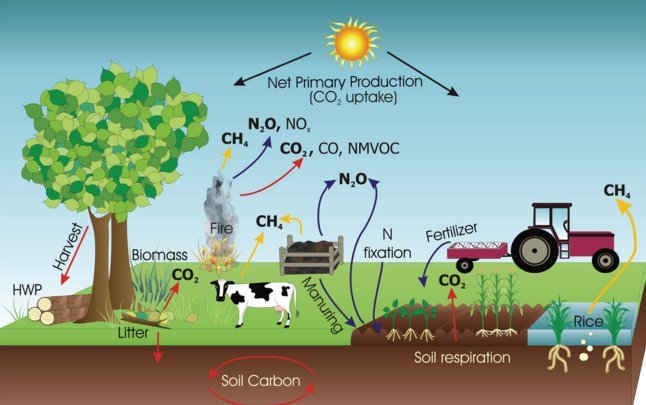
Agriculture is a major driver of climate change

Agriculture is said to be a major driver of climate change because of following reasons:
1. It accounts for 13% of total green house emissions currently. 
2. More CO2 emissions on account of deforestation for agricultural purpose. Eg: Jhum cultivation in India. 
3. Methane emissions from rice cultivation.
4. Enteric fermentation from Animals causes methane emissions. 
5. Nitrous oxide emissions from fertilizer use.
Reducing food wastage would help mitigate climate change in following ways:
1. Food production requires intensive inputs and the processes cause GHG emissions and if food does not reach plates, these emissions are without any substantive output. With population set to rise 10 billion by 2050 the need for food is set to rise and thus stopping food wastage would reduce GHG emissions. 
2. Animal based food causes more GHG emissions and changing dietary practices towards protein based food in developing countries without any effort to reduce food wastage will further increase GHG emissions and ths it is prudent to stop food wastage from not only economic point of view but also ecological point of of view.
There is need to reform food distribution system across countries. India can do its part by efficient supply chain management, promotion of Food processing industry, APMC reforms etc.


  • Thumbnail

Welcome waste as new wealth

After fighting a losing battle with the growing tide of municipal waste, the Ministry of Environment and Forests has notified the new Solid Waste Management Rules, 2016 with clear responsibilities assigned to various classes of consumers. For these rules to have any significant impact, however, the local bodies in charge of implementation should appeal to the rational impulses of communities — a small effort at segregating trash at source would be a good thing for their household budgets. Cities and towns would then have to provide the logistical chain to evacuate waste, with a cash compensation system in place for the consumer. In the absence of such a system, the rules issued 16 years ago failed spectacularly. Urban municipal bodies found it convenient to merely transport waste to the suburbs, sometimes through private agencies that secured lucrative long-term contracts. Policy failure is all too evident when Environment Minister Prakash Javadekar says that the estimated 62 million tonnes of waste a year is not fully collected or treated. Worryingly, it will go up to some 165 million tonnes in 2030, and dramatic episodes of air and water pollution from mountains of garbage as seen in Mumbai and Bengaluru in recent times could be witnessed in more places.
A productive start to containing the problem could be made if urban governments show the political will to rein in bulk generators of municipal solid waste. For instance, the provisions in the new rules for hotels and restaurants to support composting, or biomethanation, and for large housing societies, commercial establishments and other bulk producers to segregate waste, need to be rigorously enforced. Cess funds collected for the Swachh Bharat programme could be deployed to scale up infrastructure for composting, biomethanation and recycling, which Mr. Javadekar admits are grossly inadequate. Evidently, the Centre and the State governments have not so far taken the existing rules seriously: less than a third of the collected waste is being processed. Even where environmentally conscious citizens segregate at source, the chain of management dumps it all in landfills. The central monitoring committee under the Ministry should ensure that local bodies do not continue functioning in business-as-usual mode. They should align their operations, including waste management contracts, with the new rules under the annual operating plan. The Ministry should also enlist the services of ragpickers under formal systems such as cooperatives. Although there are provisions for fines for littering and non-segregation, this should be a second-order priority for municipalities, which should focus principally on creating reliable systems to handle different waste streams. If India could start with the separation of its ‘wet’ waste from the rest and produce good compost, that could transform cities and towns into clean and green havens filled with trees, gardens, lakes and rivers. It would also salvage millions of tonnes of recyclable plastic, precious metals and other materials. Garbology studies confirm that landfills swallow precious wealth every day. The time has come to recover it.


Saturday, April 9, 2016

new CRI ( Computer related inventions) guideline

Open source software, entails software that can is developed, tested or improved through public collaboration and distributed freely among others. It is said to be the way forward for innovation and not patenting because:
>There are numerous patents in the software department and the possibilities of patent infringement are large. This leads to litigation resulting in increased costs for the users.
>Numerous web giants like Facebook, linked in, twitter are all based on open source and wouldn’t have developed if the source code that their programs are based on were patented.
>Patent seeks to create monopolies, which stifles innovation as these major players try to prevent new firms from entering.
How India’s patent rules are affecting innovation?
>The Computer Related Invention (CRI) guidelines in India state that only software attached to a novel hardware can be patented. Contrary to the argument by MNCs that it will stifle innovation, it will actually lead to increased innovation due to a level playing field for new comers and experienced ones alike.
>It will be a big boost for the “Make in India” and “digital India” programmes and will foster entrepreneurship. E.g. SHAKTI processor programme at IIT-Madras aimed at building open source mobile and server processors, operating systems, etc.
>It will lead to increased spending on R&D by MNCs in a bid to stay relevant in the changing software market.
Thus the need of the hour is to do away with software patents to ensure an open playing field for all. What India needs is an independent innovation policy unaffected by corporate interests.

Friday, April 8, 2016

एक आखिरी बार चूमो

तुम्हारे चुम्बन में वो एहसास न था
जो पहली दफे किया था तब था.

तुम दबे पांव आ के
सीने से चिपक
दिल में धंस गए पता ही नहीं चला.

निकलने में वक़्त लगता है.
मक्खी तो नहीं कि
झटक दूँ और दूध गटगटा जाऊं.

एक आखिरी बार चूमो
फिर जाता हूँ.

तुम्हारे होंठों पे ज़िगर रख के

तुम्हारे होंठों पे ज़िगर रख के मैं
बाजुओं से
मसलना चाहता हूँ सांझे पल.
ढूंढना चाहता हूँ
आँखों में शबनम
सुबह के हिस्से का सूरज.

खुरदरा सा सूरज
उफन कर
सीने से लग जाता है.
जैसे उसकी मुक्ति वहीं हो.

तुम्हारे गालों को
मुट्ठियों में जकड मैं
खुद को कैद करने की
अधूरी ख़्वाहिश पूरी करता हूँ.

इत्तेफ़ाक़ से,
तुम बिलकुल तुम हो.
मेरे सीने से लग के भी
मुझसे दूर जाने के सपने देख लेते हो.
बंद आँखे किये.

तुम दूर जा के फिर मेरे ख़्वाब देखते हो.

Making a hollow in the Forest Rights Act

Over 12,000 villages across Odisha conserve their community forests, says a 2013 Odisha Jungle Manch study. In a visit last October to seven villages in Keonjhar district’s Gandhamardan range, Munda communities showed me their forest protection rosters. Each roster listed four villagers for every weekday to roam the forests and prevent tree felling and timber smuggling.
I wasn’t there to study community conservation however, but to speak to villagers about forged gram sabha consent resolutions submitted in their names last January by the Odisha government and the State-owned Odisha Mining Corporation (OMC). The submissions, to the Ministry of Environment, Forests & Climate Change (MoEFCC), were part of a “forest clearance” proposal to enable OMC to acquire and turn 1,400 hectares of forest into an iron ore mine.
Resolutions and deceit
To the shock and anger of people in the seven villages — since they had held no such gram sabhas — the copycat resolutions depicted them as saying they had no ties to the forest and that they “requested” the government to divert the sought area to OMC. Since discovering the forgery, villagers have written to the MoEFCC and the Ministry of Tribal Affairs (MoTA) twice, pointing out the fraud. They have got no response yet.
Gram sabhas mandated by the landmark Forest Rights Act, 2006 (FRA), are the only officially-recognised space for Adivasi and forest-dwelling communities to participate in State decision-making around the enclosure and destruction of forests for mining. This, when such communities not just depend on but proactively protect such forests. Forging gram sabha resolutions clears the path to lucrative mining. For example, OMC valued the ore it would sell from this proposed mine at Rs.79,000 crore. Such fictions manufacture on file the legal requirement of villagers’ participation and consent. A senior forester, serving in another Adivasi-populated, mineral-rich State, wrote to me after reading my account (http://bit.ly/22J6fHZ) of the forgery, saying, “I have seen this many times, in many files.”
Contrast the official actions and inaction on Gandhamardan with another example from Odisha: Niyamgiri. Following a 2013 Supreme Court order, in 12 gram sabhas under the FRA, villagers including Dongria Kondhs articulated ecological, spiritual and food security grounds to not mine Niyamgiri for bauxite. Over two years on, the Odisha government has moved the court to annul the gram sabha resolutions. Among other things, its petition argues, there is “grave doubt” whether what villagers said “were genuine statements setting out what was really felt.” Never mind that the gram sabhas, in line with court directives, were kept free of State government and company influence, had a magistrate present, and were videographed.
This State and mining company-created universe — where what Adivasis say must be stamped out, while fictions in their name routinely spawn far-reaching decisions to their detriment — is hardly unique to Gandhamardan and Niyamgiri. Across mineral-rich, forested Adivasi landscapes, governments are hollowing out the FRA to favour miners. Here are just three instances.
In Jharkhand’s Chatra district, the Oraon village of Jala has had to move the High Court to challenge the denial of their community forest rights (CFR) claim, and forged gram sabha consent submitted towards clearance for a coal mine. In Chhattisgarh, the official junking of the law is more candid. In Kanker district’s Rowghat area, the administration, in response to an RTI request, has stated that there is “a bar” on recognising FRA claims or granting such titles in 12 Adivasi villages, since a rail line for a proposed iron ore mine is planned in their area!
Further north, in Surguja district is Hasdeo Arand, among India’s best forests. Months ago, Gond villagers wistfully narrated how, in order to mine the area for coal, Adani Mining staff were uprooting soaring sal trees, and fencing off stretches of forest villagers had traditionally used. As we spoke, Adani staff drove up in two sport utility vehicles, insisting on being present through our conversation. This January, local officials cancelled the CFR title awarded in 2013 to the area’s Ghatbarra village. The sole purpose: to enable Adani to mine.
Cutting out the community
MoTA, the nodal ministry for FRA and the spokesperson for Adivasi interests, is yet to effectively address the hollowing out of this crucial law. The MoEFCC’s conduct also causes concern. Entrusted with stewarding our forests, it has instead concentrated great energy on how to hasten their felling (through the forest clearances it awards). In doing this, it has, among other things, mounted a prolonged effort to see if and how meaningful community participation can be eliminated from the clearance process.
But what if our governments thought less like mining companies and approached FRA not as a “roadblock” but as a means to achieve a more just, democratic and ecologically informed conversation around mining? This would mean admitting that the knowledge base of local communities, that interact most intimately with the forests, is of value in decision-making. As the 2013 SC order observed: “…we have realised that forests have the best chance to survive if communities participate in their conservation and regeneration.”
Further, if nurtured seriously as an institution of local governance, FRA-mandated gram sabhas can be a vital mechanism to outline the full costs and gains of mining, and more crucially, how these get distributed. This could help ameliorate some of the “resource curse” impacts and deep-rooted corruption that plague India’s mining industry, as outlined in grim detail by the Justice Shah Commission’s reports on illegal mining.
In years of travelling through mineral-rich areas, I cannot recall an example of an Adivasi community telling me they are better off because of the way the company took over their forest and land for mining. But there have been countless accounts of villagers being beaten up, swindled, having bulldozers pulverise their homes, sacred sites, food and livelihood sources, being incarcerated, and even killed in police firings.
These are fates that national elites would be loathe to accept for ourselves in the name of “development”. But we are happy to prescribe them for Adivasi citizens. As Masuri Behra, a Gandhamardan resident on seeing her name in the village’s forged resolution asked aloud, “Why do they kick us in the stomach like this?”
Chitrangada Choudhury is a Fellow with the Open Society Institute.

Thursday, April 7, 2016

जियो, मेरे | अज्ञेय

जियो, मेरे आज़ाद देश की शानदार इमारतो
जिनकी साहिबी टोपनुमा छतों पर गौरव ध्वज तिरंगा फहरता है
लेकिन जिनके शौचालयों में व्यवस्था नहीं है
कि निवृत्त होकर हाथ धो सकें।
(पुरखे तो हाथ धोते थे न? आज़ादी ही से हाथ धो लेंगे, तो कैसा?)

जियो, मेरे आज़ाद देश के शानदार शासको
जिनकी साहिबी भेजे वाली देशी खोपड़ियों पर
चिट्टी दूधिया टोपियाँ फब दिखाती हैं,
जिनके बाथरूम की संदली, अँगूरी, चंपई, फ़ाख्तई
रंग की बेसिनी, नहानी, चौकी तक की तहज़ीब
सब में दिखता है अँग्रेज़ी रईसी ठाठ
लेकिन सफाई का कागज़ रखने की कंजूस बनिए की तमीज़...

जियो, मेरे आज़ाद देश के सांस्कृतिक प्रतिनिधियो
जो विदेश जाकर विदेशी नंग देखने के लिए पैसे देकर
टिकट खरीदते हो
पर जो घर लौटकर देसी नंग ढकने के लिए
ख़ज़ाने में पैसा नहीं पाते,
और अपनी जेब में-पर जो देश का प्रतिनिधि हो वह
जेब में हाथ डाले भी
तो क्या ज़रूरी है कि जेब अपनी हो?

जियो, मेरे आज़ाद देश के रौशन ज़मीर लोक-नेताओ :
जिनकी मर्यादा वह हाथी का पैर है जिसमें
सबकी मर्यादा समा जाती है-
जैसे धरती में सीता समा गई थी!
एक थे वह राम जिन्हें विभीषण की खोज में जाना पड़ा,
जाकर जलानी पड़ी लंका :
एक है यह राम-राज्य, बजे जहाँ अविराम
विराट् रूप विभीषण का डंका!
राम का क्या काम यहाँ? अजी राम का नाम लो।
चाम, जाम, दाम, ताम-झाम, काम- कितनी
धर्म-निरपेक्ष तुकें अभी बाकी हैं।
जो सधे, साध लो, साधो-
नहीं तो बने रहो मिट्टी के माधो।