If you know what to look for, you can tell the meaning of a Buddha
Statue by looking at the pose / posture, and the accompanying hand
gestures. Each traditional pose has a significance related to an
important event in the the life – or past lives – of the Historical
Buddha. (Note: You can see more examples by
Visiting our Buddha Statues For Sale Page on this site.)
Also referred to as an
asana or an Attitude, there are over
100 poses illustrating the life of the Buddha. And each posture will
have a specific hand gesture, called a
Mudra,
associated with the posture. In general, the carvings of the Buddha
that you can buy are representations of highly venerated statues that
are enshrined at major temples throughout the world, or are
reproductions of well known sculptures that were originally commissioned
by royal patrons, and as such, their meanings and significance are
similar to the original statues.
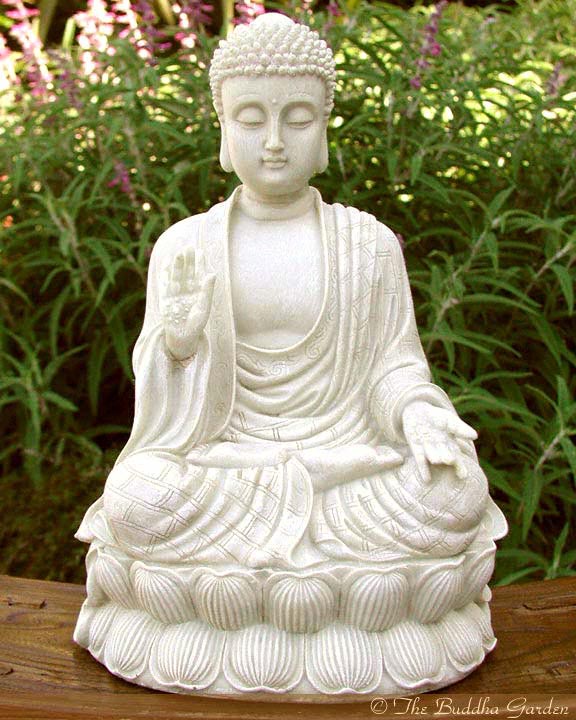
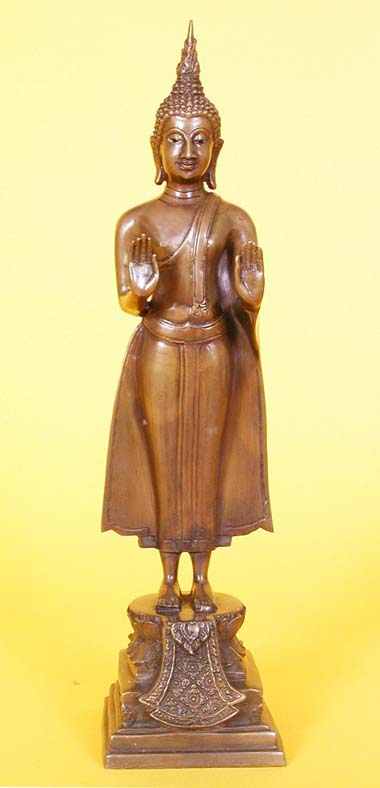
Protection Buddha (Click To View Larger Image)
Protection Buddha / Overcoming Fear
This depiction of a seated Buddha with the right hand raised and
facing outwards has two common meanings. The first is that of the
Protection Buddha, as the raised right hand symbolically represents a
shield. The second meaning, Overcoming Fear, is closely related to the
first (since one who is receiving protection would be less fearful).
The main features of this pose, aside from the raised right hand, is
that The Buddha can be depicted either sitting or standing, and the left
hand may either be extended outward or palm up in the lap. This statue
signifies courage and offers protection from fear, delusion and anger.
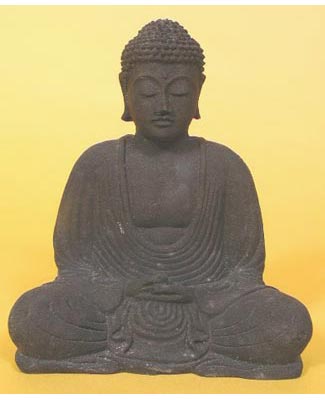
Meditation Buddha (Click to View Larger Image)
Meditation Buddha / Serenity Buddha / Calming Buddha
Another of the more common rupas is of the Buddha in Meditation. This
statue is for people who are either looking for peace and clam in their
lives, or for those who wish to improve their own meditation skills.
People will often buy a Meditation Buddha if they want to set up a
“serenity room” or a corner of their house where they can sit in calm
for a little while and unwind.
In this pose, the Buddha is depicted with both hands in the lap, face
up, and the legs are crossed, either in a Double Lotus pose (with the
ankles of each leg tucked behind one another in a locked position), or
in a Single Lotus pose (where one leg rests on top of the other leg).
Occasionally, an alms bowl is placed in the lap as well.
As this statue generally represents focused concentration, the eyes
of the Buddha are either depicted as halfway closed, or closed nearly
all the way. The silhouette of the statue is shaped – more or less –
like a triangle, which represents stability.
Many of the largest Buddha Statues in Japan, such as the Great
Kamakura Buddha Statue at Kotokuin Temple, and large statues in Korea
are in the Meditation Pose. This pose is also known as the Amithabha
Buddha, which means “Boundless Light.”
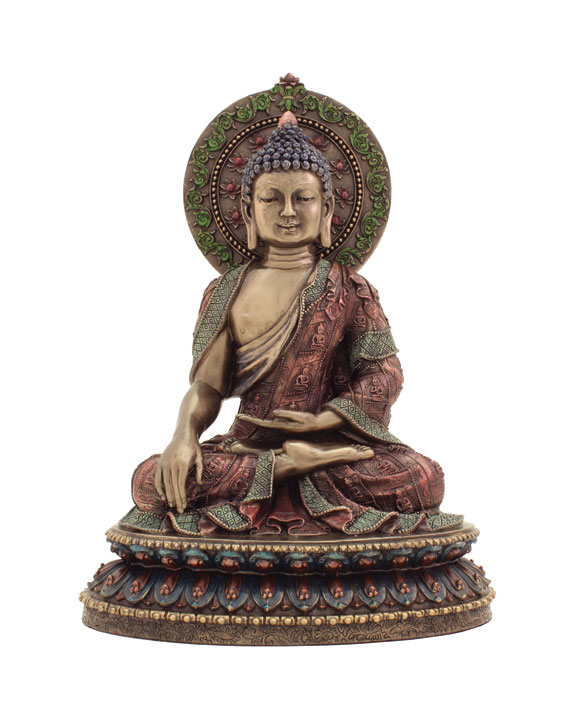
Earth Touching Buddha (Click To View Larger Image)
Calling The Earth To Witness / Earth Touching Buddha
The most common pose you will find in Thai temples is with the legs
crossed, the left hand in the lap, and the right hand pointing to the
ground with the palm facing inward toward the Buddha. This posture is
known as Calling The Earth to Witness, and it is the definition of the
moment of enlightenment for the Buddha.
It is the story of how the Buddha, after six years, finally was at
the verge of enlightenment. Unfortunately Mara, the Demon of Illusion,
tried to dissuade The Buddha from the final last steps. The Buddha
meditated all night to overcome the fears and temptations sent by Mara,
and then called the Earth Goddess to witness that the Buddha achieved
enlightenment in order to share with the rest of the world. Witnessing
that, the Earth Goddess wrung her hair, releasing flood waters that
swept away the Demon Mara and all the temptresses he had released.
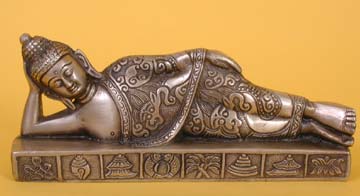
Nirvana Buddha (Click To View Larger Image)
The Nirvana Buddha / Reclining Buddha
This statue depicts the Historical Buddha in the last moments of life
on earth, prior to the Buddha dying one last time before entering
Nirvana (often written in English as ParaNirvana when referring to the
life of The Buddha). It is said that an alms giver had accidentally
given the Buddha pork that had gone bad, and this eventually led to the
death of the Buddha.
Because the Buddha had gained enlightenment in this lifetime, the
Buddha was able to escape the endless cycle of birth – death – rebirth
(known as samsara) and was able to enter Nirvana. In this pose, the
Buddha is always depicted lying on the right hand side on top of a
resting table. One of the most well-known examples of this statue is
enshrined at Wat Pho in Bangkok, Thailand, although there are numerous
other temples throughout Southeast Asia that house statues in the
posture.
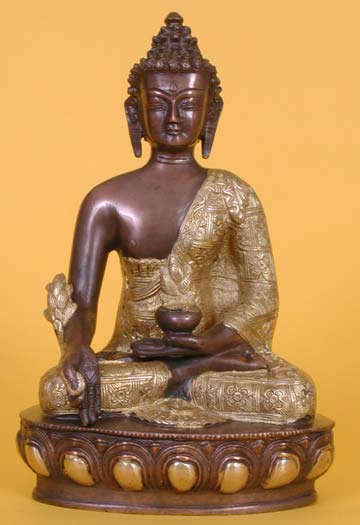
Medicine Buddha (Click To View Larger Image)
Medicine Buddha
The Medicine Buddha is depicted in paintings having blue skin, but
whether shown in statue or painted form, the right hand is held facing
downward with fingers extended toward the ground, palm facing outward
toward the viewer, a bowl of herbs rests in the left hand upon the lap.
It is believed by the Tibetans that the Buddha was responsible for
delivering the knowledge of medicine to the people of the world, and in
fact the right hand facing outward signifies “granting a boon” (meaning,
giving a blessing) to mankind. This is a common hand gesture amongst
both Buddhist and Hindu statues.
The Medicine Buddha is venerated by those seeking health, and is more
commonly found in the Buddhist temples and communities of Nepal and
Tibet.
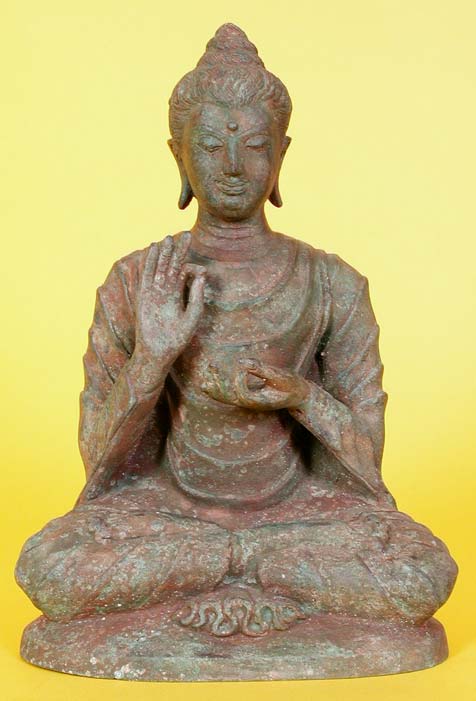
Teaching Buddha (Click To View Larger Image)
Teaching Buddha / DharmaChakra Buddha
This statue signifies wisdom, understanding, and fulfilling destiny.
Both hands are held at chest level, with thumb and index fingers forming
a circle. The right hand is turned palm in, while the left hand is
turned palm out.
As do most images of the Buddha, the Teaching Buddha depicts a
particular moment in the life of the Buddha, namely, the first sermon
the Buddha gave after reaching Enlightenment. This sermon was to a small
group of disciples who had previously scorned the Buddha. This is a
statue that is particularly appropriate for those who are either
studying or are interested in learning more about spirituality.
The phrase DharmaChakra is hard to translate. The word Dharma means
“the way of righteousness,” while the word Chakra is usually translated
as the “Universe” or as the “cosmos.” Taken together, this phrase
generally is interpreted as, “putting the cosmic law of righteousness
in order,” or “turning the wheel of cosmic righteousness.”
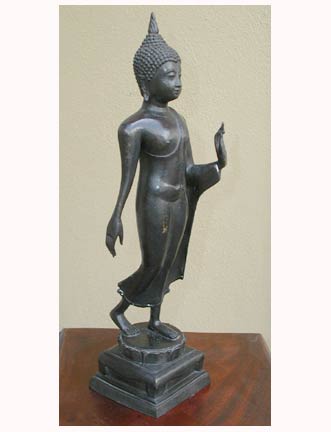
Walking Buddha (Click To View Larger Image)
Walking Buddha / Sukhothai Buddha
Signifies grace and internal beauty, and in Thai, we call this “Phra
LeeLaa”. Right hand raised, facing outward, left hand dangles along left
side of body. Standing with right foot behind, starting to raise off
the ground. This statue is particular to the Sukhothai period in
Thailand. It represents a time when the Buddha was returning to earth
after delivering a sermon on the Dharma in Heaven, and was being
accompanied by Lord Indra and Lord Brahma.
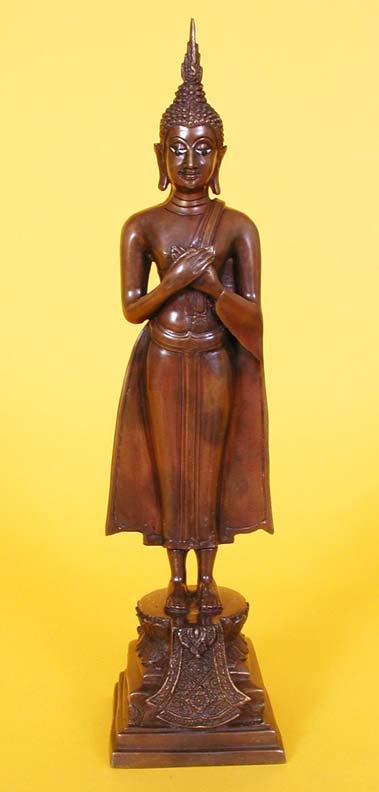
Contemplation Buddha
Contemplation Buddha (Click To View Larger Image)
In this pose, Both arms of the Buddha lie flat against the chest, the
palms of both hands facing in, with right arm on outside of left arm.
The Contemplation Buddha signifies quiet determination and patient
understanding.
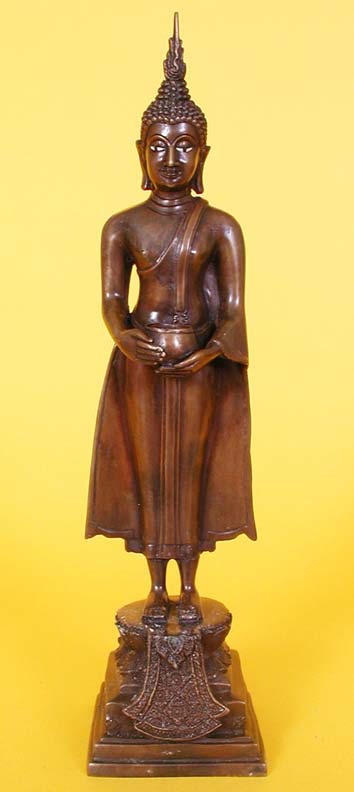
Alms Bowl Buddha / Begging Buddha
Alms Collecting Buddha (Click To View Larger Image)
Arms bent at elbows, holding an alms bowl at chest level. This statue
signifies compassion and caring for all beings. Contrary to what many
think, monks (and the Buddha) did NOT beg for food. Instead, they
collected alms. The difference is that collecting alms allows for those
GIVING the alms to make merit (meaning, to acquire good karma). Devout
Buddhists in Asia will prepare and give food to monks in the morning on
their alms rounds.
Repelling The Ocean (Click To View Larger Image)
Repelling The Ocean / Preventing the Relatives From Fighting
This statue has two meanings based on two different stories. The
first meaning of Repelling The Ocean comes from a story when the Buddha
visited Bihar state in India. A hermit unleashed a wall of water hoping
to cause a flood, but the Buddha used the power generated from
meditating to stop the water from flooding the area. The Forbidding The
Relatives from Fighting is related to a period in the life of the Buddha
where relatives of his father had an argument with relatives of the
Buddha’s mother over water, as one of the rivers that both sets of
relatives normally depended on was starting to run dry. The Buddha
raised his right hand to draw attention to their own bickering and asked
them what was ore important; water, or their family relations?
Differences In Leg Positions
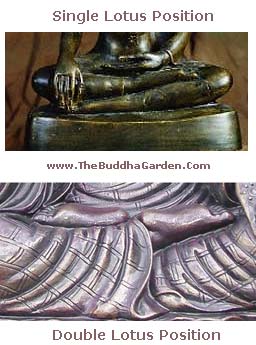
Leg Positions
In general, the Buddha is depicted as sitting with the legs crossed.
This makes a “triangle” shape to the image; the knees making the two
bottom points of the triangle shape, while the tip of the head makes the
top point of the triangle. The significance is that a triangle shape is
more “grounded” or has a more solid foundation.
There are two positions for crossed legs, namely with the right leg
resting above the left leg in the Single Lotus Position, or with both
knees pointing downward and the ankles tucked on top of one another in
the Double Lotus Position.
But there are a few postures that are not seated with crossed legs,
namely the Maitreya Buddha, where the “Buddha of the Future” sits in a
chair Western style. Also, there is a story of how a monkey and an
elephant visited to make offerings to the Buddha, and in those images he
is depicted sitting in a chair as well. there are standing Buddhas, and
in Thailand, one of the most beloved forms is of the Walking Buddha
statue, which is exclusive to the Sukhothai period of Thai art.