Friday, April 22, 2016

क्राइसिस और कविता | Crisis aur Kavita

किताबों में पढ़े कवि
नक्शों में ढूंढे उनके देश,
गूगल किया इतिहास.
अच्छे कवि मुल्क की यातनाओं में जन्मे हैं.
जैसे क्राइसिस ज़रूरी तत्व हो अच्छी कविता का.

क्राइसिस = Crisis

रेखा और मध्यमवर्ग


फसल की तरह तुम्हारे चेहरे पे
छुर्रियां उग आई हैं.
सींचने जिनके पास खूब पैसा है
उनके चेहरे पे नहीं उगती ऐसी फसल,
छुर्रिओं की फसल उलटी धुरी से उगती है.

पचपन पार रेखा
तुम जितनी पैतीस की लगती है.
ये सबसे बड़ा उदाहरण है मेरे मध्यमवर्गीय होने का.

Sunday, April 17, 2016

Tax Avoidance | Panama Papers | BEPS | Tax Evasion

Recent Panama leaks have exposed various loopholes in India’s tax regime. It is widely being assumed that tax havens are used only for illegal activities. However, tax havens are more likely to be used not just for illegal activity but even for legitimate businesses.
  • People prefer tax haven for the sake of avoiding taxes. But there are very thin lines between the legal and the illegal. The difference between tax evasion and tax avoidance is one such line.
  • Tax evasion involves not paying taxes on your income and is illegal. Tax avoidance, on the other hand, is about managing your taxes across different tax jurisdictions to take advantage of differences in tax rates, such as corporate tax rates, in tax treatment of different kinds of income, such as capital gains, and in tax treaties among countries.
  • Tax havens such as Panama, the British Virgin Islands and the Bahamas try to attract business by offering low tax rates and easy compliance.
Problems with Indian tax regime:
In India, tax rates are higher, the system is complicated and capital controls restrict foreign financial transactions.
  • Various tax laws have made compliance more costly in India. India is ranked 157 in the ease of paying taxes.
  • Further, the effective tax on profit is higher: The corporate tax rate and the dividend distribution tax put together make the tax rate on profits nearly 50%.
  • The capital gains tax makes financial transactions even more unattractive. This regime is made more tortuous by an onerous set of capital controls.
Tax avoidance as cheating:
Some countries, including OECD countries, consider even tax avoidance as illegal.
A number of OECD initiatives have been taken to reduce tax avoidance:
  • An agreement on Base Erosion and Profit Shifting (Beps) aims to prevent companies from choosing low-tax jurisdictions to book profits in.
  • The Automatic Exchange of Information (AEOI) framework will facilitate information flows among signatories.
  • The Foreign Account Tax Compliance Act (Fatca) targets non-compliance by US taxpayers and compliant countries have to provide customer information to the US government.
However, there are some cases in which the actions are clearly illegal-
  • First, when the underlying activity is criminal, say, drug or arms trade. These activities are covered under the Prevention of Money Laundering Act. As a member of the Financial Action Task Force, India works with other member countries to prevent the use of the proceeds of crime.
  • The second is when there are cases of tax evasion: A person does not declare to the tax authorities in her home country her income, which is paid into a bank account of her company in Panama, and no taxes are paid. Here, a distinction between tax evasion and avoidance is relevant. If taxes have been paid in the tax haven at its lower tax rate, then there may be no illegality. When India introduces the General Anti-Avoidance Rule (Gaar), some of these activities may become illegal.
  • The third case is if there is a violation of capital controls. This is an India-specific issue. Under the Liberalised Remittance Scheme (LRS), every Indian resident is allowed to invest $2,50,000 abroad every year. In 2004, the limit was one-tenth of this. Money remitted abroad is from income on which tax has already been paid. If the amount invested abroad exceeds the amount allowed by the RBI, it is a violation of the law.
  • Fourth, the illegality may be the non-declaration of assets held abroad. A provision in the Finance Bill introduced in 2015 made it criminal not to declare foreign assets in annual tax returns. If the assets held in tax havens have been declared, then it is not illegal to hold them.
Why be concerned about these issues?
There is a widespread perception that offshore companies are conduits for money laundering, illegal transactions, tax evasion or parking unexplained wealth. Hence, it is necessary to keep an eye on such activities and prevent them.
What’s needed?
  • First, rationalisation of capital controls should be a top priority. Many government reports have laid out the path forward.
  • Second, India must move to a simple tax regime with lower compliance costs. The blueprint is ready in the Direct Taxes Code.
Conclusion:
The new government at the Centre has the opportunity to simplify our tax laws that reduce the scope for disputes between taxpayers and revenue authorities. The objective should be to encourage voluntary compliance and severely penalise tax evasion. This, along with clarity on introduction of a new Direct Taxes Code and a roadmap for the implementation of a nationwide Goods and Services Tax, will go some way in creating a non-adversarial tax climate conducive to growth and investment. In the long run, this is the only sustainable path to revenue generation.

Saturday, April 16, 2016

दोराहा | जावेद अख़्तर

अपनी बेटी ज़ोया के नाम
 
ये जीवन इक राह नहीं
इक दोराहा है

पहला रस्ता बहुत सरल है
इसमें कोई मोड़ नहीं है
ये रस्ता इस दुनिया से बेजोड़ नहीं है
इस रस्ते पर मिलते हैं रिश्तों के बंधन
इस रस्ते पर चलनेवाले 
कहने को सब सुख पाते हैं
लेकिन
टुकड़े टुकड़े होकर 
सब रिश्तों में बँट जाते हैं
अपने पल्ले कुछ नहीं बचता
बचती है बेनाम सी उलझन
बचता है साँसों का ईंधन
जिसमें उनकी अपनी हर पहचान
और उनके सारे सपने
जल बुझते हैं
इस रस्ते पर चलनेवाले
ख़ुद को खोकर जग पाते हैं
ऊपर-ऊपर तो जीते हैं
अंदर-अंदर मर जाते हैं
 
दूसरा रस्ता बहुत कठिन है
इस रस्ते में कोई किसी के साथ नहीं है
कोई सहारा देनेवाला हाथ नहीं है
इस रस्ते में धूप है 
कोई छाँव नहीं है
जहाँ तस्सली भीख में देदे कोई किसी को
इस रस्ते में ऐसा कोई गाँव नहीं है
ये उन लोगों का रस्ता है
जो ख़ुद अपने तक जाते हैं
अपने आपको जो पाते हैं
तुम इस रस्ते पर ही चलना
 
मुझे पता है 
ये रस्ता आसान नहीं है
लेकिन मुझको ये ग़म भी है
तुमको अब तक 
क्यूँ अपनी पहचान नहीं है

वक़्त | जावेद अख़्तर

ये वक़्त क्या है?
ये क्या है आख़िर
कि जो मुसलसल[1] गुज़र रहा है
ये जब न गुज़रा था, तब कहाँ था
कहीं तो होगा
गुज़र गया है तो अब कहाँ है
कहीं तो होगा
कहाँ से आया किधर गया है
ये कब से कब तक का सिलसिला है
ये वक़्त क्या है

ये वाक़ये [2]
हादसे [3]
तसादुम[4]
हर एक ग़म और हर इक मसर्रत[5]
हर इक अज़ीयत[6] हरेक लज़्ज़त[7]
हर इक तबस्सुम[8] हर एक आँसू
हरेक नग़मा हरेक ख़ुशबू
वो ज़ख़्म का दर्द हो
कि वो लम्स[9] का हो ज़ादू
ख़ुद अपनी आवाज हो
कि माहौल की सदाएँ[10]
ये ज़हन में बनती
और बिगड़ती हुई फ़िज़ाएँ[11]
वो फ़िक्र में आए ज़लज़ले [12] हों
कि दिल की हलचल
तमाम एहसास सारे जज़्बे
ये जैसे पत्ते हैं
बहते पानी की सतह पर जैसे तैरते हैं
अभी यहाँ हैं अभी वहाँ है
और अब हैं ओझल
दिखाई देता नहीं है लेकिन
ये कुछ तो है जो बह रहा है
ये कैसा दरिया है
किन पहाड़ों से आ रहा है
ये किस समन्दर को जा रहा है
ये वक़्त क्या है

कभी-कभी मैं ये सोचता हूँ
कि चलती गाड़ी से पेड़ देखो
तो ऐसा लगता है दूसरी सम्त[13]जा रहे हैं
मगर हक़ीक़त में पेड़ अपनी जगह खड़े हैं
तो क्या ये मुमकिन है
सारी सदियाँ क़तार अंदर क़तार[14]
अपनी जगह खड़ी हों
ये वक़्त साकित[15] हो और हम हीं गुज़र रहे हों
इस एक लम्हें में सारे लम्हें
तमाम सदियाँ छुपी हुई हों
न कोई आइन्दा [16] न गुज़िश्ता [17]
जो हो चुका है वो हो रहा है
जो होने वाला है हो रहा है
मैं सोचता हूँ कि क्या ये मुमकिन है
सच ये हो कि सफ़र में हम हैं
गुज़रते हम हैं
जिसे समझते हैं हम गुज़रता है
वो थमा है
गुज़रता है या थमा हुआ है
इकाई है या बंटा हुआ है
है मुंज़मिद[18] या पिघल रहा है
किसे ख़बर है किसे पता है
ये वक़्त क्या है


शब्दार्थ:
  1. ऊपर जायें लगातार
  2. ऊपर जायें घटनाएँ
  3. ऊपर जायें दुर्घटनाएँ
  4. ऊपर जायें संघर्ष,टकराव
  5. ऊपर जायें हर्ष, आनंद, ख़ुशी
  6. ऊपर जायें तकलीफ़
  7. ऊपर जायें आनंद
  8. ऊपर जायें मुस्कराहट
  9. ऊपर जायें स्पर्श
  10. ऊपर जायें आवाज़ें
  11. ऊपर जायें वातावरण
  12. ऊपर जायें भूचाल
  13. ऊपर जायें दिशा, ओर
  14. ऊपर जायें पंक्ति दर पंक्ति
  15. ऊपर जायें ठहरा हुआ
  16. ऊपर जायें भविष्य
  17. ऊपर जायें भूतकाल
  18. ऊपर जायें जमा हुआ

Monday, April 11, 2016

When less is not more | S Y Quraishi

Simultaneous elections to panchayat, assembly and Lok Sabha may be desirable.
They are not feasible.

Prime Minister Narendra Modi’s suggestion that elections to the Lok Sabha, Vidhan Sabha and local bodies should be held simultaneously has brought to centrestage an issue that has been raised intermittently, for years. Earlier, L.K. Advani had made the same suggestion. In a May 2010 blogpost, he advocated a fixed term for elected bodies and a need for simultaneous elections. Leaders of several parties also raised the issue, leading to a Parliament committee examining it. The idea is good in principle but seems fraught with constitutional issues and administrative problems.
Let’s first examine the reasons that have prompted this proposal — that frequent elections bring to a standstill normal functioning of the government and life of the citizens and bring a heavy recurring cost.
It is true that normal work comes to a standstill to a considerable extent. Typically, elections to the Lok Sabha are spread over two and a half months. As soon as the Election Commission announces the poll dates, the model code of conduct (MCC) comes into operation. This means that the government cannot announce any new schemes, make any new appointments, transfers or postings without EC approval. Ministers get busy in the election campaign, the district administration machinery gets totally focused on elections.
The second reason, the cost, is a major issue. The costs of election have gone up enormously. It has two components — the cost of management to the EC/ government. And the cost to candidates and political parties. Though there are no exact estimates, one guesstimate puts it at Rs 4,500 crore. The bigger problem is the havoc played by the money power of political parties and contestants. Though the law prescribes a ceiling on the expenditure of candidates, the fact is that it is violated with impunity. In my book, I had documented 40 ways of abusing money power which we had identified and taken steps to check. But the politicians soon outsmarted us. Among other things, the money is now spent much before the EC comes into the picture. The worst problem is that there is no cap on the expenditure of political parties, which exploit this loophole to the hilt. The ceiling of Rs 70 lakh looks like peanuts when political parties spend ten, twenty times more to promote their candidates, which distorts the level playing field besides vitiating the spirit of free and fair elections. One estimate had put the cost of this at Rs 30,000 crore in the 2014 elections.
Another consequence of frequent elections is the aggravation of vices like communalism, casteism, corruption (vote-buying and fund-raising) and crony capitalism. If the country is perpetually in election mode, there is no respite from these evils.
Frequent elections have some benefits too. One, politicians, who tend to forget voters after the elections for five years have to return to them. This enhances accountability, keeps them on their toes. Two, elections give a boost to the economy at the grassroots level, creating work opportunities for lakhs of people. Three, there are some environmental benefits also that flow out of the rigorous enforcement of public discipline like non-defacement of private and public property, noise and air pollution, ban on plastics, etc. “Let EC Raj continue” was one headline in a Punjab paper. And one national newspaper from the south carried letters to the editor for one week after the 2011 election in Tamil Nadu, expressing appreciation for the quality of life during the MCC days!
Four, local and national issues do not get mixed up to distort priorities. In voters’ minds, local issues overtake wider state and national issues.
I have often heard a “solution” — that the vote of no-confidence must contain an expression of confidence in an alternative ruling arrangement. That will be an unmitigated atrocity against the people’s will. How can a few dozen MLAs — purchasable as they are — upturn the people’s mandate? Horse-trading will rule the roost. Just a few MPs changing loyalty can bring down the government, to be replaced by the opposition party that organises the coup.
Some suggest that the Vidhan Sabha and panchayat elections could be clubbed — at least, the impact is restricted to the state. But I doubt if subversion of the people’s mandate at the panchayat level, too, can be taken lightly. Infringement of the people’s right to choose their representatives for the sake of saving money or for administrative convenience, or “to save party workers their time” (the immediate provocation for PM Modi’s suggestion) cannot pass judicial muster.
Imagine a scenario when the Lok Sabha gets dissolved (in 13 days, as actually happened in 1998), and for the sake of simultaneity all state assemblies with full or thin majority are also dissolved. And then, in the resultant Lok Sabha elections, the same party comes to power (as actually happened in 1999), but state assemblies go topsy-turvy!
Did the Constituent Assembly visualise such a situation? Only partly. Initially, it considered a part-time EC, thinking that there would be no work between two elections for five years. Eventually, as a concession to a remote possibility, it allowed a single, full-time CEC. We didn’t have to wait long to see that possibility becoming a harsh reality. In 1956, the Kerala Vidhan Sabha was dissolved, establishing a questionable trend that worsened with time.
In conclusion, if the reasons for the demand are accepted (money and dislocation), let’s look at what is possible. It’s possible to reduce the duration of the election process by half — by conducting the elections in one day. That requires making available to the EC five times the Central armed police force that is currently provided. Instead of 700-800 companies, the EC will then need 3,500 companies. Raising a few battalions of various paramilitary forces will also give relief to the extremely stretched and stressed forces, provide employment and contribute to better enforcement in troubled areas.
The other possible and desirable action is to cut the role of money power in elections. It requires two things: Putting a cap on political party expenditure and state-funding of political parties (not elections), with a simultaneous ban on all private, especially corporate, funds. Prime Minister Modi has the majority and clout to get these reforms implemented.
The writer is a former Chief Election Commissioner of India and author of ‘An Undocumented Wonder — the Making of the Great Indian Election’
- See more at: http://indianexpress.com/article/opinion/columns/narendra-modi-when-less-is-not-more/#sthash.wBaIiARR.dpuf

Sunday, April 10, 2016

न देखना कैसे देखें | Ravish Kumar

image

हम कैसे देखें इस तस्वीर को
कैसे न देखें
न देखना कैसे देखें
नातिन की शादी से चंद रोज़ पहले की बात है
एक नाना झूल गए पेड़ पर
नाना जो कि भारत के किसान हैं
उस भारत का क़र्ज़ा था इनपर
कुल पचास हज़ार
गोद में लेकर कितना खेला होगा नातिन से
कंधे पर लेकर दूर तक दौड़े होंगे
न जाने कितनी बार
उन खेतों में
जिनकी पैमाइश मात्र तीन एकड़ है
जिनसे पैदा हुआ चार कुंतल गेहूँ है
ज़िला झाँसी थाना समथर
उम्र पैंसठ साल
हार गया जो जीवन का समर
मर गया जो लटक कर
घर गया जो ख़बर लिखकर
सो गया जो ख़बर पढ़कर
सबको नींद आती ही रही
वही जागता रहा दिन भर
खेत में खड़े पेड़ के नीचे
खड़ा हो गया खेत छोड़ कर
नाना
काश आप भी भाग जाते
किसी ललित की तरह
किसी विजय की तरह
आ जाते चुपके से शादी की रात
भींच कर बाहों में नातिन को
चुपके से रो तो लेते
उसे विदा तो कर देते चुपचाप
किसी कवि की संवेदना से बाहर
किसी सरकार की वेदना से दूर
बंद रास्तों में फँसी आपकी आत्मा
तड़पती रही होगी
मुक्त होने के लिए
वहाँ जाने के लिए
जहाँ या तो कोई क़र्ज़दार जाता है
या कोई उम्रदराज़
किसान का मरना किसका मरना है
न किसान जानता है
न भारत महान जानता है
हम कैसे देखें इस तस्वीर को
कैसे न देखें
न देखना कैसे देखें
न भगवान जानता है
न जनता का भगवान जानता है
मित्रों ये ख़बर अभी आई है कि एक किसान मर गया है । ये ख़बर तो कब की आ चुकी है कि उससे पहले हम सब मर चुके हैं ।

from naisadak.org 

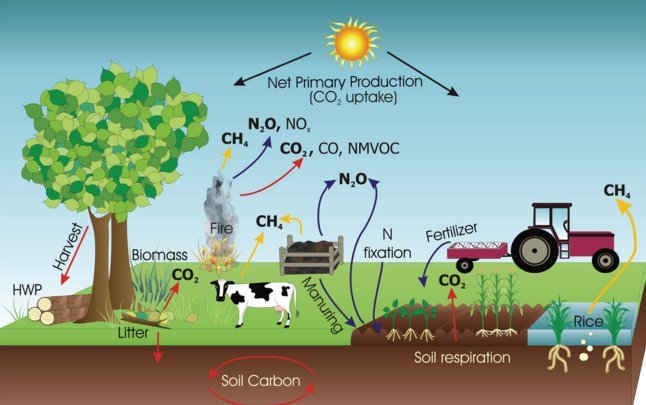
Agriculture is a major driver of climate change

Agriculture is said to be a major driver of climate change because of following reasons:
1. It accounts for 13% of total green house emissions currently. 
2. More CO2 emissions on account of deforestation for agricultural purpose. Eg: Jhum cultivation in India. 
3. Methane emissions from rice cultivation.
4. Enteric fermentation from Animals causes methane emissions. 
5. Nitrous oxide emissions from fertilizer use.
Reducing food wastage would help mitigate climate change in following ways:
1. Food production requires intensive inputs and the processes cause GHG emissions and if food does not reach plates, these emissions are without any substantive output. With population set to rise 10 billion by 2050 the need for food is set to rise and thus stopping food wastage would reduce GHG emissions. 
2. Animal based food causes more GHG emissions and changing dietary practices towards protein based food in developing countries without any effort to reduce food wastage will further increase GHG emissions and ths it is prudent to stop food wastage from not only economic point of view but also ecological point of of view.
There is need to reform food distribution system across countries. India can do its part by efficient supply chain management, promotion of Food processing industry, APMC reforms etc.


  • Thumbnail

Welcome waste as new wealth

After fighting a losing battle with the growing tide of municipal waste, the Ministry of Environment and Forests has notified the new Solid Waste Management Rules, 2016 with clear responsibilities assigned to various classes of consumers. For these rules to have any significant impact, however, the local bodies in charge of implementation should appeal to the rational impulses of communities — a small effort at segregating trash at source would be a good thing for their household budgets. Cities and towns would then have to provide the logistical chain to evacuate waste, with a cash compensation system in place for the consumer. In the absence of such a system, the rules issued 16 years ago failed spectacularly. Urban municipal bodies found it convenient to merely transport waste to the suburbs, sometimes through private agencies that secured lucrative long-term contracts. Policy failure is all too evident when Environment Minister Prakash Javadekar says that the estimated 62 million tonnes of waste a year is not fully collected or treated. Worryingly, it will go up to some 165 million tonnes in 2030, and dramatic episodes of air and water pollution from mountains of garbage as seen in Mumbai and Bengaluru in recent times could be witnessed in more places.
A productive start to containing the problem could be made if urban governments show the political will to rein in bulk generators of municipal solid waste. For instance, the provisions in the new rules for hotels and restaurants to support composting, or biomethanation, and for large housing societies, commercial establishments and other bulk producers to segregate waste, need to be rigorously enforced. Cess funds collected for the Swachh Bharat programme could be deployed to scale up infrastructure for composting, biomethanation and recycling, which Mr. Javadekar admits are grossly inadequate. Evidently, the Centre and the State governments have not so far taken the existing rules seriously: less than a third of the collected waste is being processed. Even where environmentally conscious citizens segregate at source, the chain of management dumps it all in landfills. The central monitoring committee under the Ministry should ensure that local bodies do not continue functioning in business-as-usual mode. They should align their operations, including waste management contracts, with the new rules under the annual operating plan. The Ministry should also enlist the services of ragpickers under formal systems such as cooperatives. Although there are provisions for fines for littering and non-segregation, this should be a second-order priority for municipalities, which should focus principally on creating reliable systems to handle different waste streams. If India could start with the separation of its ‘wet’ waste from the rest and produce good compost, that could transform cities and towns into clean and green havens filled with trees, gardens, lakes and rivers. It would also salvage millions of tonnes of recyclable plastic, precious metals and other materials. Garbology studies confirm that landfills swallow precious wealth every day. The time has come to recover it.


Saturday, April 9, 2016

new CRI ( Computer related inventions) guideline

Open source software, entails software that can is developed, tested or improved through public collaboration and distributed freely among others. It is said to be the way forward for innovation and not patenting because:
>There are numerous patents in the software department and the possibilities of patent infringement are large. This leads to litigation resulting in increased costs for the users.
>Numerous web giants like Facebook, linked in, twitter are all based on open source and wouldn’t have developed if the source code that their programs are based on were patented.
>Patent seeks to create monopolies, which stifles innovation as these major players try to prevent new firms from entering.
How India’s patent rules are affecting innovation?
>The Computer Related Invention (CRI) guidelines in India state that only software attached to a novel hardware can be patented. Contrary to the argument by MNCs that it will stifle innovation, it will actually lead to increased innovation due to a level playing field for new comers and experienced ones alike.
>It will be a big boost for the “Make in India” and “digital India” programmes and will foster entrepreneurship. E.g. SHAKTI processor programme at IIT-Madras aimed at building open source mobile and server processors, operating systems, etc.
>It will lead to increased spending on R&D by MNCs in a bid to stay relevant in the changing software market.
Thus the need of the hour is to do away with software patents to ensure an open playing field for all. What India needs is an independent innovation policy unaffected by corporate interests.