Friday, August 7, 2015

37% of Western Ghats ecologically sensitive: Kasturirangan panel report| Kasturirangan recommendation

Around 60,000 sq km of Western Ghats, spread across six states, should be turned into a no-go area for commercial activities like mining, thermal power plants, polluting industries and large housing plans, the high-level working group headed by Planning Commission member K Kasturirangan has recommended.

The Kasturirangan panel was set up to study the Gadgil committee report on the Western Ghats. The Gadgil panel report had faced unanimous opposition from state governments for recommending that almost three-fourth of the hills, including plantations, cultivated lands and large habitations, be turned into a restricted development zone with an over-arching authority to regulate the region superseding the elected authorities' role.

The Kasturirangan committee has in contrast advised against bringing cultivated lands, plantations and habitations outside the ambit of such a restrictive regime - called Ecologically Sensitive Area (ESA) under the Environment Protection Act, 1976. Instead, it has suggested that 90% of the natural forests left in the Western Ghats complex - adding upto 60,000 sq km and constituting 37% of the entire hilly belt — be conserved under the ESA provisions of the green law. The forest area falling within the ESA would also cover 4,156 villages across the six states. The panel has said, "The villages falling under ESA will be involved in decision making on the future projects. All projects will require prior-informed consent and no-objection from the gram sabha (village council) of the village."

The panel has recommended that there should be a complete ban on mining activity in this zone and current mining activities should be phased out within five years, or at the time of expiry of the mining lease. It has banned development of any township or construction over the size of 20,000 sq m in the ESA zone. It has not recommended a ban on hydroelectric projects in the zone, but put a regime of stricter clearances for dams and other projects. For dams, it has demanded an uninterrupted ecological flow of at least 30% level of the rivers flow till individual baselines for dams are set. Cumulative studies to assess impact of dams on a river and ensuring that the minimum distance between projects is maintained at three km and that not more than 50% of the river basin is affected at any time.

The report suggests doing away with the complete moratorium on industrial and mining activity in the two Maharashtra districts of Sindhudurg and Ratnagiri. It has suggested persisting with the ban only on the area of the two districts falling within the ESA and a strict regulation in the rest.

The report has steered clear from demanding a strict ecological control over the Western Ghat complex requiring changes and regulations on agricultural practices the way Gadgil committee report had suggested. It has also favoured a new authority to regulate the region's development and economic growth. The authors say, "The high-level working group has deviated from WGEEP (Gadgil committee report) by not recommending a blanket prescriptive on what constitutes good development, which will be implemented through a prohibitory regime. Instead, HLWG has considered and recommended prohibitory and regulatory regime only for those activities with maximum interventionist and destructive impact on the ecosystem."

Sunita Narain, member of the Kasturirangan panel and director general of Centre for Science and Environment (CSE), said, "We have recommended ESA for natural areas which constitute 37% of the ghats. These areas must be protected. There is great biodiversity value outside these patches too but there we recommend a framework to incentivize people towards green growth and not a prohibitory or penalizing regime."

The panel consisted of Ajay Tyagi, joint secretary in the environment ministry; J M Mauskar, retired senior bureaucrat; academicians C R Babu and Kanchan Chopra; Jagdish Kishwan, retired senior forest officer, P S Roy, deputy director of National Remote Sensing Centre; Darshan Shankar of Foundation for Revitalization of Local Health Traditions, a Karnataka-based NGO and Indrani Chandrasekharan of Planning Commission besides Kasturirangan and Narain.

The committee has also not recommended an outright rejection of the Athirapally hydroelectric project in Kerala and Gundya dam in Karnataka. It has warned that the state government must assess if the Athirapally dam is viable and if the trade off against the loss of irreplaceable biodiversity is beneficial. On the Gundya hydroelectric project, it has advised extreme caution and said the project should not get a green nod till an elaborate review of the river flows and ecological damage are made.

NJAC | The Constitution (121st Amendment) Bill, 2014


  • The Constitution (One Hundred and Twenty- First Amendment) Bill, 2014 was introduced in the Lok Sabha on August 11, 2014 by the Minister of Law and Justice, Mr. Ravi Shankar Prasad.
  • According to the Statement of Objects and Reason of the Bill, there is a need for a broad based National Judicial Appointment Commission (NJAC), for making recommendations for selection of judges.  The Bill seeks to enable equal participation of Judiciary and Executive, ensure that the appointments to the higher judiciary are more participatory, transparent and objective.
  • The Constitution (121st Amendment) Bill amends the provisions of the Constitution related to the appointment of Supreme Court and High Court judges, and the transfer of High Court judges.
  • Creation of the NJAC: Article 124 (2) of the Constitution provides that the President will make appointments of Supreme Court (SC) and High Court(HC) judges after consultation with the Chief Justice of India and other SC and HC judges as he considers necessary.  The Bill amends Article 124 (2) of the Constitution to provide for a Commission, to be known as the National Judicial Appointments Commission (NJAC).  The NJAC would then make recommendations to the President for appointments of SC and HC judges.
  • Composition of the NJAC: A new Article, Article 124A provides for the composition of the NJAC.  The NJAC would consist of:
    • Chief Justice of India (Chairperson)
    • Two senior most Supreme Court Judges
    • The Union Minister of Law and Justice
    • Two eminent persons (to be nominated by a committee consisting of the Chief Justice of India, Prime Minster of India and the Leader of Opposition in the Lok Sabha)
  • Of the two eminent persons, one person would be from the SC/ST/OBC/minority communities or be a woman.  The eminent persons shall be nominated for a period of three years and shall not be eligible for re-nomination.
  • Functions of the NJAC: A new Article, Article 124B, provides for the functions of the NJAC which include: 
    • Recommending persons for appointment as Chief Justice of India, Judges of the Supreme Court, Chief Justices of High Courts and other Judges of High Courts;
    • Recommending transfer of Chief Justices and other Judges of High Courts from one High Court to any other High Court; and
    • Ensuring that the persons recommended are of ability and integrity.

  • Power of Parliament to make law on procedures: A new Article, Article 124C, enables Parliament to pass a law to: (i) regulate the procedure of appointments, and (ii) empower the NJAC to lay down the procedure for its functioning, and manner of selection of persons for appointment, through regulations. 

Thursday, August 6, 2015

Yemen on the brink: What you need to know about the crisis

Airstrikes by Saudi Arabia against Shia rebels in Yemen have added a regional dimension to the conflict in the Arab world’s poorest country.The advance of the Houthis raised Saudi fears that the Shia minority rebels would seize control of the whole of its Sunni-majority neighbour and take it into the orbit of Shia Iran. The airstrikes that followed have transformed Yemen into another arena for the regional struggle between Saudi Arabia and Iran. Here is a detailed look at the crisis in Yemen and the key players.

Yemen on the brink


Who are fighting whom?

  •  Houthis:
    The rebel group controls nine of 21 provinces now
  •  Saudi-led coalition:
    Here are some of those who are participating and what they are deploying:
    Saudi Arabia: 100 fighter jets, 150,000 soldiers and some naval units
    UAE: 30 fighter jets
    Bahrain: 15 fighter jets
    Kuwait: 15 fighter jets
    Qatar:10 fighter jets
    Jordan:6 fighter jets
    Sudan:3 fighter jets
    Egypt: naval and air forces involved.
  •  Yemeni security forces:
    The military is now split as units that support Mr. Hadi, units that support the Houthis, and units that support a still-influential Saleh, who is in the Houthi camp for now
  •  Popular Resistance Committees:
    Militia loyal to Hadi in his stronghold of south Yemen.
  •  AQAP: Mr. Hadi and Houthis are fighting al-Qaeda in the Arabian Peninsula, which has staged several attacks in the country and is strong in the south. Active since 2009. AQAP has taken advantage of the power struggle.
  •  IS: A new group of militants inspired by the Islamic State group has claimed major attacks, including suicide bombings which killed at least 142 people at Shia mosques in Sana’a.
  •  U.S.: CIA drones have continued to target top AQAP leaders, but the campaign has suffered from Mr. Hadi’s absence. Last week, U.S. military advisers were withdrawn from a southern base as al-Qaeda militants seized a nearby city.

Who are the Houthis?

The Houthis are followers of the Shia Zaidi sect, the faith of around a third of Yemen’s population. Officially known as Ansarallah (the partisans of God), the group began as a movement preaching tolerance and peace in the Zaidi stronghold of North Yemen in the early 1990s.
After some protests pitted it against the government, the group launched an insurgency in 2004 against the then ruler Ali Abdullah Saleh that lasted till 2010. Their opponents view them as a proxy of Shia Iran. The group is hostile to the United States but has also vowed to eradicate al-Qaeda. They participated in the 2011 Arab Spring inspired revolution in Yemen that replaced Saleh with Abdrahbu Mansour Hadi.

Key dates to the Yemen conflict

  •  September 21, 2014: Houthi rebels seize government and military sites in Sana’a after several days of fighting that killed more than 270 people. Rival groups sign a U.N.-brokered peace deal stipulating a Houthi withdrawal from the capital and formation of a new government.
  •  October 9, 2014: Al-Qaeda in the Arabian Peninsula, which has declared war on the Houthis, claims an attack in Sana’a in which 47 are killed.
  •  October 14, 2014: The Houthis seize the Red Sea port of Hodeida, 230 km west of Sana’a, then move toward the centre without opposition from government forces but face fierce resistance from AQAP and its tribal allies.
  •  January 20, 2015: Houthis attack Mr. Hadi’s residence and seize the presidential palace, and the President and Prime Minister resign two days later.
  •  February 6, 2015: The rebels announce they have dissolved Parliament and installed a presidential council to run the country. The United States and Gulf monarchies accuse Iran of backing the Houthis. In the south and southeast, authorities reject what they brand a coup attempt.
  •  February 21, 2015: Mr. Hadi flees south to Aden after escaping from weeks under house arrest and urges the international community to “reject the coup,” rescinding his resignation and subsequently declaring Aden the temporary capital.
  •  March 19, 2015: Clashes in which at least 11 are killed force the closure of the international airport in Aden and Mr. Hadi is moved to a more secure location after an air raid on the presidential palace there.
  •  March 22, 2015: The Houthis advance southwards, seizing the airport and a nearby military base in Taez, north of Aden and a strategic entry point to Mr. Hadi’s stronghold. Houthi leader Abdelmalek al-Houthi says the rebels have moved south to combat Al-Qaeda and the Islamic State group.
  •  March 25, 2015: Mr. Hadi is again moved as rebel forces bear down on Aden, capturing a major airbase nearby just days after U.S. military personnel were evacuated from it.

http://www.thehindu.com/news/international/yemen-on-the-brink-what-you-need-to-know-about-the-crisis/article7040080.ece

Wednesday, August 5, 2015

Types of Ecosystems

There are essentially two kinds of ecosystems; Aquatic and Terrestrial. Any other sub-ecosystem falls under one of these two headings.

Terrestrial ecosystems

Terrestrial ecosystems can be found anywhere apart from heavily saturated places. They are broadly classed into:

The Forest Ecosystems

They are the ecosystems in which an abundance of flora, or plants, is seen so they have a big number of organisms which live in relatively small space. Therefore, in forest ecosystems the density of living organisms is quite high. A small change in this ecosystem could affect the whole balance, effectively bringing down the whole ecosystem. You could see a fantastic diversity in the fauna of the ecosystems, too. They are further divided into:
  • Tropical evergreen forest: These are tropical forests that receive a mean rainfall of 80 for every 400 inches annually. The forests are characterised by dense vegetation which comprises tall trees at different heights. Each level is shelter to different types of animals.
  • Tropical deciduous forest: There, shrubs and dense bushes rule along with a broad selection of trees. The type of forest is found in quite a few parts of the world while a large variety of fauna and flora are found there.
  • Temperate evergreen forest: Those have quite a few number of trees as mosses and ferns make up for them. Trees have developed spiked leaves in order to minimize transpiration.
  • Temperate deciduous forest: The forest is located in the moist temperate places that have sufficient rainfall. Summers and winters are clearly defined and the trees shed the leaves during the winter months.
  • Taiga: Situated just before the arctic regions, the taiga is defined by evergreen conifers. As the temperature is below zero for almost half a year, the remainder of the months, it buzzes with migratory birds and insects.
The Desert Ecosystem
Desert ecosystems are located in regions that receive an annual rainfall less than 25. They occupy about 17 percent of all the land on our planet. Due to the extremely high temperature, low water availability and intense sunlight, fauna and flora are scarce and poorly developed. The vegetation is mainly shrubs, bushes, few grasses and rare trees. The stems and leaves of the plants are modified in order to conserve water as much as possible. The best known desert ones are the succulents such as the spiny leaved cacti. The animal organisms include insects, birds, camels, reptiles all of which are adapted to the desert (xeric) conditions.

The Grassland Ecosystem
Grasslands are located in both the tropical and temperate regions of the world though the ecosystems vary slightly. The area mainly comprises grasses with a little number of trees and shrubs. The main vegetation includes grasses, plants and legumes that belong to the composite family. A lot of grazing animals, insectivores and herbivores inhabit the grasslands. The two main kinds of grasslands ecosystems are:
  1. Savanna: The tropical grasslands are dry seasonally and have few individual trees. They support a large number of predators and grazers.
  2. Prairies: It is temperate grassland, completely devoid of large shrubs and trees. Prairies could be categorized as mixed grass, tall grass and short grass prairies. 
The Mountain Ecosystem
Mountain land provides a scattered and diverse array of habitats where a large number of animals and plants can be found. At the higher altitudes, the harsh environmental conditions normally prevail, and only the treeless alpine vegetation can survive. The animals that live there have thick fur coats for prevention from cold and hibernation in the winter months. Lower slopes are commonly covered with coniferous forests.

Aquatic Ecosystems
The aquatic ecosystem is the ecosystem found in a body of water. It encompasses aquatic flora, fauna and water properties, as well. There are two main types of aquatic ecosystem - Marine and Freshwater.

The Marine Ecosystem
Marine ecosystems are the biggest ecosystems, which cover around 71% of Earth's surface and contain 97% of out planet's water. Water in Marine ecosystems features in high amounts minerals and salts dissolved in them. The different divisions of the marine ecosystem are:
  • Oceanic: A relatively shallow part of oceans which lies on the continental shelf. 
  • Profundal: deep or Bottom water. 
  • Benthic Bottom substrates.
  • Inter-tidal: The place between low and high tides. 
  • Estuaries 
  • Coral reefs 
  • Salt marshes 
  • Hydrothermal vents where chemosynthetic bacteria make up the food base.
Many kinds of organisms live in marine ecosystems: the brown algae, corals, cephalopods, echinoderms, dinoflagellates and sharks.

The Freshwater Ecosystem
Contrary to the Marine ecosystems, the freshwater ecosystem covers only 0.8% of Earth's surface and contains 0.009% of the total water. Three basic kinds of freshwater ecosystems exist:
  • Lentic: Slow-moving or till water like pools, lakes or ponds.
  • Lotic: Fast-moving water such as streams and rivers.
  • Wetlands: Places in which the soil is inundated or saturated for some lenghty period of time. 
The ecosystems are habitats to reptiles, amphibians and around 41% of the world’s fish species. The faster moving turbulent waters typically contain a greater concentrations of dissolved oxygen, supporting greater biodiversity than slow moving waters in pools.

Monday, August 3, 2015

उस शहर, इस शहर


उस शहर के बाहर
जितने भी लोग गए
शहर की याद में मर गए.

इस शहर को
जितने भी लोग आये
इस शहर में रह गए.

उस शहर में कवितायेँ थीं
इस शहर में पैसा.

लोगों ने यादों में उस शहर को चुना,
बसर करने ये शहर.

कवितायेँ निवाला नहीं देती,
कवि भूखे मरते हैं,
पाठक रोटी खाने के बाद ही
पढ़ सकता है ग्रन्थ.

शहर रोटियों से बसते हैं,
कविताओं से नहीं.

Saturday, August 1, 2015

10 Inspiring Indians Who Are Making Positive Changes In The Society

Inspiration is what keeps us going. These amazing, brave, dedicated inspiring leaders of India are doing groundbreaking work in the social sector and working for a better tomorrow. They help us believe that there is good in the world. So here I have enlisted 10 such inspiring Indians who have gone against all odds to reach out to people in a way that is entirely different. This post is not really in any particular order because, after all, ranking them seems a little fruitless.

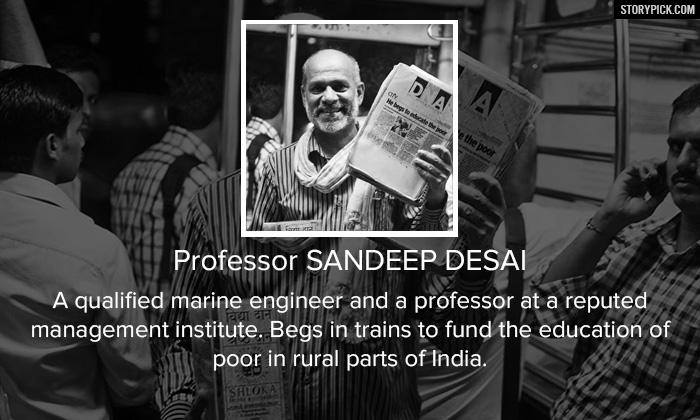
1.

Since 1997, he quit his job and started serving the society and took up other assignments to fund Shloka, a free English-medium school for children from the Goregaon slums in Mumbai. His foundation currently runs 4 English Medium schools which provide free education to the poor. He requests small donations and goes around shouting “Vidyadaan Shreshth Daan” in local trains. This man is one of those faces of the society who break the general belief that one must have their pockets full to do something for the society.

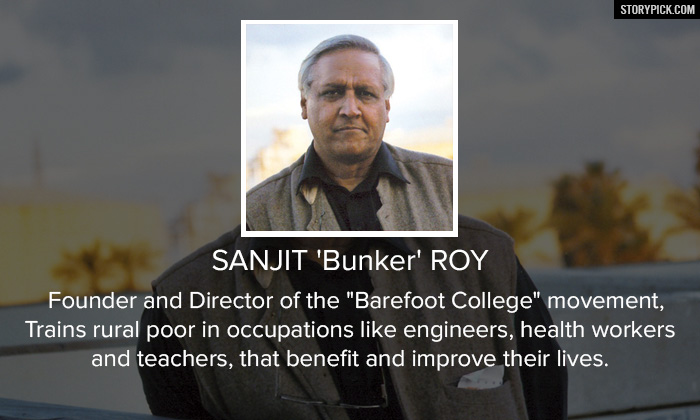
2.

The college gives simple school lessons in reading, writing and  accounting to adults and children. It works to impart skills  people’s need in their everyday lives. The most sought after students are “drop-outs, cop-outs and wash-outs”. He has helped over1000 villages in 37 countries to get electrification with solar power. The ‘Barefoot approach’ may be viewed as a ‘concept’, ‘solution’, ‘revolution’, ‘design’ or an ‘inspiration’ but it is really a simple message that can easily be replicated by the poor and for the poor in neglected and underprivileged communities anywhere the world.

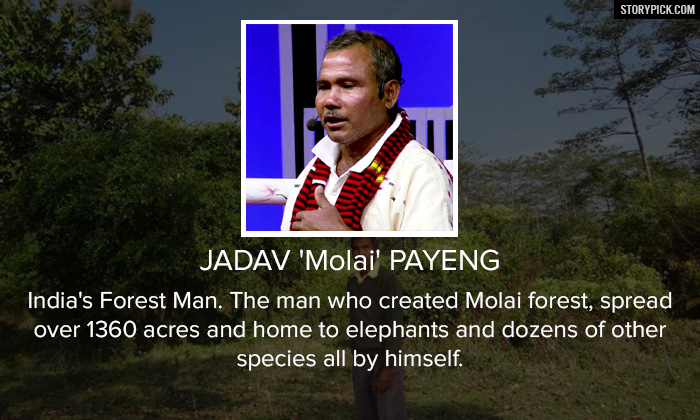
3.

Never underestimate the power of ‘One’. In 1979, Payeng, then 16, encountered a large number of snakes that had died due to excessive heat after floods washed them onto the tree-less sandbar. That is when he planted around 20 bamboo seedlings on the sandbar. He worked on projects after projects and transformed the area into forest over 30 years. Molai forest, now houses Bengal tigers, Indian rhinoceros, over 100 deer and rabbits besides apes and several varieties of birds, including a large number of vultures.

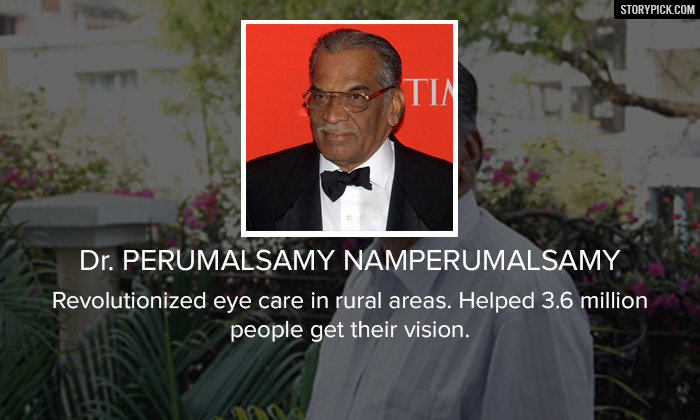
4.

‘All people have a right to sight’. Dr. Perumalsamy Namperumalsamy and his army of cataract fixers at India’s Aravind Eye Care Hospitals have been performing surgeries to give the blind people their eyesight back. The surgery has been around for decades, but the chairman of Aravind — which was founded in 1976 with the goal of bringing assembly-line efficiency to health care — figured out how to replace cataracts safely and quickly and helped 3.6 million people get their vision. Featured in TIME’s Top 100 list.

5.

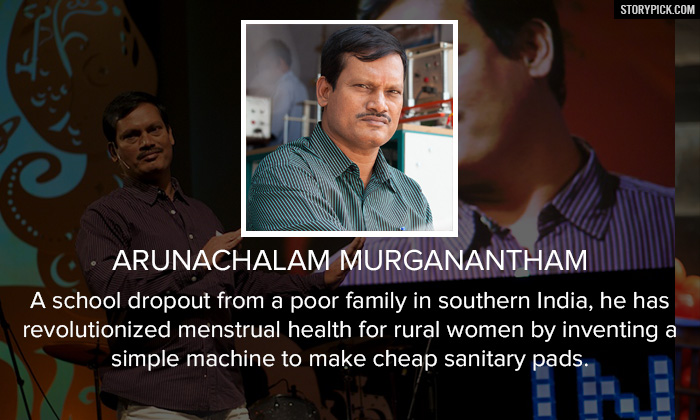
There are men who squirm at the mention of a woman’s period. Then there’s Muruganantham, who re-engineered a sanitary machine which makes about 120 napkins an hour.  Currently more than 1300 machines made by his start-up company are installed across 27 states in India and seven other countries.  Receiving the award from the Indian president was not the happiest moment of his life. But his proudest moment came after he installed a machine in a remote village in Uttarakhand, in the foothills of the Himalayas.

6.

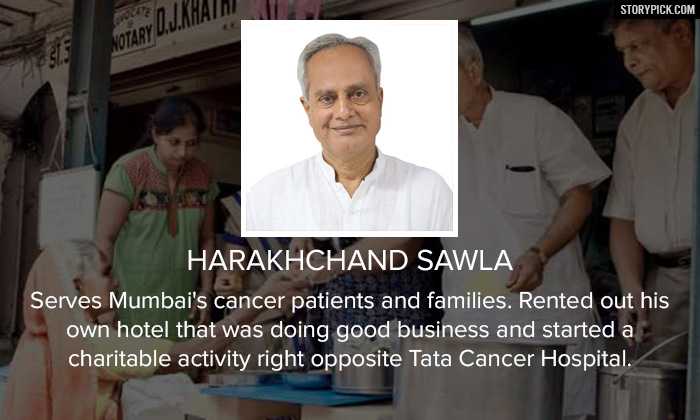
This activity consisted of providing free meals for cancer patients and their relatives. Beginning with fifty, the number of beneficiaries soon rose to hundred, two hundred, three hundred. As the numbers of patients increased, so did the number of helping hands. The ‘Jeevan Jyoti’ trust founded by Mr Sawla now runs more than 60 humanitarian projects. For last 27 years, millions of cancer patients and their relatives have found ‘God’, in the form of Harakhchand Sawla.

7.

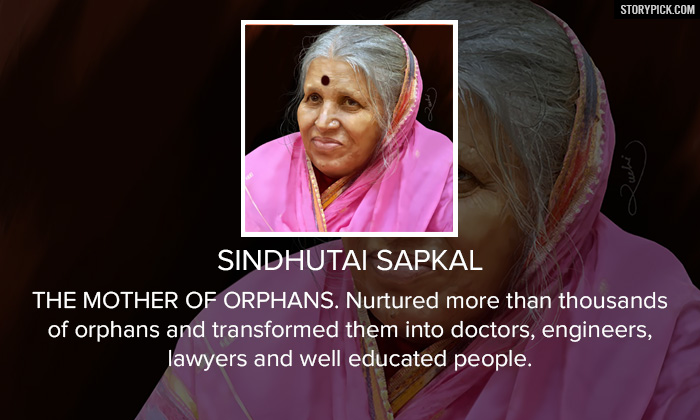
Her life started as being an unwanted child, followed by an abusive husband who abandoned her when she was nine months pregnant. But Sindhutai emerged stronger with every difficulty she faced and became a ‘mother’ to over 1400 homeless children. Currently she has opened 5 shelter homes for the orphans where they are being educated as well as provided all the basic amenities of life . She has proved that a mother can be someone who adopts you and takes proper care of you.

8.

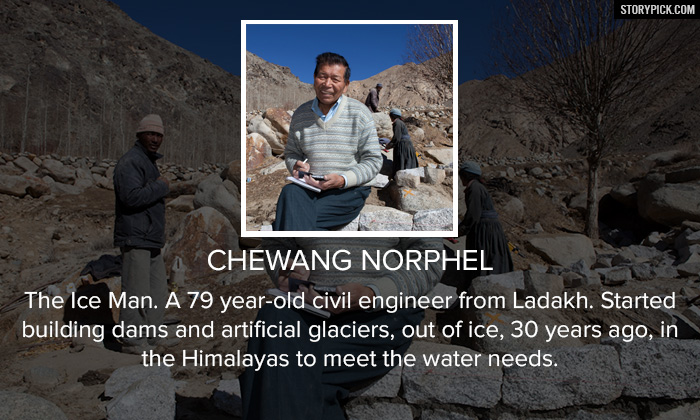
‘The Ice Man’. Sounds like a pretty cool super hero, and he kind of is. You’ll find him in the Himalayas. Back in 1987, Norphel invented artificial glaciers and started constructing massive dams in order to efficiently use the water gathered from melting ice to change the lives of the farmers. 30 years ago, Norphel was laughed at and never taken seriously, but today he stands in front of the camera as a proud citizen, and a real climate hero. He has proved that if man is the one responsible for disturbing nature, he also has the capacity to save it.

9.

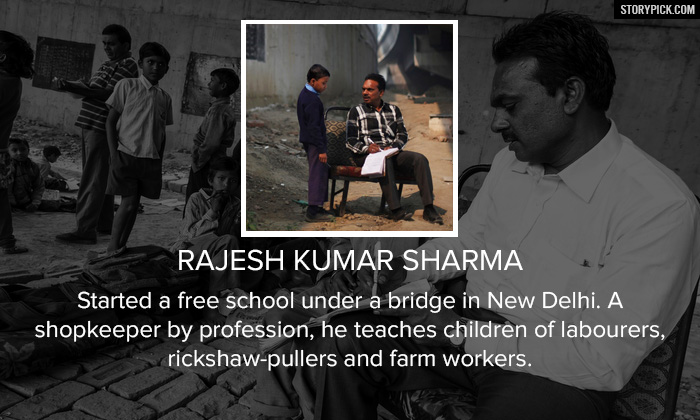
Sharma, a father of three from Aligarh, was forced to drop out of college in his third year due to financial difficulties. When he decided to start the free school, he didn’t want other children to face the same difficulties. So he eventually persuaded local laborers and farmers to allow their children to attend his school instead of working to add to the family income. The children from the neighbouring villages attend class for two hours daily, where they learn math and basic reading and writing skills. He believes, his greatest achievement was changing the attitude of his students’ parents. Most of them now encourage their children to study.

10.

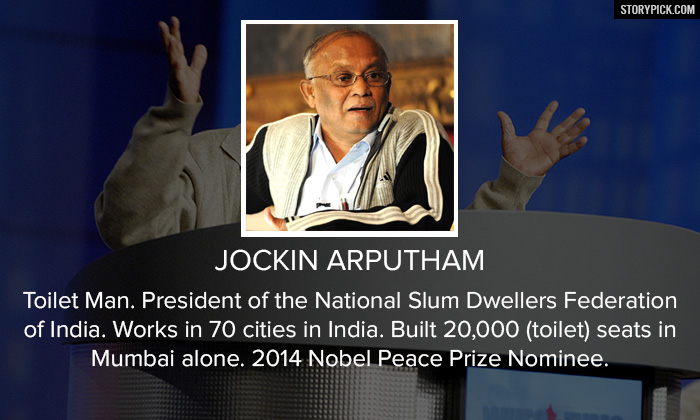
Arputham was born in Kolar Gold Fields, near Bangalore, in the south of India. He moved to Mumbai when he was 18 to work as a carpenter. Having no place to live in, he began sleeping outside people’s houses in Janata Colony, a slum of around 70,000 people. When the inhabitants of the slum were threatened with eviction, he united the community in organizing protests and fighting injustice. Over the years, Arputham has built 30,000 houses in India, and 1,00,000 houses abroad. For his remarkable work, he has been awarded the the Padma Shri. He didn’t win the Nobel Peace Prize but Jockin Sir has dedicated his life to bring peace for slum dwellers.
This may be a small force at present, but if we all stand together , we can wipe out all the social tensions.
I salute these true heroes who have made us all extremely proud.
Source: http://www.storypick.com/10-inspiring-indians/

Friday, July 31, 2015

तीस्ता हमारे खून की प्यासी नहीं | Apoorvanand

तीस्ता के जेल जाने के मायने हैं भारत की आत्मा को कैद करना.यह कोई काव्योक्ति नहीं है.आत्मा कोई भौतिक यथार्थ नहीं है.वह है सत्य को पहचानने और उसके अनुसार काम करने का साहस अर्जित करने की हमारी आकांक्षा का एक दूसरा नाम. वह हमें अपनी सांसारिक क्षुद्रताओं को पहचानने और उनसे सीमित हो जाने पर लज्जित हो पाने की क्षमता है.आत्मा क्या है,यह आपको तब मालूम होगा जब आप सी बी आई के अधिकारियों से अकेले में बात करें और तीस्ता के साथ इस संस्था के व्यवहार पर उनकी प्रतिक्रिया सुनें.वे जो कर रहे हैं,उसकी अनैतिकता का उन्हें पूरा अहसास है.वे जानते हैं कि वे अपनी आत्मा को कुचल कर ही तीस्ता के साथ वह कर सकते हैं,जो अभी वे कर रहे हैं.
कई बार अपनी आत्मा को सुनना भी कठिन होता है.जब वह क्षमता भी हमसे जाती रहे,तब सम्पूर्ण विनाश के अलावा और कुछ भी नहीं.क्या भारतीय समाज की आत्मा या उसका अन्तःकरण पूरी तरह निष्क्रिय हो चुका है? पहले भी कई बार जब ऐसा लगा, कोई न कोई संस्था उठ खड़ी हुई है और उसने भारत की आत्मा के जीवित होने का प्रमाण दिया है.गुजरात के जनसंहार की गंभीरता का अहसास जब संसद तक में न दिखाई दिया, जो भारत की जनता की प्रतिनिधि संस्था है, तब मानवाधिकार आयोग ने इसकी नोटिस ली. लेकिन ध्यान रहे कि मनावाधिकार आयोग खुद ब खुद सक्रिय नहीं हो गया था. अनेक व्यक्तियों के, जिनमें तीस्ता सीतलवाड़ शामिल थीं, 2002 में खूरेंजी के बीच गुजरात जाकर उस भयंकर अपराध की शहादतें और सबूत इकट्ठा करने और उनकी रिपोर्ट बनाने के चलते ही आयोग को आधार मिला कि वह गुजरात खुद जाए और देखे कि आज़ाद भारत में कैसे राज्य का तंत्र ही अपने नागरिकों के एक हिस्से की ह्त्या और विस्थापन में शामिल है.
हत्याएँ हुई थीं, बलात्कार हुए थे, लोग अपने घरों और इलाकों से विस्थापित किए गए थे.यह कोई कुदरती हादसा न था और न हिंदू  क्रोध का स्वतःस्फूर्त विस्फोट. इस अपराध में संगठन शामिल थे, सरकार के लोग शामिल थे,पुलिस और प्रशासन की खुली भागीदारी के बिना यह मुमकिन न था. अगर यह अपराध था तो क्या अपराधियों की शिनाख्त करना, उन्हें भारत के क़ानून के मुताबिक़ उनके किए की सजा देना ज़रूरी न था? क्या इसके बिना जनसंहार के शिकार लोगों को इन्साफ मुमकिन था? यह बहुत स्पष्ट था कि गुजरात की सरकार और वहां के राजकीय तंत्र  की इसमें कोई  रुचि न थी.वह इसे एक भूकंप,सुनामी, तूफ़ान की तरह का हादसा मान कर  गुजर जाने देने और भूल जाने की वकालत कर रहा था.
गुजरात सरकार की बेरुखी का अंदाज इससे लगाया जा सकता है कि उसने मानवाधिकार आयोग की 2002-03 की रिपोर्ट को विधान सभा के पटल पर रखने में दस साल लगाए और वह भी तभी किया जब गुजरात उच्च न्यायालय ने उसे ऐसा न करने के लिए फटकार लगाई. इस रिपोर्ट में आयोग ने खासकर साबरमती संहार, गुलबर्ग सोसाइटी संहार,नरोदा पाटिया, बेस्ट बेकरी और सरदारपुरा के संहारों की जाँच  सी बी आई से कराने की सिफारिश की थी. गुजरात सरकार ने ऐसा करने से इनकार कर दिया था. यह रिपोर्ट भी विधान सभा सत्र के आख़िरी दिन पेश की गई जिससे इस पर कोई बहस न हो सके. तब की गुजरात सरकार का मुखिया ही आज भारत सरकार का मुखिया है.
तीस्ता का जुर्म यह था कि उन्होंने कई अन्य मानवाधिकार कार्यकर्ताओं के साथ मिलकर इन तमाम अपराधों का पीछा किया.तीस्ता ने न्यायतंत्र को सोने न दिया और इन्साफ के लिए ज़रूरी सबूत बचाए रखने और गवाहों को टिकाए रखने में अथक श्रम किया. कई मामले उनकी वजह से गुजरात से बाहर की अदालतों में गए. और अनेक मामलों में इन्साफ हुआ.मैं साहस की बात नहीं कर रहा क्योंकि जो गुजरात नहीं गए हैं,वे समझ ही नहीं सकते कि गुजरात में इस जनसंहार की बात करने भर के लिए किस दिलगुर्दे की ज़रूरत थी.
तीस्ता गुजरात जाने वाली अकेली शख्स न थीं.लेकिन वे इस मुस्लिम विरोधी संहार में कानूनी इंसाफ के लिए लड़ने वाले चंद लोगों में शामिल हैं.इन सारे लोगों को, जो भारत के अलग-अलग हिस्सों से गुजरात गए,गुजरात विरोधी घोषित किया गया और इनके खिलाफ घृणा-प्रचार चलाया गया. गुजरात के प्रबुद्ध  समाज के मुट्ठी भर लोग ही गुजराती राष्ट्रवाद से मुक्त होकर इनके साथ आने का साहस जुटा पाए और वे भी गुजरात के गद्दार घोषित किए गए.
क़ानून का शासन अपने आप नहीं स्थापित होता. यह जिम्मेदारी सिर्फ राजकीय निकायों की नहीं है.राज्य के मूल दमनकारी चरित्र से परिचित लोग जानते हैं कि  राज्य प्रायः वर्चस्वशाली समूहों का हितसाधन करता है. पूँजी के खिलाफ श्रम, ‘उच्च’ जातियों और ‘निम्न’ जातियों, बहुसंख्यक धार्मिक समूह और अल्पसंख्यक समूह के प्रसंग में उसके आचरण से यह साफ़ हो जाता है.इसलिए ऐसे लोगों की, समूहों की जनतन्त्र में भी ज़रूरत बनी रहती है जो राज्य को न्याय के लिए मजबूर करें. उन्नीस सौ चौरासी के शिकारों को क्यों न्याय नहीं मिला? क्यों रामशिला पूजन अभियान और रामजन्म भूमि अभियान के दौरान और उनके चलते हुए हुए खूनख़राबे के अपराधी न सिर्फ बच निकले बल्कि देश की सत्ता पर काबिज भी हुए? क्योंकि हमारे पास पर्याप्त संख्या में तीस्ता सीतलवाड़ नहीं.
गुजरात में कोई चार सौ मामलों में जुर्म तय हुआ और मुजरिमों को सजा हुई. दिलचस्प है कि इस संख्या को तमगे की तरह गुजरात राज्य दिखाता फिरता है, साबित करने को कि वह कितना न्यायप्रिय है. इस संख्या के पीछे तीस्ता सीतलवाड़. मुकुल सिन्हा और जाने कितने लोगों की दिनरात की मेहनत है और यह गुजरात राज्य के चलते नहीं, उसके बावजूद हुआ है
सी बी आई(?)कहती है कि तीस्ता राष्ट्रीय सुरक्षा के लिए खतरा है. इससे बड़ा मजाक नहीं सुना गया होगा. अगर संघ परिवार, भारतीय जनता पार्टी की विभाजनकारी राजनीति और अन्य दलों की भीरुता की बावजूद भारत में अल्पसंख्यकों का यकीन बना हुआ है और वह सुरक्षित रहा है तो तीस्ता जैसों की जमात की वजह से. अगर भारत के हिंदू खुद को मानवीय कह पा रहे हैं, तो तीस्ता जैसों के कारण.
तीस्ता अभिजात वर्ग की ही सदस्य हैं. वे अंग्रेज़ी फर्राटे से बोल-लिख सकती हैं, अभिजन-व्यवहार से परिचित हैं.शौक से पहनती-ओढ़ती हैं और उन्होंने कभी दीनता या गरीबी का अभिनय नहीं किया.क्या इस वजह से अभिजात वर्ग और मध्य वर्ग मन ही मन तीस्ता से घृणा करता है? क्या तीस्ता सीतलवाड़, शबनम हाशमी,कविता श्रीवास्तव,सी के जानु,माधुरी, दयामनी बारला, वृंदा ग्रोवर, इंदिरा जयसिंह शिक्षित समुदाय को लगातार याद दिलाती हैं कि शिक्षा जो उन्होंने अर्जित की है,वह आत्मोत्थान के लिए,उदर-शिश्न-सीमित जीवन के लिए नहीं थी.वह सिर्फ उनका अर्जन नहीं. उसपर इस देश के गरीबों का, जो उनके तरह सुसंस्कृत नहीं कहे जाते, हक है.यह शिक्षा दरअसल इंसाफ के लिए है.
क्या तीस्ता को हम सब अपनी नज़र से दूर कर देना चाहते हैं क्योंकि वे विजय देव नारायण साही की तरह ही हमें सोने नहीं देती: “मुझे दिख रहा है/दिमाग धीरे-धीरे पथराता जा रहा है/अब तो नसों की ऐंठन भी महसूस नहीं हो रही है/और तुम्हें सिर्फ एक ऐसी/मुलायम सहलाने वाली रागिनी चाहिए/जो तुम्हें इस भारीपन में आराम सके/और तुम्हें हल्की ज़हरीली नींद आ जाए.
लेकिन मेरे भाई मैं तुम्हें सोने नहीं दूँगा/क्योंकि अगर तुम सो गए /तो सांप का यह ज़हर/ तुम्हारे सारे शरीर में फैल जाएगा/फिर कुछ लहरें आएंगी और किस्सा खत्म हो जाएगा.”
आगे भी सुनें, “ नशा चढ़ रहा है/…..लकिन जहां-जहां मैंने तुम्हारी नसें चीर दी हैं/वहां से कितना काला/खून उमड़ रहा है/ इससे यह नहीं साबित होता/कि मैं तुम्हारे खून का प्यासा हूँ…”
तीस्ता हमारी दुश्मन नहीं.वह हमारी आत्मा की पहरेदार है. हम उसे ही  कैद में न डाल दें, यह सोचकर  कि उसकी पुकार हमारी नींद में खलल है. ऐसी नींद में चैन का भ्रम है,लेकिन है वह निश्चय ही हमारी अंतिम मृत्यु.
Source:  Kafila

MDG: Missing targets

In his keynote speech at the Jaipur Literary Festival held in January, Professor Amartya Sen highlighted the vast disparities of development in India. Whereas in some States such as Tamil Nadu and Kerala the human development indices are on a par with many European nations, many States have a score below the poorest sub-Saharan countries.
Such skewed development across the country marks India’s efforts to meet the Millennium Development Goals of 2015. According to “Millennium Development Goals: India Country Report 2014”, brought out by the Ministry of Statistics and Programme Implementation, India’s achievement in respect of the MDGs is a mixed bag. It says India is on track to attaining the targets of universal primary education and developing a global partnership for development. However, the results are either mixed or poor in terms of achieving other MDGs.
A mixed bag
The report says India is progressing towards halving, between 1990 and 2015, the percentage of population below the national poverty line. But this claim is disputed by critics who say much of the decline that is shown is a statistical mirage produced by tampering with the definition of poverty and the way poverty is measured.
In a new research report, the McKinsey Global Institute has estimated that 680 million Indians, or 56 per cent of the population, lack the means to meet their essential needs. This works out to nearly 1.5 times the government’s official poverty figures. From all indications it is clear that the country will fail to reach the target of poverty alleviation.
The country, says the government report, is on track to ensuring that by 2015 children everywhere, boys and girls alike, will be able to complete primary education. Critics have, however, questioned the quality of education that is on offer. The various Annual Status of Education Reports (ASERs) of Pratham and a recent UNESCO study indicate that India is a poor performer in imparting quality education to children.
Gender and health
On reaching parity in youth literacy by 2015, the government says it is on target. However, gender parity in higher education is yet to be achieved and the progress is really slow. The overall atmosphere of insecurity among women in the country indicates that gender parity in many walks of life is still far off.
On meeting the targets for under-five mortality rate, infant mortality rate and maternal mortality ratio, the country sees sharp swings across States. India also has the largest number of first-day deaths in the world.

The report says the country is on track to attaining the target to halt and begin to reverse by 2015 the spread of HIV/AIDS. But the targets cannot be met in the case of malaria and tuberculosis.
Environment and living
It says India has performed well in achieving the target of integrating the principles of sustainable development into country policies and programmes and reversing the loss of environmental resources. However, the ground reality makes this claim laughable.
Given the fact that the government itself has acknowledged that its recent survey has grossly underestimated the number of slums in the country, one should be suspicious of its data on providing access to safe drinking water, basic sanitation, etc.
Technology
The report says India is steadily moving towards achieving the target of making available the benefits of new technologies, especially in information technology and communications. 


In its obsession to reduce the country’s fiscal deficit at any cost, the government is increasingly cutting down budgetary allocations to health care and poverty alleviation. There is also an eagerness to privatise most of the essential services, which will make the poor even more vulnerable.

( Pulished in frontline in March 2014. )

MDG report: India on track in reducing poverty

India has halved its incidence of extreme poverty, from 49.4 per cent in 1994 to 24.7 per cent in 2011, ahead of the 2015 deadline set by the U.N,, shows the Millennium Development Goals (MDG) Report, 2015, released on Tuesday.
The report set the limit for extreme poverty as those living on $1.25 or less a day. The reduction in poverty is still less than that achieved by several of India’s poorer neighbours. Pakistan, Nepal and Bangladesh have each outstripped India in poverty reduction.
While the report says India is on track to achieving the hunger targets, the nation remains home to one-quarter of the world’s undernourished population, over a third of the world’s underweight children, and nearly a third of the world’s food-insecure people. The report is especially important because it marks the deadline by which the MDG should have been achieved. India has achieved 11 out of 22 parameters in the report — spanning education, poverty, health, education and so on — and is on track to achieve one more by 2015-end. Bibek Debroy, member of NITI Aayog, released the report.
‘Tardy pace on maternal mortality front’
Though India has halved its incidence of extreme poverty, the nation is categorised as making “slow” progress on the other 10 parameters, including maternal mortality and access to sanitation, says the MDG Report.
“India hasn’t done that badly on the poverty goals. It hasn’t even done that badly on the education MDGs. The gross enrolment rate in almost every State you can think of is more than one. You can point towards the quality of education and the high drop-out rates, but at least one is getting them to school,” Mr. Debroy said.
India’s pace of progress on the poverty-reduction goal seems relatively slower than its neighbours is in some part due to its significantly bigger size and greater diversity. “While there are pockets of good performance, there are also sections that fare very poorly, and this brings the national average down,” Nagesh Kumar, Head, South and South-West Asia, United Nations Economic and Social Commission for Asia and the Pacific, told The Hindu.
Fall in Co2 emission
On the environment front, India is one of the few countries that have reduced its carbon dioxide emissions in relation to its GDP. India emitted 0.65 kg of carbon dioxide per $1 of GDP in 1990, which fell to 0.53 kg in 2010.
Dr. Debroy said that India was still lagging on several health parameters such as maternal mortality, infant mortality and basic sanitation. Although the infant mortality rate fell drastically from 88.2 deaths per 1,000 live births in 1990 to 43.8 in 2012, the annual progress on this had been slow. The same could be said for the maternal mortality rate, which fell from 560 per lakh live births in 1990 to 190 in 2013. He also said that these health indicators must be looked at carefully since many were interconnected. “Suppose no infant dies, then you have many malnourished children that have survived. What does that do to the ‘underweight children’ parameter? One should not make quick conclusions on the basis of such parameters,” he said.

Thursday, July 30, 2015

Sagarmala Project

On 25 March 2015, the Union Cabinet, chaired by Prime Minister Narendra Modi, gave the final nod to proceed with the Sagarmala Project and prepare the concept and institutional framework. It was a significant development in India’s growth story. Taking ex-PM Atal Bihari Vajpayee’s dream project forward, Modi has rightly identified Sagarmala as a crucial infrastructure initiative whose development has the potential to boost India’s GDP by 2%.
Why is Sagarmala Project So Crucial for India?
India is bound by sea on three sides and has a 7,516.6 km coastline, making it the 7th largest in the world. Therefore, it is only natural that Indian ports handle 90% of the export-import trade volume. But that does not tell the entire story. The railways contribute 9% to the GDP, the road sector contributes 6%, whereas the ports’ share of GDP is only 1%! This contradiction reflects the vast potential for development of coastal cities and ports.
India suffers from poor port linkages, under performance of existing port infrastructure and lack of developed infrastructure near ports, for value addition of inbound or outbound merchandise. Along with this, an inefficient inter-modal transport connectivity results in high cost of logistics and exports. The share of merchandise trade in GDP for Germany is 75%, and for European Union it is 70%. For India, it is 42%. The Sagarmala project aims to improve this.
The present government has therefore prioritised the development of coastal cities, along with existing and new port development, as growth drivers.
The Sagarmala Project Stands on Three Pillars of Focus
·         Supporting port-led development with pro-active policy initiatives and providing institutional framework to assist all stakeholders.
·         Modernising port infrastructure.
·         Developing integrated transport infrastructure for connecting the coast to the hinterland.
The Current Infrastructure Scenario
Unfortunately, the country has not focussed on developing the coastal and port infrastructure in an integrated manner that would have realised its full potential. Today, most ports lack adequate cargo handling infrastructure. The ship turnaround time is poor compared to most other developed ports in China, Japan, Korea, Dubai, Netherlands, etc. The loading-unloading processes are cumbersome. The rail and road connectivity to the hinterland is inadequate. Industrial centres near port locations that can offer value addition are also lacking.
Integrated Development at the Core of Sagarmala Project
Under the project, 12 smart cities will be developed near ports with an investment of Rs 50,000 crore. These will be integrated townships that will have affordable housing and implement green initiatives for sustainable living. The government has identified 1,208 islands for development along with 189 light houses. This is likely to boost both domestic and international tourism significantly.
Giving boost to economic activity near coastal locations, Coastal Economic Zones (CEZs) will be established. These CEZs will be planned with modern support infrastructure and adequate fiscal incentives to attract investment. Kandla Port in Gujarat, for instance, has around two lakh acres of land in its possession and has been identified as a potential CEZ.
The project will undertake redevelopment of existing port infrastructure through upgrade in port handling equipment and extensive use of IT in improving monitoring and operations of port activity. Jawaharlal Nehru Port Trust, which is one of the 12 major ports in India, will receive Rs 4,000 crore to develop its SEZ.
The project will identify suitable port locations with deep drafts to enhance shipping and port handling capacity. Specialised ports with focus on handling coal, energy, chemicals, commodities, etc., will be developed.
Development and linking of short-sea shipping, coastal shipping and inland waterways transportation will get the due attention. Further development of ship building, ship repair and ship recycling industry will also be a priority. Enhanced development of offshore drilling and storage platforms is another objective of the project. It also aims at developing logistics parks and warehousing near coastal locations to support port activity.
With its long coastline, India offers great potential for developing offshore renewable energy and government has accorded due priority to attract investment in this area. The power generated will feed the coastal activity and also contribute to the national grid.
The Government Means Business
The government is planning a comprehensive National Perspective Plan (NPP) to be prepared in six months. The NPP will identify suitable geographical locations along the coast to develop as CEZs. The NPP will endeavour to synergise and integrate the CEZs with various existing government development initiatives like the National Highways Development, Inland Waterways, Smart Cities, SEZs, Industrial Corridors and Dedicated Freight Corridors.
Sagarmala Coordination and Steering Committee
To plan, initiate, supervise and monitor the Sagarmala project at the apex level, A Sagarmala Coordination and Steering Committee (SCSC) will be constituted under the chairmanship of the Cabinet Secretary and will have on board Secretaries from the Ministry of Shipping, Road Transport and Highways, Industrial Policy and Promotion, Environment, Forest & Climate Change, Revenue, Expenditure, Defence, Home Affairs, Chairman Railway Board and the CEO of NITI Aayog. The SCSC will ensure fund availability and oversee smooth coordination among various arms of the central government and state governments and agencies.
Under the Federal structure, the states will play a major role in implementing and facilitating development in their respective areas. Each stakeholder state will have a State Sagarmala Committee (SSC) that will be headed by the Chief Minister or the Minister in charge of Ports. The panel will comprise members of relevant departments and agencies. The State Maritime Board or the State Port Development will report to the SSC and monitor and implement projects in the state. To facilitate investments in CEZs and port development activities, the government is open to setting up of Special Purposes Vehicles (SPVs). The SSC will coordinate with the SPVs for speedy implementation of individual projects.
The central government proposes to establish Sagarmala Development Company (SDC), under the Companies Act 1956, that will extend equity support to SPVs operating in various states. The SDC will be mandated to prepare Detailed Master Plans for various proposed zones within a period of two years and submit a business plan within six months.
The central government has allocated Rs 692 crore for FY ’15-’16 for launching of the initial phase.
Sagarmala Could Well Emerge a Jewel in the NDA Crown
The need exists as does the opportunity to develop India’s coastal potential and while it was Atal Bihari Vajpayee who dreamt of it, the credit for its launch and implementation will remain with PM Modi. If successfully implemented, this will be yet another success story for the PM to flaunt at the time of the next general elections.