Wednesday, June 10, 2015

India’s deceptive Constitution | Chintan

Every written constitution is supplemented by important unwritten principles: the constitutional law of all nations (whether or not they have a codified Constitution) consists of some combination of the written and unwritten. Judges interpret the abstract language of written constitutions and speak where the text remains silent. As a codified constitution grows older, it forms less and less of the constitutional law of a nation, having been supplemented by judicial decisions and political practice over time. But what happens when constitutional law diverges from the written constitution to such an extent that it is not just a ‘radically incomplete statement’ of the higher law but, going a step further, is positively misleading?
Deceptions in provisions
The Indian Constitution is transforming into a deceptive one — several constitutional provisions misrepresent what the existing constitutional position is. Most conspicuous among these are Articles 368(4) and (5), which categorically provide that there is ‘no limitation whatever’ on the power of Parliament to amend the Constitution. In the most famous case in the Supreme Court’s history (Kesavananda Bharati v State of Kerala), the Court assumed the power to strike down constitutional amendments that altered, destroyed, or abrogated the ‘basic structure’ of the Constitution. Articles 368(4) and (5) thus have no effect, and Parliament’s power to amend the Constitution is unquestionably constrained. Similarly, Article 31B — a clause intended to protect legislation inserted into the Ninth Schedule of the Constitution ‘notwithstanding’ the judgment of any court — does not, by virtue of a succession of Supreme Court judgments, fully insulate legislation from judicial scrutiny. Instead, courts can test legislation inserted into the Ninth Schedule on the basis that it abrogates fundamental rights that form part of the basic structure of the Constitution. The deception espoused by provisions of the Indian Constitution is fairly unique. In most other nations with written constitutions, the divergence between the text and practice arises on account of the difficult of formally amending a constitution, coupled with the need to modernise a constitution’s functioning. As Tom Ginsburg and other scholars observe in the context of the U.S. Constitution, judges “have filled in the details of the vague 18th century document to make it suitable for modern life”. In contrast, the Indian Constitution has proven relatively easy to change, and has been amended more than once a year on average. The deception in India has arisen on account of the fact that even though the Indian Supreme Court has the power to strike down or set aside constitutional amendments, it has no power to repeal them, which means that many ineffective provisions of the Constitution remain on the books. Parliament is the only institution that can change the Constitution to more accurately reflect the true constitutional position, and, so to speak, force the hand of the publishers.
This discussion has an interesting bearing on one of the most important cases currently being heard by the Supreme Court — the challenge to the constitutional amendment that sought to change the way in which judges of the Supreme Court and High Courts are appointed. Under the system, as it existed before the amendment, the power to appoint judges effectively belonged to a collegium of the senior-most judges of the Supreme Court.
Parliament attempted to transform the appointments process by amending the Constitution to establish a six-member National Judicial Appointments Commission. Naturally, as it stands, the constitutional text contains provisions explaining the modalities of how the Commission is to perform its task. In the event that this constitutional amendment is struck down, we will be left with a situation in which the Constitution refers to an appointments process by a body that neither had an inaugural meeting, nor appointed a single judge.
Deception may not be seen as much of a problem for lawyers. However, it represents a major access barrier for members of civil society who, quite understandably, refer to the constitutional text as the first (and often, only) port of call in understanding what the constitutional position is. Aside from its symbolic significance, one of the benefits of a codified constitution is that it generates awareness about the processes of government.
The National Democratic Alliance government has promised to repeal hundreds of obsolete statutes, including many that have been struck down, as part of a legislative clean-up exercise. It is more perilous to envisage the same being done for the Constitution — the concern always being that any government in power will silently remove an inconvenient provision of the Constitution too, appropriately sandwiched between groups of obsolete provisions. Perhaps all that can be done, then, is to encourage people to continue reading the text of the Constitution as a starting point — but warn them that what you see is not necessarily what you get.

(Chintan Chandrachud is a PhD Candidate at the University of Cambridge.)

Source: http://www.thehindu.com/opinion/op-ed/indias-deceptive-constitution/article7295299.ece

Monday, June 8, 2015

India China and World Economy

Indian media — as well as several official representatives of the government — are full of excitement at the possibility that in the coming year India’s rate of growth of economic activity might actually be higher than that of China.
It is not just that the extremely rapid growth of the giant Asian neighbour is slowing down substantially, but also that India’s GDP growth is projected to be higher than before, and the Central Statistical Organisation’s latest revisions to the GDP estimates suggest that the recent deceleration was less sharp than generally perceived.
But as it happens, over the past two decades the differential performance of the two economies has been such that — even with the recent slowdown — China is still likely to account for a larger contribution to global GDP growth than India for some time to come, simply because of its much greater size.
Chart 1 describes the share of China and India in global GDP (according to World Bank estimates).
China’s great leap
This shows that until the late 1970s, the Indian economy was actually larger in size and accounted for a slightly bigger share of world GDP (although it must be borne in mind that Chinese data for that period are notoriously unreliable). It was only in 1979 — just after the agricultural reform in China that unleashed the productive forces of the peasantry in the context of a relatively egalitarian countryside — that China overtook India in terms of global income share.
Thereafter, and particularly in the 2000s, the gap grew by leaps and bounds, to the point that in 2013 the size of the Chinese economy was around 3.3 times that of the Indian economy when measured in terms of US dollars at 2005 prices.
This means that, if India is even to equal the output contribution of China in the coming year, its growth rate must exceed three times the growth rate of the Chinese economy. The difference in GDP growth is also obviously reflected in differences in per capita GDP.
Taken once again in terms of 2005 dollar prices, per capita GDP in China was only around half that of India in 1960.
China exceeded India in per capita GDP only in 1985, but thereafter the divergence was dramatic, because of the combination of faster aggregate output growth and lower population growth in China compared to India.
Per head performance
In 2013, Chinese per capita GDP was more than three times that of India.
These estimates consider GDP as estimated in terms of nominal exchange rates, in constant US$ prices for 2005. This is one way of considering the relative size of the two economies.
But a more popular way of comparing per capita GDP is the use of deflators based not on nominal exchange rates but on purchasing power parity (PPP) exchange rates that seek to establish the relative purchasing power of each currency in terms of prices of a common basket of commodities.
This has become the preferred way of comparing cross-country incomes and even poverty within countries, in much of the international discussion. However, the use of PPP exchange rates can be quite dubious, as they are based on prices of a basket of average representative consumption goods in the US, which may not be so relevant to consumption elsewhere, especially the poor in much of the developing world.
They are unchanging over time, even though consumption patterns tend to shift with technological change and evolving preferences.
PPP exchange rates are also notoriously imperfect because of the infrequency and unsystematic nature of the price surveys that are used to derive them, which can make them quite dated or even misleading.
There is a less talked about but possibly even more significant conceptual problem with using PPP estimates.
In general, countries that have high PPP, that is where the actual purchasing power of the currency is deemed to be much higher than the nominal value, are typically low-income countries with low average wages.
It is precisely because there is a significant section of the workforce that receives very low remuneration, that goods and services are available more cheaply than in countries where the majority of workers receive higher wages.
Therefore, using PPP-modified GDP data may miss the point, by seeing as an advantage the very feature that reflects greater poverty of the majority of wage earners in an economy.
There is another concern: that the use of PPP estimates may also be misleading because in effect the World Bank tends to use a simple multiple to derive the data across a long period of years, on the basis of a price survey for a particular year, without considering the significant volatility in prices that may affect genuine purchasing power.
This is particularly the case with respect to China and India, two countries for which the PPP data have fluctuated wildly over time depending upon the changing nature of price surveys and other factors.
The most recent revision of the PPP index has increased the income estimates for both countries. Charts 2 and 3 show the estimates of per capita income in US dollar terms for China and India in PPP (based on 2011 surveys) and nominal (based on 2005 prices) exchange rates.
Price concerns
It appears that the gap between nominal and PPP per capita income has been widening, but that is really an optical illusion: in fact, the World Bank in its latest estimates based on price surveys for 2011 has simply used the multiplicands of 3.22 for China and 4.5 for India to derive the PPP estimates for all the previous and subsequent years!
This explains why the per capita income estimates in PPP terms appear to move broadly in consonance with the per capita GDP of either country relative to the world average (with the differences mainly due to the change in the denominator).
This tendency would otherwise be hard to explain in economic terms, but not so hard to explain if it is simply the result of a statistical artefact!

This tendency would otherwise be hard to explain in economic terms, but not so hard to explain if it is simply the result of a statistical artefact!

Source : http://www.thehindubusinessline.com/opinion/columns/c-p-chandrasekhar/theres-no-comparison-statistically-speaking/article7049744.ece  

(This article was published on March 30, 2015)

Indian Architecture | Nitin Singhania

Ancient India
  • Harappan Architecture
  • Mauryan Architecture
  • Post Mauryan Architecture
  • Gupta Age
  • Development of Architecture in South India
Medieval India
  • Delhi Sultunate (1206-1526)
    • Imperial Style (Developed By Empire – a state initiative)
      • Slave Dynasty 1206-1290
      • Khilji 1290- 1320
      • Tughlaq 1320 -
      • Lodhi
    • Provincial Style (Other than Empire)
      • Jaunpur
      • Malwa
      • Bijapur
  • Mughals (1526-18th century)
    • Babur
    • Humayun
    • Akbar
    • Sahjahan
    • Aurangjeb
Modern India
  • Indo- Gothic Style
  • Neo Roman Style

Sculpture vs Architecture

Architecture refers to designing and construction of building whereas Sculpture is 3-D work of Art.
In Architecture, various types of materials are used ie stones, wood, glass, metal etc. Whereas sculpture is made of single piece of material.
Architecture involves study of engineering and engineering mathematics and depends on measurement whereas sculpture involves creativity and imagination, may not depend on measurement.

Harappan Civilization


Seals
  • Seals are square, rectangular, circular or triangular piece of material – mainly stones. with an average size of 2’X2′ . Dominantly square seals were found on them, we find picto-graphic scripts along with animal impressions which are yet to be deciphered.
  • Seals are made up of steatite(a river soft stone). Evidences of copper, gold and ivory seal has also been found in some instances.
  • 5 signs or symbols on an average are present on seals.
  • Direction of writing is from right to left.
  • eg . Pashupati seal, Unicorn Seal
  • Seals are decorated with animals motifs such as unicorn, bull, rhinoceros, tiger, elephants, bison, goat, buffalo except cow etc.
  • Inscriptions or human figures are present on both sides of seals. Even in some cases, these are present on all three sides.
Significance and Purpose of seals
  • Mainly used as a unit of trade and commerce
  • Also used as an educational tools
  • Used as amuletes(for protective and spiritual purpose). Found with dead bodies and had a hole for wearing.
Terracotta Figures(Sculpture)
  • Fired/ Baked clay
  • These figures are hand made using pinching method
  • Mother goddess, toy carts with wheels, bird and animal figures
Bronze sculptures
  • Bronze casting was practised on wide scale under harappan art.
  • The technique used for casting is known as lost-wax technique
  • Under this technique, at first wax figures are covered with a coating of clay and allowed to dry. Then it is heated and molten wax is allowed to drain out through a tiny hole at the bottom of clay cover. The hallow mould is then filled with bronze or any other metal. Once the metal is cooled, the clay is removed.
  • Excavations where it was prevalent- Kalibangan, Daimabad, Harappa.
  • eg. Bronze dancing girl => It is naked girl wearing only ornaments which include bangles, armlets, necklace, amulets. The left hand is on the hip. It is made using lost wax technique.
Other stone sculpture
  • Bearded Priest
  • Male torso (Red sandstone>
Pottery
Red and black pottery ( Painted pottery)
  • It consists of mainly, wheel-made. Very few are handmade.
  • The more common is plain pottery
  • Under red and black pottery, red color was used to paint the backgraound and black color to draw design of trees, birds, animals, human figures and other geomatrical patterns.
Use of pottery
  • For household purposes – storage of water, foodgrains etc.
  • For decoration – miniature vessels were used for decoration(Less than half inch)
  • Used as perforated pottery (Large hole at the bottom and small holes all over the wall and was probably used for straining liquor)
Ornaments
    • They are made of large variety of materials ranging from preceious metals, gemstones, bones and even baked clay
    • Necklaces, armlets and finger rings were common and worn by both males and females, While women wore ear-rings and anklets.
    • evidences of dead bodies buried along with ornaments have also been found
    • Harappans were also conscious of fashions as different hair styles, wearing of beard etc has been found
    • Cinnabar was used as cosmetic lipstick, face paint and even eye liner were all known to them
    • Spinning of cotton and wool were most common among harappans.
Extensive Town Planning
    • Houses were built of baked bricks, of fixed sizes
    • Use of stones and wood in building have also been found
    • the concept of 2 storied house was also present
    • Public bath was common feature. eg – Great bath at Mohan jodaro. It has galleries and rooms on all sides.
    • Granaries was another important creation which used to be located in citadels.
    • Drainage System of harappa was note worthy. There was temporary cover of drains, underground.
    • Roads used to cut at right angle

Mauryan Art

Mauryan Art is divided into 2 =>
  • Court Art – with state initiative eg. Pillars, stupas etc.
  • Popular art – With individual Initiatives eg. Caves, Sculptures and pottery
Pillars
Mauryan Pillars
Mauryan Pillars
  • Mauryans Pillars have outside influence (Perisan or Iranian or Achaemenian influence) – Bell shaped capitals have been taken from Persian.
  • Mauryan Pillars were made up of Chunar sandstones
  • Uniformity can be seens in the pillars
  • Edicts are inscribed on pillars
  • Animals were bulls, galloping horses, lions , elephants etc.
Achaemanian Pillars versus Mauryan Pillars
  • Shaft monoliths in mauryan whereas in achaemanian pillars were made up of various pieces of sandstones.
  • Achaemanians pillara not independently erected, found in buildings
  • High polishing can be seen in both
Purpose of Pillars
  • as a symbol of the state
  • To commemorate victory – eg- Lauria Nandangarh – Champaran in Bihar, Sarnath Pillars near Varanasi.
Stupas
Mauryan Stupa Structure
Mauryan Stupa2
  • It is conventional representation of funeral cunrulus, in which ashes of the dead are buried
  • It is a Buddhist monument which is hemi-spherical dome with Buddha’s relics and ashes inside
  • However the concept of stupas started in the vedic period
  • In Buddhist tradition, originally 9 stupas were built after the death of Buddha, 8 of them over his relics and ashes and 9th over the vessel in which the relics were originally deposited.
  • Core of stupas were made of unburnt bricks and outer surface with burnt brick covered with a thick layer of a plaster.
  • CHHATRAS represents TRIRATNAS(Buddha-enlightened, Dham – Doctrine, Sangha – Order) of Buddhism – They are umbrella shaped.
  • Sculpture can be seen on Torana and Medhi
  • Maximum number of stupas were constructed by King Ashoka – 84000
  • Examples of Stupas are – Sanchi Stupas built by Ashoka, Barhud Stupa By Shunga Dynasty, Oldest Stupa – Paprahawa in UP
Popular Art
  • Caves
  • Sculpture
  • Pottery
Caves
    • The beginning of rock cut architecture. Two features were added by Mauryans-
        Polishing inside the cave
        Development of artistic Gateway
    • Examples = Barabar Cave(4) and Nagrajuni cave(near gaya)(3) – called 7 sisters
Uses of Caves
Caves were used as viharas in Mauryan Age. The viharas were given to Jain Monks – Ajeevikas.
Sculptures
  • Yaksh and Yakshini – Objects of worship in folk religion
  • Yaksh has been found at Parbham in UP and also Pawaya in Gwaliar
  • Yakshini found at Didarganj in Bihar
  • These figures are associated with all 3 religions – Jainism, Buddhism and Hinduism.
  • In Buddhism, figures found on stupas
  • In Jainism – all 24 Jain Thirthankaras are associated with a Yakshini.
  • In Hinduism – A Tamil text ‘Shilpodiganam’ also mentions about Yakshini.
Pottery
Northern Black Polished Ware (NBPW)
  • Black color was used
  • Highly lusturous Polish
  • It is a luxury ware showing maturity
  • Highest level of pottery making

Sunday, June 7, 2015

Buddha Poses

If you know what to look for, you can tell the meaning of a Buddha Statue by looking at the pose / posture, and the accompanying hand gestures. Each traditional pose has a significance related to an important event in the the life – or past lives – of the Historical Buddha. (Note: You can see more examples by Visiting our Buddha Statues For Sale Page on this site.)
Also referred to as an asana or an Attitude, there are over 100 poses illustrating the life of the Buddha. And each posture will have a specific hand gesture, called a Mudra, associated with the posture. In general, the carvings of the Buddha that you can buy are representations of highly venerated statues that are enshrined at major temples throughout the world, or are reproductions of well known sculptures that were originally commissioned by royal patrons, and as such, their meanings and significance are similar to the original statues.
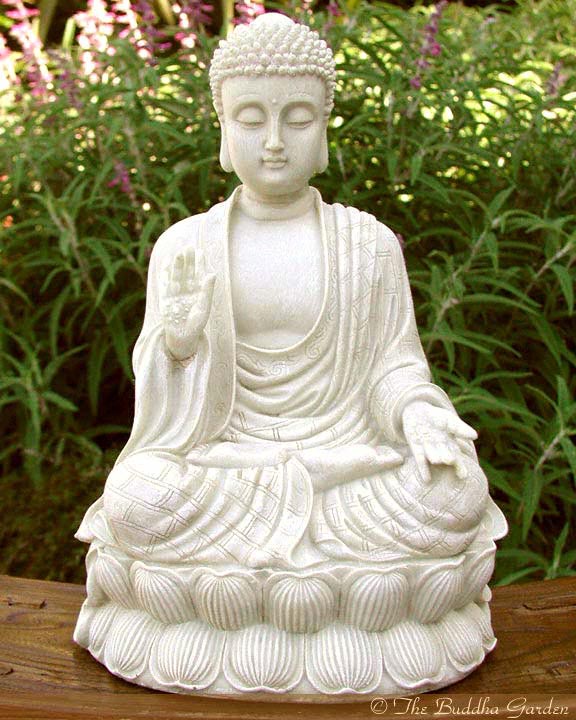
Protection / Warding Off Fear Pose
Protection Buddha (Click To View Larger Image)

Protection Buddha / Overcoming Fear

This depiction of a seated Buddha with the right hand raised and facing outwards has two common meanings. The first is that of the Protection Buddha, as the raised right hand symbolically represents a shield. The second meaning, Overcoming Fear, is closely related to the first (since one who is receiving protection would be less fearful).
The main features of this pose, aside from the raised right hand, is that The Buddha can be depicted either sitting or standing, and the left hand may either be extended outward or palm up in the lap. This statue signifies courage and offers protection from fear, delusion and anger.
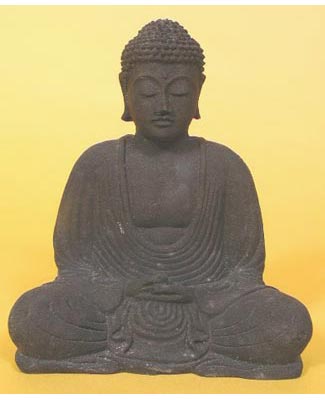
Meditation Pose / Boundless Light / Serenity
Meditation Buddha (Click to View Larger Image)

Meditation Buddha / Serenity Buddha / Calming Buddha

Another of the more common rupas is of the Buddha in Meditation. This statue is for people who are either looking for peace and clam in their lives, or for those who wish to improve their own meditation skills. People will often buy a Meditation Buddha if they want to set up a “serenity room” or a corner of their house where they can sit in calm for a little while and unwind.
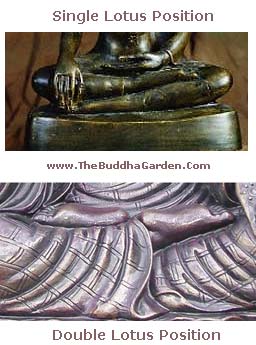
In this pose, the Buddha is depicted with both hands in the lap, face up, and the legs are crossed, either in a Double Lotus pose (with the ankles of each leg tucked behind one another in a locked position), or in a Single Lotus pose (where one leg rests on top of the other leg). Occasionally, an alms bowl is placed in the lap as well.
As this statue generally represents focused concentration, the eyes of the Buddha are either depicted as halfway closed, or closed nearly all the way. The silhouette of the statue is shaped – more or less – like a triangle, which represents stability.
Many of the largest Buddha Statues in Japan, such as the Great Kamakura Buddha Statue at Kotokuin Temple, and large statues in Korea are in the Meditation Pose. This pose is also known as the Amithabha Buddha, which means “Boundless Light.”

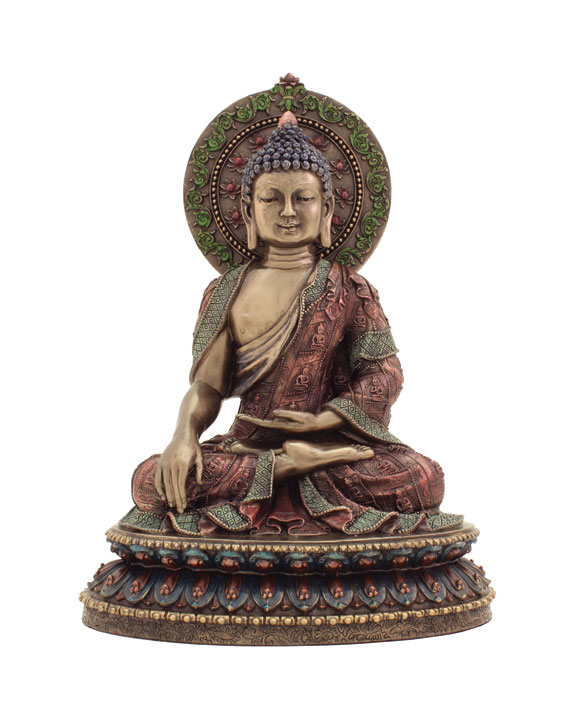
Calling The Earth To Witness The Enlightenment
Earth Touching Buddha (Click To View Larger Image)

Calling The Earth To Witness / Earth Touching Buddha

The most common pose you will find in Thai temples is with the legs crossed, the left hand in the lap, and the right hand pointing to the ground with the palm facing inward toward the Buddha. This posture is known as Calling The Earth to Witness, and it is the definition of the moment of enlightenment for the Buddha.
It is the story of how the Buddha, after six years, finally was at the verge of enlightenment. Unfortunately Mara, the Demon of Illusion, tried to dissuade The Buddha from the final last steps. The Buddha meditated all night to overcome the fears and temptations sent by Mara, and then called the Earth Goddess to witness that the Buddha achieved enlightenment in order to share with the rest of the world. Witnessing that, the Earth Goddess wrung her hair, releasing flood waters that swept away the Demon Mara and all the temptresses he had released.

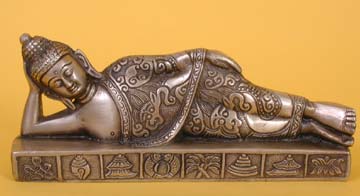
Nirvana / Reclining Buddha Pose
Nirvana Buddha (Click To View Larger Image)

The Nirvana Buddha / Reclining Buddha

This statue depicts the Historical Buddha in the last moments of life on earth, prior to the Buddha dying one last time before entering Nirvana (often written in English as ParaNirvana when referring to the life of The Buddha). It is said that an alms giver had accidentally given the Buddha pork that had gone bad, and this eventually led to the death of the Buddha.
Because the Buddha had gained enlightenment in this lifetime, the Buddha was able to escape the endless cycle of birth – death – rebirth (known as samsara) and was able to enter Nirvana. In this pose, the Buddha is always depicted lying on the right hand side on top of a resting table. One of the most well-known examples of this statue is enshrined at Wat Pho in Bangkok, Thailand, although there are numerous other temples throughout Southeast Asia that house statues in the posture.
Medicine Buddha
Medicine Buddha (Click To View Larger Image)

Medicine Buddha

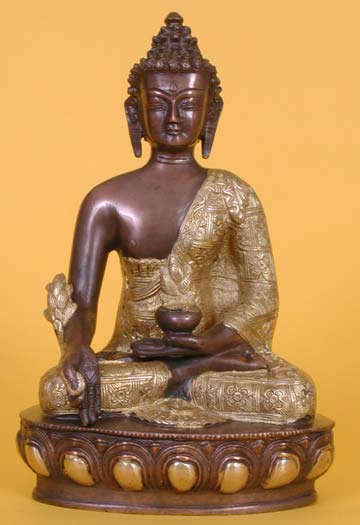
The Medicine Buddha is depicted in paintings having blue skin, but whether shown in statue or painted form, the right hand is held facing downward with fingers extended toward the ground, palm facing outward toward the viewer, a bowl of herbs rests in the left hand upon the lap.
It is believed by the Tibetans that the Buddha was responsible for delivering the knowledge of medicine to the people of the world, and in fact the right hand facing outward signifies “granting a boon” (meaning, giving a blessing) to mankind. This is a common hand gesture amongst both Buddhist and Hindu statues.
The Medicine Buddha is venerated by those seeking health, and is more commonly found in the Buddhist temples and communities of Nepal and Tibet.
The Teaching Buddha / DharmaChakra
Teaching Buddha (Click To View Larger Image)

Teaching Buddha / DharmaChakra Buddha

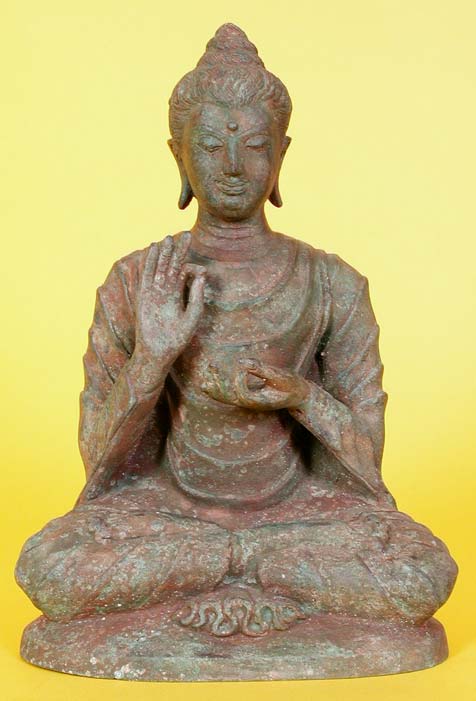
This statue signifies wisdom, understanding, and fulfilling destiny. Both hands are held at chest level, with thumb and index fingers forming a circle. The right hand is turned palm in, while the left hand is turned palm out.
As do most images of the Buddha, the Teaching Buddha depicts a particular moment in the life of the Buddha, namely, the first sermon the Buddha gave after reaching Enlightenment. This sermon was to a small group of disciples who had previously scorned the Buddha. This is a statue that is particularly appropriate for those who are either studying or are interested in learning more about spirituality.
The phrase DharmaChakra is hard to translate. The word Dharma means “the way of righteousness,” while the word Chakra is usually translated as the “Universe” or as the “cosmos.” Taken together, this phrase generally is interpreted as, “putting the cosmic law of righteousness in order,” or “turning the wheel of cosmic righteousness.”
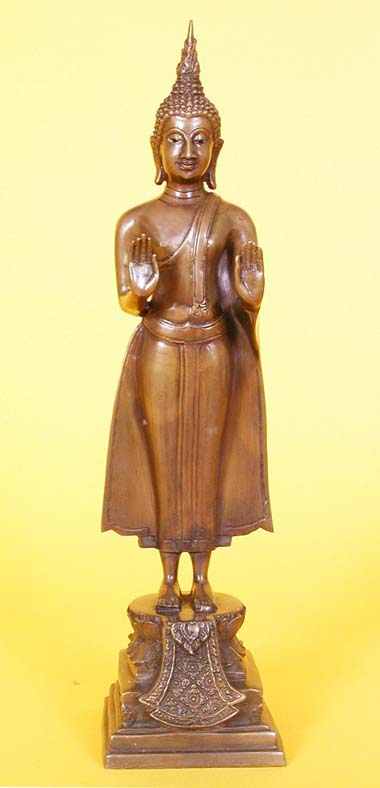
Sukhothai Walking Buddha / Returning From Heaven
Walking Buddha (Click To View Larger Image)

Walking Buddha / Sukhothai Buddha

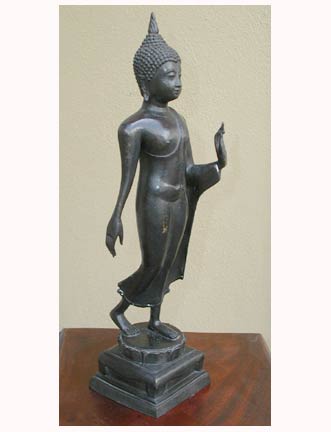
Signifies grace and internal beauty, and in Thai, we call this “Phra LeeLaa”. Right hand raised, facing outward, left hand dangles along left side of body. Standing with right foot behind, starting to raise off the ground. This statue is particular to the Sukhothai period in Thailand. It represents a time when the Buddha was returning to earth after delivering a sermon on the Dharma in Heaven, and was being accompanied by Lord Indra and Lord Brahma.

Contemplation Buddha

Contemplation Pose
Contemplation Buddha (Click To View Larger Image)
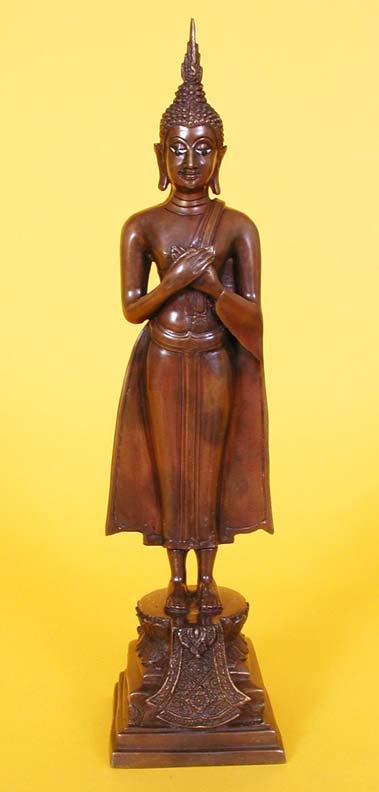
In this pose, Both arms of the Buddha lie flat against the chest, the palms of both hands facing in, with right arm on outside of left arm. The Contemplation Buddha signifies quiet determination and patient understanding.

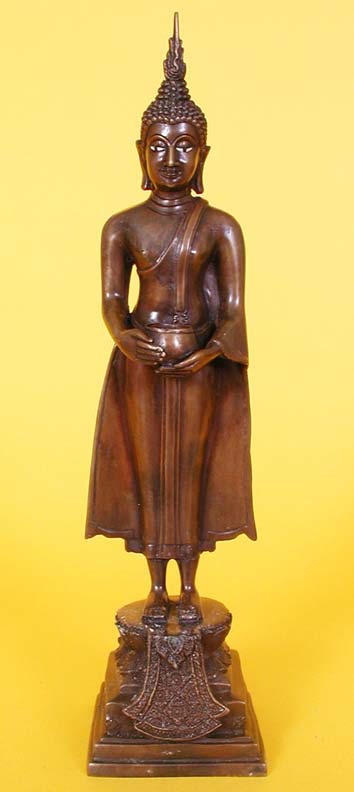
Alms Bowl Buddha / Begging Buddha

Collecting Alms Pose
Alms Collecting Buddha (Click To View Larger Image)
Arms bent at elbows, holding an alms bowl at chest level. This statue signifies compassion and caring for all beings. Contrary to what many think, monks (and the Buddha) did NOT beg for food. Instead, they collected alms. The difference is that collecting alms allows for those GIVING the alms to make merit (meaning, to acquire good karma). Devout Buddhists in Asia will prepare and give food to monks in the morning on their alms rounds.
Repelling The Ocean / Stopping The Relatives From Fighting
Repelling The Ocean (Click To View Larger Image)

Repelling The Ocean / Preventing the Relatives From Fighting

This statue has two meanings based on two different stories. The first meaning of Repelling The Ocean comes from a story when the Buddha visited Bihar state in India. A hermit unleashed a wall of water hoping to cause a flood, but the Buddha used the power generated from meditating to stop the water from flooding the area. The Forbidding The Relatives from Fighting is related to a period in the life of the Buddha where relatives of his father had an argument with relatives of the Buddha’s mother over water, as one of the rivers that both sets of relatives normally depended on was starting to run dry. The Buddha raised his right hand to draw attention to their own bickering and asked them what was ore important; water, or their family relations?

Differences In Leg Positions

Single Lotus and Double Lotus Leg Positions
Leg Positions
In general, the Buddha is depicted as sitting with the legs crossed. This makes a “triangle” shape to the image; the knees making the two bottom points of the triangle shape, while the tip of the head makes the top point of the triangle. The significance is that a triangle shape is more “grounded” or has a more solid foundation.
There are two positions for crossed legs, namely with the right leg resting above the left leg in the Single Lotus Position, or with both knees pointing downward and the ankles tucked on top of one another in the Double Lotus Position.
But there are a few postures that are not seated with crossed legs, namely the Maitreya Buddha, where the “Buddha of the Future” sits in a chair Western style. Also, there is a story of how a monkey and an elephant visited to make offerings to the Buddha, and in those images he is depicted sitting in a chair as well. there are standing Buddhas, and in Thailand, one of the most beloved forms is of the Walking Buddha statue, which is exclusive to the Sukhothai period of Thai art.

Suger Cube


तुम बिन ज़िंदगी के मायने क्या हैं.
तुम बिन सबकुछ कड़बा है.

मेरी फिल्टर कॉफी में पड़े दो सुगर क्यूूब हो तुम.

Saturday, June 6, 2015

फ़िल्टर


शादी उस मंहगी सिगरेट की तरह है जिसके अंत में ढंग का फ़िल्टर लगा है... इमोशंस अंदर फ़िल्टर होके जाते हैं. इसलिए कुछ सालों में सब इश्क़-विश्क उड़ जाता है... और बचता  क्या है… वही फ़िल्टर ... जिसे सड़क पे कुचला जाने के लिए फेंक दिया जाता है.

पता है फ़िल्टर का नाम क्या है?
-दम्भ.

फ़िल्टर

कुर्ते की जेब से
नज़्में तुम्हारे नाम की
पानी में बहा दीं.

पानी गुलाबी हो गया,
'लव पिंक कलर' का.

उफ़! ये आर.ओ.  ( R. O. )
सब फ़िल्टर हो गया.
तुमने पिया साफ़ पानी
इश्क़ और नज़्में सिंक में तड़प रही हैं.

छत पे कूँदती लड़की

छत पे ऊंघती चाँदनी दिखी क्या
तुम्हारी आँखें चांदी की है
रेगिस्तान में पानी पहचान लेगी.

धूप से कहो, रात के अगले पहर
रेत ठंडी हो जाती है,
प्यासा राँझा इश्क़ पीने तभी आता है.

धूप को बादल खा गए हैं.
छिपकली से डरती लड़की
धूप से बचा लाई
चांदनी ओक में भर.

धूप राँझा का कुछ न बिगाड़ पाई
लड़की बादल हो गई,
धूप ही खा गई.

छत पे कूँदती लड़की
चांदनी चूम बड़ी हो गई.

Difference between regular bank lending and capital markets

Regular bank lending is not usually classed as a capital market transaction, even when loans are extended for a period longer than a year. A key difference is that with a regular bank loan, the lending is not securitized (i.e., it doesn't take the form of resalable security like a share or bond that can be traded on the markets). A second difference is that lending from banks and similar institutions is more heavily regulated than capital market lending. A third difference is that bank depositors and shareholders tend to be more risk averse than capital market investors. The previous three differences all act to limit institutional lending as a source of finance. Two additional differences, this time favoring lending by banks, are that banks are more accessible for small and medium companies, and that they have the ability to create money as they lend. In the 20th century, most company finance apart from share issues was raised by bank loans. But since about 1980 there has been an ongoing trend for disintermediation, where large and credit worthy companies have found they effectively have to pay out less in interest if they borrow direct from capital markets rather than banks. The tendency for companies to borrow from capital markets instead of banks has been especially strong in the US. According to Lena Komileva writing for The Financial Times, Capital Markets overtook bank lending as the leading source of long term finance in 2009 - this reflects the additional risk aversion and regulation of banks following the 2008 financial crisis.

Role of Industrialisation in India

Industrialisation is the process of manufacturing consumer goods and capital goods and of building infrastructure in order to provide goods and services to both individuals and businesses. As such Industrialisation plays a major role in the economic development of underdeveloped countries like India with vast manpower and varied resources. Let us discuss, in detail, the role of industrialization in the Indian economy.
1. Raising Income: The first important role is that industrial development provide a secure basis for a rapid growth of income. The empirical evidence suggests a close correspondence between the high level of income and industrial development. In the industrially developed countries, for example, the GNP per capita income is very high at around $ 28,000. Whereas for the industrially backward countries it is very low at around $ 400 only.
2. Changing the Structure of the Economy: In order to develop the economy underdeveloped countries need structural change through industrialization. History shows that in the process of becoming developed economy the share of the industrial sector should rise and that of the agricultural sector decline. This is only possible through deliberate industrialization. As a result, the benefits of industrialization will ‘trickle down’ to the other sectors of the economy in the form of the development of agricultural and service sectors leading to the rise in employment, output and income.
3. Meeting High-Income Demands: Beyond certain limits, the demands of the people are usually for industrial products alone. After having met the needs of food, income of the people are spent mostly on manufactured goods. This means the income-elasticity of demand for the manufactured goods is high and that of agricultural products is low. To meet these demands and increase the economy’s output underdeveloped countries need industrialization.
4. Overcoming Deterioration in the Terms of Trade: Underdeveloped countries like India need industrialization to free themselves from the adverse effects of fluctuations in the prices of primary products and deterioration in their terms of trade. Such countries mainly export primary products and import manufactured goods. The prices of primary products have been falling or are stable whereas the prices of manufactured products have been rising. This led to deterioration in the terms of trade of the LDCs. For economic development such countries must shake off their dependence on primary products. They should adopt import substituting and export oriented industrialization.
5. Absorbing Surplus Labour (Employment Generation): Underdeveloped countries like India are characterized by surplus labour and rapidly growing population. To absorb all the surplus labour it is essential to industrialise the country rapidly. It is the establishment of industries alone that can generate employment opportunities on an accelerated rate.
6. Bringing Technological Progress: Research and Development is associated with the process of industrialization. The development of industries producing capital goods i.e., machines, equipment etc., enables a country to produce a variety of goods in large quantities and at low costs, make for technological progress and change in the outlook of the people. This results in bringing about an industrial civilization or environment for rapid progress which is necessary for any healthy economy.
7. Strengthening the Economy: Industrialisation of the country can provide the necessary elements for strengthening the economy. In this regard the following points may be noted.
(a) Industrialisation makes possible the production of goods like railways, dams, etc. which cannot be imported. These economic infrastructures are essential for the future growth of the economy.
(b) It is through the establishment of industries that one can impart elasticity to the system and overcome the historically given position of a primary producing country. Thus, with industrialization we can change the comparative advantage” of the country to suit its resources and potentialities of manpower.
(c) Through industrialization the requirements for the development of agriculture can be met. For example, improved farm-implements, chemical fertilizers, storage and transport facilities, etc., appropriate to our own conditions can be adequately provided only by our own industries.
(d) The industrial development imparts to an economy dynamic element in the form of rapid growth and a diversified economic structure which make it a progressive economy.
(e) Providing for Security: Industrialisation is needed to provide for the country’s security. This consideration becomes all the more critical when some international crisis develops. In such situation, dependence of foreign sources for defence materials is a risky affair. It is only through industrial development in a big way that the national objective of self-reliance in defence materials can be achieved.