Saturday, December 27, 2014

Unposted Letter


लिखना जब ज़िन्दगी का आखिरी न मनाया त्यौहार लगे
और तुम्हारी सांसे फिर मुझे गर्माहट दें
चुपके से लबों में समा जीवित हो जाओ,
तो आखिरी लफ्ज़ भी आखिर तुम्हें ही दूँ.
तुमसे दूर जाना बोर्डिंग जाने सा है,
भय, भय और भय बस.
तुम तक पहुंचना मनु का पहला कदम धरती पे.
अफ़सोस में तुमसे दूर नहीं जा सकता, न तुम तक ही.
शादी के बाद लड़कियां घर से पराई नहीं होती बस,
तारों से भी होती हैं.
वे तार जो सितारे लाने के वादे करते हैं
फिर खुद अँधेरे में डूब जाते हैं.
पराई औरतें पराये मर्दों से बात नहीं करती
सभ्यता के आदम में किसी गधे ने लिखा था ये,
लेकिन पराई औरतें पराये आदमी के साथ जी लेती हैं,
प्यार और ऊष्मा के परे.
आज की कविता तुम्हारे नाम लिखता,
स्याही कम है, कागज़ स्याह हैं
और रात आधी है, जो काट रहा है
तुम्हारा ये तार सितारों की ओट में.
कविता टेबल पे पड़े
बिस्किट कुतर रही है.

New PPP contracts to have renegotiation clause / Vrishti Beniwal

The Union finance ministry is not for putting a renegotiation clause in previously awarded public-private partnership (PPP) contracts, saying that would be against law. It is, however, looking to put such a clause in new contracts, to revive investment in infrastructure projects.

Officials said certain renegotiation triggers might be necessary for long-term projects, as in the case of some complicated construction contracts. If the scope of a project is changed midway, that could trigger renegotiation. The ministry might soon come up with a guidance note or a discussion paper on this.

“You can’t change the conditions after awarding the contract. It can lead to disputes and others can challenge it. (But) In a 60-year contract, you don’t know what will happen. However, if a renegotiation happens, it should not alter financial returns,” said a  ministry official.

Earlier, the infrastructure sectors, particularly roads and power, had pushed for changes in the terms of signed contracts to get more favourable terms, in the case of those which had become financially unsustainable due to extra-aggressive bidding to secure them. GMR, GVK, Adani, Reliance Power and are some companies which have tried to modify their contracts or exit these.

“Most projects in the roads sector are not doing well. If they extend the maturity or reduce the premium, that would be a violation of original bid conditions. So, rather than renegotiating, they must concentrate on addressing the fundamental aspects,” said Rajaraman Venkataraman, director, infrastructure, India Ratings.

The industry has been pushing for introduction of a mechanism to avoid unrealistic over-bidding by companies. And, to enable contract renegotiation, to ease the pressure on the balance sheets of banks, staring at huge non-performing assets due to developers’ inability to pay.

Government officials, on the other hand, said there already was a ‘force majeure’ clause (meaning, for unforeseen events that include major macro economic changes and excuse a party from an obligation).

“We are looking at best practices in the world for contract renegotiation. The longer the term of contract, the better it is for both the sides,” added the official.

Globally, about a third of projects undertaken on a basis have to be renegotiated. This is higher in  sectors such as transport, water and sanitation. Usually, the renegotiations have been favorable to the companies, resulting in increased rates or lower investment obligations.

“As the country with one of the world’s largest share of private sector investments, India is being keenly monitored and would do well to use this opportunity to devise best practices for renegotiation of PPP contracts and set global standards,” rating agency CRISIL had said in a report earlier this year.

Under the 12th five-year Plan, ending in 2016-17, an investment of Rs  55,75,072 crore or 8.18 per cent of the country’s gross domestic product has been pegged as needed for infrastructure. Of this, about half is expected from the private sector.

However, the mid-year economic analysis, penned by economic advisers in the finance ministry, said the PPP model had been less than successful. It pointed to over-exuberant investment, especially in the infrastructure sector in the form of PPPs, as the most important domestic challenge in the way of reviving of investments.

PARTNERSHIP CONUNDRUM
  • The finance ministry does not want a renegotiation clause in previously awarded PPP contracts, saying that would be against the law
     
  • However, it wants such a clause in new contracts to revive investment in infrastructure projects
     
  • Infrastructure sectors, particularly roads and power, had earlier pushed for changes in the terms of signed contracts to get more favourable terms
     
  • GMR, GVK, Adani, Reliance Power and Tata Power are some companies which tried to modify their contracts or exit these
     
  • The industry has been pushing for introduction of a mechanism to avoid unrealistic over-bidding by companies
     
  • It also wants to enable contract renegotiation, to ease the pressure on the balance sheets of banks, staring at huge non-performing assets due to developers’ inability to pay
     
  • Government officials, however, said there already was a clause for unforeseen events, including major macroeconomic changes.

Source: http://www.business-standard.com/article/economy-policy/new-ppp-contracts-to-have-renegotiation-clause-114121900212_1.html

Action plan soon to prevent deaths from diarrhoea, pneumonia / AARTI DHAR

The Centre will soon launch an action plan against diarrhoea and pneumonia in four States, including Rajasthan. The aim is to end preventable child deaths from these two by 2025. As high as 36 per cent of all child deaths, below the age of 5, in India are caused by these two conditions.
India accounts for the highest number of diarrhoea and pneumonia deaths among children in the world with over 2 lakh children dying of diarrhoea and over 3.8 lakh children of pneumonia annually, accounting for the mortality of 4 in every 10 children under-five.
The highest burden is being borne by the poorest sections of society.
The four States where the India Action Plan for Diarrhoea and Pneumonia will be rolled out — Madhya Pradesh, Uttar Pradesh, Bihar and Rajasthan — account for half of under-five mortality in the country which stands at 62 deaths per 1,000 live births nationally. The under-five mortality rate of Rajasthan is 59 per 1,000 live births.
Launch next month
The action plan, likely to be launched next month, is a follow-up of the Global Action Plan for Diarrhoea and Pneumonia that was launched by WHO and UNICEF in April 2013 which aims to reduce pneumonia mortality to less than 3 per 1,000 live births, diarrhoea deaths to less than 1 per 1,000 live births, reduce incidence of severe pneumonia and diarrhoea by 75 per cent compared to 2010 levels and reduce by 40 per cent the global number who are stunted as compared to 2010 levels by 2025.
While India has taken several measures to reduce maternal and child mortality over the years, including launching of the National Rural Health Mission; Reproductive Maternal Neonatal Child Health plus Adolescent programme and the India Newborn Action Plan to end preventable newborn deaths, the success in reducing under-five mortality has not been uniform.
Seven States have achieved the MDG-4 target of U5MR of 38 per 1,000 live births and nine States are showing a decline of more than the national average.
While Delhi, Kerala, Karnataka, Maharashtra, Punjab, Tamil Nadu and West Bengal have achieved the MDG target, the rate of decline is 7.3 per cent in Rajasthan, 5.6 per cent in Madhya Pradesh, 7 per cent in Uttar Pradesh and 6 per cent in Bihar.
Twenty per cent districts in Rajasthan have shown an increase in U5MR between 2010-11 and 2012-13 in the annual health surveys.
Collaboration
The WHO and UNICEF have been entrusted to collaborate with the respective governments in implementing the action plan which is not a new project or a programme but a framework for strengthening coordination of existing interventions where the coverage remains low like in exclusive breastfeeding (39 per cent), vitamin A supplement (75 per cent), DTP3 immunisation (83 per cent), measles immunization (84 per cent), HiB 3 immunisation (43 per cent) and other interventions like access to antibiotics and ORS solutions, sanitation, better living condition, hand wash and clean drinking water.
Since diarrhoea and pneumonia are caused by multiple pathogens, no single intervention, including vaccine, will help in protecting children.

Source: http://www.thehindu.com/todays-paper/tp-national/action-plan-soon-to-prevent-deaths-from-diarrhoea-pneumonia/article6726609.ece

‘Coral bleaching in Pacific may become worst die-off in 20 years’ / KARL MATHIESEN

Scientists warn extreme sea temperatures could cause a “historic” coral reef die-off around the world over the coming months, following a massive coral bleaching already under way in the North Pacific. Experts said the coral die-off could be the worst in nearly two decades.
Reports of severe bleaching have been accumulating in the inbox of the U.S. National Oceanic and Atmospheric Administration’s (NOAA) Coral Reef Watch programme since July.
A huge swathe of the Pacific has already been affected, including the Northern Marianas Islands, Guam, the Republic of the Marshall Islands, Hawaii, Kiribati and Florida. Some areas have recorded serious bleaching for the first time.
“On a global scale it’s a major bleaching event. What it may be is the beginning of a historic event,” said Coral Reef Watch coordinator Dr. Mark Eakin.
Thermal stress
In the Marshall Islands, bleaching of unprecedented severity is suspected to have hit most of the country’s 34 atolls and islands. The Guardian witnessed devastated expanses of coral that look like forests covered with snow. Warm water will soon begin hitting reefs in the southern Pacific and the Indian Ocean as the seasons and currents shift. Dr. Eakin said coral watch modelling predicts bleaching on Australia’s Great Barrier Reef as early as January. Bleaching is caused by persistent increases in sea surface temperature. Just 1°C of warming lasting a week or more can be enough to cause long-term breakdown of reef ecosystems.
The worst coral bleaching event on record is a mass die-off during 1998. A massive El Niño event combined with climate change to raise global sea and air temperatures to never-before-recorded levels and killed around 15 per cent of the world’s corals.
Professor Ove Hoegh-Guldberg, a coral reef expert from the University of Queensland, said the current bleaching event was on track to be as bad or worse than 1998.
“Many coral reef scientists are expecting something similar to 1997-98 to unfold in the next six to 12 months.” Dr. Eakin said. Even under a weak El Niño, bleaching could continue until 2016 — lasting twice as long as the 1998 event. High sea surface temperatures due to climate change are making El Niño a less decisive factor in coral bleaching.
Initial analysis of the Guardian ’s photos from the Marshallese atoll of Arno showed its reefs could be added to the fast-growing list of seriously affected places. In less extreme temperatures, bleached coral may not die completely. But Karl Fellenius, a coral reef manager from the University of Hawaii said that in the Marshall Islands “it’s looking like the thermal stress was so profound that the corals died within days of getting bleached.” This does not augur well for the future of the world’s reefs under climate change. “The real problem is that recovery from a major bleaching event can take decades and these events keep coming back every 10 years or less. [Reefs] just don’t have time to recover,” said Dr. Eakin. The combined effect of rising temperatures and sea levels could mean the end for coral reefs in the next 50 years, said Prof. Hoegh-Guldberg.

Source: http://www.thehindu.com/todays-paper/tp-opinion/coral-bleaching-in-pacific-may-become-worst-dieoff-in-20-years/article6714110.ece

Agricultural Households in Debt

A little over half of India's were in debt, with 40 per cent of the dues from non-institutional lenders, during agricultural year 2012-13 (July to June), according to a official survey.

This 'Situation assessment survey of agricultural households' showed 51.9 per cent of all agricultural households were indebted, with the average amount of unpaid dues being Rs 47,000.

Conducted by the Office, this should not be confused with a Census, as these figures would provide only broadly representative data. For instance, the survey was conducted in 4,529 of India's 638,000 villages. It covered 35,000 agricultural households.

Among the major states, Andhra Pradesh had the highest share of indebted agricultural households in the country (92.9 per cent), followed by Telangana (89.1 per cent) and Tamil Nadu (82.5) per cent.

About 60 per cent of the loans dues were taken from the institutional sources. About 42.9 per cent were from banks, 4.8 per cent from cooperatives and 2.1 per cent from the government, among other institutional sources. About 40 per cent of loans were received from non-institutional lenders - 25.8 per cent were from money lenders.

Meanwhile, another survey on 'Debt and investment in India' showed non-institutional agencies played a major role in advancing of credit to households, particularly in rural India. This covered the period of January-December 2013 and sought responses from 4,529 villages in rural areas and 3,507 urban blocks. Non-institutional agencies had given credit to 19 per cent of rural households, while institutional agencies had done so to 17 per cent.

In urban India, institutional agencies had advanced credit to 15 per cent of households, against 10 per cent by non-institutional ones.

The institutional agencies played a significant role in providing credit to households with a moderate rate of interest (six to 15 per cent) for both rural and urban areas. Among total cash dues funded by institutional agencies, 89 per cent in the rural and 92 per cent in the urban areas were provided at less than 15 per cent interest.

On the other hand, non-institutional agencies provided a significant amount of its total loans to households at an interest rate of 20 per cent or above. The share of such loans to the total by non-institutional agencies was 69 per cent in rural areas and 58 per cent in urban ones.

AGRI ARREARS
  • 2.6 per cent of agricultural households own less than 0.01 hectares (ha) of land
  • Among the agri households having less than 0.01 ha land, about 56 per cent gets wage/salary employment as the principal source of income and another 23 per cent depends on livestock as their principal source of income
  • A third of agri households own up to 0.4 ha
  • A majority of agricultural households which possess more than 0.4 ha has cultivation as the principal source of income
  • About 63.5 per cent of agri households has cultivation as the principal source of income. About 22 per cent has wage/salaried employment as the principal source
  • About 44 per cent of agri households has a job card of the Mahatma Gandhi National Rural Employment Guarantee Scheme
  • About 12 per cent of agri households do not possess a ration card
  • A Below Poverty Line card is possessed by about 36 per cent of agri households and another five per cent has Antyodaya cards
  • About 13 per cent of agri households having less than 0.01 ha do not have a ration card

http://www.business-standard.com/article/economy-policy/half-of-farm-households-in-debt-114122200074_1.html

Thursday, December 18, 2014

लड़की को लकड़ियाँ इकठ्ठा करते देखा है


मुझे याद नहीं मैंने पानी को रोते कब देखा था
धुंए को सिगार सुलगाते कब,
लेकिन याद है लड़की को लकड़ियाँ इकठ्ठा करते देखना.

पहले उसने लकड़ियाँ बीनी
अरमानों की चिता पे फेरे ले मुंह फेरा
और अंत तक सतीत्व बचाती रही,
सती होने.

मैंने लड़की को चिता की लकड़ियाँ इकठ्ठा करते देखा है.

Why have people accepted Batman over other superheroes?


1.)Batman is natural :- You see Batman is the one who does not have any special power and does not even need any. That is, he is not bit by a spider (Spiderman), neither is he a mutant (X-Men) and nor he is from other planet (Superman) . He is just a Homo Sapien as you and me. On the other hand not even a gifted one, as everyone dear to him was taken away at very early stages of his life. His parents were shot dead in front of his eyes . 

2.)Batman is about PAIN :- Bruce Wayne had a deep cut in his heart about his parents . He was left with nothing, but a hollow Wayne Manor and his dearly Butler Mr. Alfred .

3.)Batman is about DEDICATION :- Bruce Wayne did not become Batman because he was destined to be so, but he bent himself in a way so that he could become a hero . He had only one thing in mind and that is "Vengeance". He had to avenge the death of his parents, and that kept him motivated and each time he tried to push himself over the edge .

4.)Batman is about LEARNING :- The Batman, may be the strongest, but each time and after every fight, he learns, he teaches himself something new. Who could forget the famous  "WELL SCENE" in which Bruce Wayne defeats his biggest enemy "THE FEAR FOR DEATH" .

5.)Batman is about ETHICS :-The Batman never gives up what he actually stands for and that is JUSTICE . There were a few of them who could really shake The Batman .Especially The Joker needs a mention over here, The Joker killed Rachel, infected Harvey Dent and finally destroyed Peace in Gotham yet The Batman having a chance to kill him, did not do so, for the reason he stands since by the law it is illegal to kill someone, even that someone be as monstrous as The Joker .

6.)Batman is about connecting the masses:-And now you tell me how many of you get inspired after watching him . I am sure most of you . This was all what Batman stands for, he is a symbol to bring within the heroism from you, me and all of us . Each time I do anything I try to connect myself with him as -
A hero can be anyone, even someone who turns off lights and fans while leaving a room .
A hero can be anyone, even someone who pays his taxes on time so that equity exists in the society.

7.)And finally, Batman is not at all about comparisons :- Batman is a symbol, he always needed more and more number of people to get inspired from him and not fighting among themselves for knowing who is the better one . So stop comparing and bring out the Dark Knight within you .

Read more answers Here.

Swachh Bharat and Sanitation / Agnikalam

Nirmal remained unattained. Now we want to graduate to swachh, also a laudable objective if its broad contours are to be imagined. To begin let me ask rather obviously, was there any centrally sponsored nirmal scheme that went to local - as opposed to state - governments, which central ministries were responsible, has there been any of programmes undertaken under nirmal, and have states been pursued regarding their promise to set up state finance commissions to ensure constitutionally guaranteed financing of municipal and panchayat programmes? Or is to turn out to be another unfulfilled wish?

It is one thing to expect the middle class not to litter Indian streets. But the depth of the problem lies elsewhere. Unless all Indians are assured a basic right in relieving themselves decently and in privacy, that is, have access to at least septic tank or slab/open pit, leave alone modern latrines, how could they be expected to throw their garbage in bins, presuming, of course, that adequate number of bins are provided?
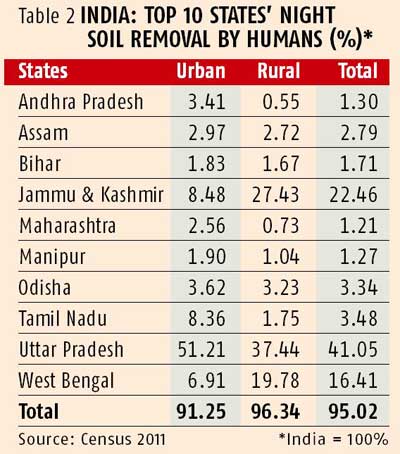
Coming to brass tacks, let us examine relevant figures. Based on Census 2011, table 1 reveals that about one-fifth of urban and more than two-thirds of rural households do not have in-house facilities; most of them use open fields. Table 2 lists the top 10 states' shares of night soil removal by humans, one of the most degrading human occupations. Unsurprisingly, by far the highest occurrence is in Uttar Pradesh, though surprisingly dismal performance persist also in rural West Bengal and urban Tamil Nadu. Rural conditions of Jammu and Kashmir are also poor, noteworthy in light of pre-election promises being made to Kashmiris on development.

Using should not be terribly erroneous in light of little improvement over time. A 2014 World Health Organization-Unicef cross-country comparison in table 3 lists the top 10 countries that have achieved the highest reduction in open defecation since 1990 as a percentage of population. In the sub-continent, it shows a rapid decline in open defecation in Bangladesh, Pakistan and Nepal. Reflecting the numbers on the use of open fields in table 1, it is not surprising that India does not feature in table 3 at all, while Sri Lanka does not feature for the opposite reason that there is likely to be little open defecation there. Also to be observed are that Ethiopia's reduction is most striking, while Bangladesh, Peru and Vietnam have rapidly reduced their incidence to single digits.

In table 4, the same source reveals that India's inclusion significantly worsens southern Asia's performance between 1990-2012 or 2000-12. Clearly, India has been, and continues to be, an outlier by far. As one indicator, 12 per cent of rural plus urban southern Asia other than India uses open defecation. But since in India it is 48 per cent, southern Asia's number jumps to 38 per cent once India is included in it! Indeed, globally, India represents almost 60 per cent of open defecation.

Thus, the statistics for India on sanitation, in the above discussion on latrines in particular, are no less than shocking. Should any policymaker expect from those who suffer such ignominy through life? The answer is decidedly in the negative, and even less so from those who hand carry excreta through urban and village streets, not unusually the subject of mockery for being of a low caste. These very fundamental challenges have to be addressed through rational allocation of financial resources to the appropriate level of government, ex ante and ex post impact assessment (IA) and tight monitoring and evaluation (M&E) of an intelligently designed Swachh Bharat programme.

Implementation of the programme has to be followed by wide induction in awareness of the dignity of labour and social equity more broadly. When Mohandas Karamchand Gandhi iterated, "Karo pahale, kaho pichhe", he actually cleaned out night soil of the Bihar Harijan, or so my generation was taught in junior school. In that light, by the time the joy of middle to high school came to be experienced, tasks following Gandhi's example were meted out to us to be applied in urban slums. Rhetorically, how many children are going through a culture of this kind of activity today?

In sum, Swachh Bharat is a correct policy revival but will fail unless buttressed by a robust, palpable implementation structure. The prime minister has to show his mettle by revealing his plan to make India clean and smart. Luckily, there exists a handful of municipalities from where one could derive inspiration. One such is the 2013-14 Budget of Berhampur Municipal Corporation in Ganjam district of Odisha that details its Budget allocation in garbage collection, solid waste management, drainage, public toilet, water supply, housing, roads and bridges, street lighting, parks, livelihood, infrastructure and project assistance. It elaborates that it wants mandatory public disclosure of documents and allocation, to ensure citizen participation - common in developed societies - increase allocation for the urban poor, and for basic services including water, garbage, drainage and public toilets, and implement a development outcome budget to ensure effective government management and accountability. It is rejuvenating for it sets an example for other local governments to follow. Central government bureaucrats should pick up such examples consistently and give concrete shape to the prime minister's vision though the leadership in this endeavour has to continue to be his.

http://www.business-standard.com/article/opinion/agnikalam-anatomy-of-aswachh-bharat-and-alchemy-to-swachh-114121600972_1.html

Wednesday, December 17, 2014

ओ रे बाबा हम चाँदी नहीं माँगते / पीयूष मिश्रा

ओ रे बाबा हम चाँदी नहीं माँगते
ओ रे बाबा हम सोना नहीं माँगते
हम हीरे का खज़ाना नहीं माँगते
गर हम कुछ माँगते माँगते हैं तो अपना हक
माँगते माँगते माँगते

हम यूँ ही कट जाना नहीं माँगते
हम यूँ ही जल जाना नहीं माँगते
हम यूँ ही मर जाना नहीं माँगते
गर हम कुछ माँगते माँगते हैं तो अपना हक
माँगते माँगते माँगते

पोप सुन लो ज़रा, तुम भी ये दासताँ
हमने सीखी है ये, गैलिलियो की ज़ुबाँ
धर्म तुम्हारा था, हज़्ज़ारों साल से
आज हमारा है, ऐसा उसने कहा
हम स्वर्ग-नरक का फ़साना नहीं माँगते
उलझा हुआ ताना-बाना नहीं माँगते
गर हम कुछ माँगते माँगते हैं तो अपना हक
माँगते माँगते माँगते

हम जीने का बहाना नहीं माँगते
हम गुज़रा ज़माना नहीं माँगते
हम बासी ये तराना नहीं माँगते
गर हम कुछ...

ओ ज़मींदार भई, तूने जो ज़ुल्म किए
इक-इक करके सभी हमने मालूम किए
झूठा लगान था, झूठा फ़रमान था
झूठी हर बात थी, झूठा हर दाम था
हम झूठा लगान चुकाना नहीं माँगते
खेतों में बारूद उगाना नहीं माँगते
गर हम कुछ माँगते माँगते हैं तो अपना हक
माँगते माँगते माँगते

भूखे बच्चों को रुलाना नहीं माँगते
हम फेंका हुआ खाना नहीं माँगते
अब हम थक जाना नहीं माँगते
गर हम कुछ...

bilateral investment protection agreemen

The finance ministry has finalised a proposal for a model to replace the current Bipa (bilateral investment protection agreement). The model will provide protection only to companies and natural persons  with substantial business activity in their home country. The move will help prevent treaty shopping, the practice of multinational companies taking advantage of more favourable tax jurisdictions (also known as tax havens).

The proposed model would require the enterprise to have substantial operations in India and would exclude claims of indirect or minority shareholders. It would only entertain the claims of investors with at least 50 per cent stake or the right to appoint a majority of the directors or senior management personnel.

The model draft proposal has also made it clear that tax measures will be excluded from the BIT (bilateral investment treaty). In simple terms, this means no tax measure introduced by the host country will be subject to any dispute settlement under the BIT.

The clearly defines government for the first time to include only the central and state governments and not activities of any local government.

[ ALSO READ: India to replace BIPA with a new pact to protect investments ]

The proposed model agreement plans to remove some of the broad obligations found in the current Bipa model, which gives arbitral tribunals wide latitude to interpret provisions. So, the most favoured nation obligation would be removed.

The new model would introduce an early review mechanism to dismiss frivolous claims leading to significant costs. It also establishes a mechanism under which a host country can pursue counter claims against foreign investors for their illegal conduct.

Under the Bipa, the exceptional provisions to preserve the right of the state to develop policies in accordance with national interest are limited. It contains only one exception: essential security interest. The new model broadens the scope to include protection of the environment, conservation of natural resources, stability and integrity of the financial system, public health and safety, and improving working conditions, amongst others.

Under the proposed model of investor-state dispute settlement, the aggrieved party should exhaust all adminstrative and judicial procedures within a specified time frame within the country before the claim can be submitted for arbitration. Upon exhaustion of these remedies, the investor will have to engage in consultation with the host state to find a solution for one year. Failure to go through this process will lead to the investor being barred from pursuing investor-state arbitration.

The proposed model would also balance investor rights with their obligations under the domestic law. So, it does not provide any protection to investors who violate core obligations under the law.

A new model agreement was needed by the government as there had been a substantial increase in the amount of disputes under Bipa. The number of disputes went up to 550 in 2012. In that year, 58 new cases were initiated, the highest in a single year.

http://www.business-standard.com/article/economy-policy/new-look-bipa-won-t-let-mncs-milk-tax-havens-114121501080_1.html