Thursday, December 18, 2014

लड़की को लकड़ियाँ इकठ्ठा करते देखा है


मुझे याद नहीं मैंने पानी को रोते कब देखा था
धुंए को सिगार सुलगाते कब,
लेकिन याद है लड़की को लकड़ियाँ इकठ्ठा करते देखना.

पहले उसने लकड़ियाँ बीनी
अरमानों की चिता पे फेरे ले मुंह फेरा
और अंत तक सतीत्व बचाती रही,
सती होने.

मैंने लड़की को चिता की लकड़ियाँ इकठ्ठा करते देखा है.

Why have people accepted Batman over other superheroes?


1.)Batman is natural :- You see Batman is the one who does not have any special power and does not even need any. That is, he is not bit by a spider (Spiderman), neither is he a mutant (X-Men) and nor he is from other planet (Superman) . He is just a Homo Sapien as you and me. On the other hand not even a gifted one, as everyone dear to him was taken away at very early stages of his life. His parents were shot dead in front of his eyes . 

2.)Batman is about PAIN :- Bruce Wayne had a deep cut in his heart about his parents . He was left with nothing, but a hollow Wayne Manor and his dearly Butler Mr. Alfred .

3.)Batman is about DEDICATION :- Bruce Wayne did not become Batman because he was destined to be so, but he bent himself in a way so that he could become a hero . He had only one thing in mind and that is "Vengeance". He had to avenge the death of his parents, and that kept him motivated and each time he tried to push himself over the edge .

4.)Batman is about LEARNING :- The Batman, may be the strongest, but each time and after every fight, he learns, he teaches himself something new. Who could forget the famous  "WELL SCENE" in which Bruce Wayne defeats his biggest enemy "THE FEAR FOR DEATH" .

5.)Batman is about ETHICS :-The Batman never gives up what he actually stands for and that is JUSTICE . There were a few of them who could really shake The Batman .Especially The Joker needs a mention over here, The Joker killed Rachel, infected Harvey Dent and finally destroyed Peace in Gotham yet The Batman having a chance to kill him, did not do so, for the reason he stands since by the law it is illegal to kill someone, even that someone be as monstrous as The Joker .

6.)Batman is about connecting the masses:-And now you tell me how many of you get inspired after watching him . I am sure most of you . This was all what Batman stands for, he is a symbol to bring within the heroism from you, me and all of us . Each time I do anything I try to connect myself with him as -
A hero can be anyone, even someone who turns off lights and fans while leaving a room .
A hero can be anyone, even someone who pays his taxes on time so that equity exists in the society.

7.)And finally, Batman is not at all about comparisons :- Batman is a symbol, he always needed more and more number of people to get inspired from him and not fighting among themselves for knowing who is the better one . So stop comparing and bring out the Dark Knight within you .

Read more answers Here.

Swachh Bharat and Sanitation / Agnikalam

Nirmal remained unattained. Now we want to graduate to swachh, also a laudable objective if its broad contours are to be imagined. To begin let me ask rather obviously, was there any centrally sponsored nirmal scheme that went to local - as opposed to state - governments, which central ministries were responsible, has there been any of programmes undertaken under nirmal, and have states been pursued regarding their promise to set up state finance commissions to ensure constitutionally guaranteed financing of municipal and panchayat programmes? Or is to turn out to be another unfulfilled wish?

It is one thing to expect the middle class not to litter Indian streets. But the depth of the problem lies elsewhere. Unless all Indians are assured a basic right in relieving themselves decently and in privacy, that is, have access to at least septic tank or slab/open pit, leave alone modern latrines, how could they be expected to throw their garbage in bins, presuming, of course, that adequate number of bins are provided?
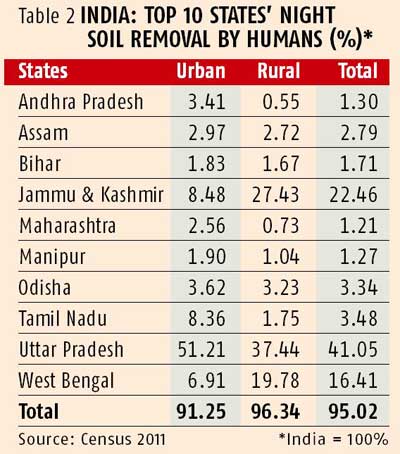
Coming to brass tacks, let us examine relevant figures. Based on Census 2011, table 1 reveals that about one-fifth of urban and more than two-thirds of rural households do not have in-house facilities; most of them use open fields. Table 2 lists the top 10 states' shares of night soil removal by humans, one of the most degrading human occupations. Unsurprisingly, by far the highest occurrence is in Uttar Pradesh, though surprisingly dismal performance persist also in rural West Bengal and urban Tamil Nadu. Rural conditions of Jammu and Kashmir are also poor, noteworthy in light of pre-election promises being made to Kashmiris on development.

Using should not be terribly erroneous in light of little improvement over time. A 2014 World Health Organization-Unicef cross-country comparison in table 3 lists the top 10 countries that have achieved the highest reduction in open defecation since 1990 as a percentage of population. In the sub-continent, it shows a rapid decline in open defecation in Bangladesh, Pakistan and Nepal. Reflecting the numbers on the use of open fields in table 1, it is not surprising that India does not feature in table 3 at all, while Sri Lanka does not feature for the opposite reason that there is likely to be little open defecation there. Also to be observed are that Ethiopia's reduction is most striking, while Bangladesh, Peru and Vietnam have rapidly reduced their incidence to single digits.

In table 4, the same source reveals that India's inclusion significantly worsens southern Asia's performance between 1990-2012 or 2000-12. Clearly, India has been, and continues to be, an outlier by far. As one indicator, 12 per cent of rural plus urban southern Asia other than India uses open defecation. But since in India it is 48 per cent, southern Asia's number jumps to 38 per cent once India is included in it! Indeed, globally, India represents almost 60 per cent of open defecation.

Thus, the statistics for India on sanitation, in the above discussion on latrines in particular, are no less than shocking. Should any policymaker expect from those who suffer such ignominy through life? The answer is decidedly in the negative, and even less so from those who hand carry excreta through urban and village streets, not unusually the subject of mockery for being of a low caste. These very fundamental challenges have to be addressed through rational allocation of financial resources to the appropriate level of government, ex ante and ex post impact assessment (IA) and tight monitoring and evaluation (M&E) of an intelligently designed Swachh Bharat programme.

Implementation of the programme has to be followed by wide induction in awareness of the dignity of labour and social equity more broadly. When Mohandas Karamchand Gandhi iterated, "Karo pahale, kaho pichhe", he actually cleaned out night soil of the Bihar Harijan, or so my generation was taught in junior school. In that light, by the time the joy of middle to high school came to be experienced, tasks following Gandhi's example were meted out to us to be applied in urban slums. Rhetorically, how many children are going through a culture of this kind of activity today?

In sum, Swachh Bharat is a correct policy revival but will fail unless buttressed by a robust, palpable implementation structure. The prime minister has to show his mettle by revealing his plan to make India clean and smart. Luckily, there exists a handful of municipalities from where one could derive inspiration. One such is the 2013-14 Budget of Berhampur Municipal Corporation in Ganjam district of Odisha that details its Budget allocation in garbage collection, solid waste management, drainage, public toilet, water supply, housing, roads and bridges, street lighting, parks, livelihood, infrastructure and project assistance. It elaborates that it wants mandatory public disclosure of documents and allocation, to ensure citizen participation - common in developed societies - increase allocation for the urban poor, and for basic services including water, garbage, drainage and public toilets, and implement a development outcome budget to ensure effective government management and accountability. It is rejuvenating for it sets an example for other local governments to follow. Central government bureaucrats should pick up such examples consistently and give concrete shape to the prime minister's vision though the leadership in this endeavour has to continue to be his.

http://www.business-standard.com/article/opinion/agnikalam-anatomy-of-aswachh-bharat-and-alchemy-to-swachh-114121600972_1.html

Wednesday, December 17, 2014

ओ रे बाबा हम चाँदी नहीं माँगते / पीयूष मिश्रा

ओ रे बाबा हम चाँदी नहीं माँगते
ओ रे बाबा हम सोना नहीं माँगते
हम हीरे का खज़ाना नहीं माँगते
गर हम कुछ माँगते माँगते हैं तो अपना हक
माँगते माँगते माँगते

हम यूँ ही कट जाना नहीं माँगते
हम यूँ ही जल जाना नहीं माँगते
हम यूँ ही मर जाना नहीं माँगते
गर हम कुछ माँगते माँगते हैं तो अपना हक
माँगते माँगते माँगते

पोप सुन लो ज़रा, तुम भी ये दासताँ
हमने सीखी है ये, गैलिलियो की ज़ुबाँ
धर्म तुम्हारा था, हज़्ज़ारों साल से
आज हमारा है, ऐसा उसने कहा
हम स्वर्ग-नरक का फ़साना नहीं माँगते
उलझा हुआ ताना-बाना नहीं माँगते
गर हम कुछ माँगते माँगते हैं तो अपना हक
माँगते माँगते माँगते

हम जीने का बहाना नहीं माँगते
हम गुज़रा ज़माना नहीं माँगते
हम बासी ये तराना नहीं माँगते
गर हम कुछ...

ओ ज़मींदार भई, तूने जो ज़ुल्म किए
इक-इक करके सभी हमने मालूम किए
झूठा लगान था, झूठा फ़रमान था
झूठी हर बात थी, झूठा हर दाम था
हम झूठा लगान चुकाना नहीं माँगते
खेतों में बारूद उगाना नहीं माँगते
गर हम कुछ माँगते माँगते हैं तो अपना हक
माँगते माँगते माँगते

भूखे बच्चों को रुलाना नहीं माँगते
हम फेंका हुआ खाना नहीं माँगते
अब हम थक जाना नहीं माँगते
गर हम कुछ...

bilateral investment protection agreemen

The finance ministry has finalised a proposal for a model to replace the current Bipa (bilateral investment protection agreement). The model will provide protection only to companies and natural persons  with substantial business activity in their home country. The move will help prevent treaty shopping, the practice of multinational companies taking advantage of more favourable tax jurisdictions (also known as tax havens).

The proposed model would require the enterprise to have substantial operations in India and would exclude claims of indirect or minority shareholders. It would only entertain the claims of investors with at least 50 per cent stake or the right to appoint a majority of the directors or senior management personnel.

The model draft proposal has also made it clear that tax measures will be excluded from the BIT (bilateral investment treaty). In simple terms, this means no tax measure introduced by the host country will be subject to any dispute settlement under the BIT.

The clearly defines government for the first time to include only the central and state governments and not activities of any local government.

[ ALSO READ: India to replace BIPA with a new pact to protect investments ]

The proposed model agreement plans to remove some of the broad obligations found in the current Bipa model, which gives arbitral tribunals wide latitude to interpret provisions. So, the most favoured nation obligation would be removed.

The new model would introduce an early review mechanism to dismiss frivolous claims leading to significant costs. It also establishes a mechanism under which a host country can pursue counter claims against foreign investors for their illegal conduct.

Under the Bipa, the exceptional provisions to preserve the right of the state to develop policies in accordance with national interest are limited. It contains only one exception: essential security interest. The new model broadens the scope to include protection of the environment, conservation of natural resources, stability and integrity of the financial system, public health and safety, and improving working conditions, amongst others.

Under the proposed model of investor-state dispute settlement, the aggrieved party should exhaust all adminstrative and judicial procedures within a specified time frame within the country before the claim can be submitted for arbitration. Upon exhaustion of these remedies, the investor will have to engage in consultation with the host state to find a solution for one year. Failure to go through this process will lead to the investor being barred from pursuing investor-state arbitration.

The proposed model would also balance investor rights with their obligations under the domestic law. So, it does not provide any protection to investors who violate core obligations under the law.

A new model agreement was needed by the government as there had been a substantial increase in the amount of disputes under Bipa. The number of disputes went up to 550 in 2012. In that year, 58 new cases were initiated, the highest in a single year.

http://www.business-standard.com/article/economy-policy/new-look-bipa-won-t-let-mncs-milk-tax-havens-114121501080_1.html

Tuesday, December 16, 2014

Section 309 / Rajeev Dhavan

The Union government has decided to decriminalise suicide. A funny interpretation could well be that the Modi government can now commit hara kiri with impunity. But it should be noted that the cases under Section 309, which criminalises suicide, are haphazard, often concealing abetment to murder.
Philosophically, it is argued that the right to life includes the right to die without provocation or abetment by anyone else. In a development that could be traced back to the Wolfenden Committee report of 1957, England ended the criminalisation of suicide in 1961. Countries across the world followed suit. There is also concern about a duty to the sanctity of life. The law does not recognise a duty to save. But we need not get drawn into that controversy. We are concerned with the narrower issue of punishing a failed suicide attempt with imprisonment of up to one year or a fine or both. The offence of suicide is cognisable. A policeman is empowered to go to the hospital where the individual who attempted suicide is recovering, arrest him, and put him through the torture of criminal proceedings at a time when he is already emotionally fragile. In 1970, the Law Commission’s 42nd report recommended repeal and found it “monstrous… to inflict further suffering on even a single individual who has already found life unbearable, and happiness so slender”. In 1972, a bill was introduced in the Rajya Sabha, and discussed in a joint committee that lapsed in 1979.
Politics failed to humanise this provision. The matter was then addressed by the high courts. Bombay (1987) and Delhi (1985) struck down the provision, while Andhra Pradesh (1983) did not. The matter reached the Supreme Court in P. Rathinam vs Union of India (1994), which, in a sprawling and untidy judgment, struck down the provision. But some Supreme Court judges, including Justice J.S. Verma, felt that the right to die was inconsistent with “life and liberty”. This was consecrated in Gian Kaur vs The State of Punjab (1996), though the latter suffered from faulty logic and misplaced concerns.
The proposed amendment was supported by 18 states and four Union Territories. Bihar, Madhya Pradesh and Delhi continued to resist decriminalisation with no coherent argument of principle. But the most interesting aspect of the proposal is that it was linked to Section 124(1) of the mental health bill, which laid down that “the person who attempts to commit suicide shall ordinarily be presumed, unless proved otherwise, to have a mental illness and not be subject to any investigation or prosecution”. The wording of this section is clumsy. It cannot be that if the person is shown to not have a mental illness, he gets neither medical help nor immunity from prosecution.
Not all individuals attempting suicide are mentally ill in the narrow sense of the word. They may suffer from frustration, despair about living, health, debt, poverty, romance or shame, failure, depression. The instances I have culled from newspapers show that all are “sane” human beings who feel that they cannot continue living. This is not to suggest that people attempting suicide do not require medical or psychiatric help. They need support to regain their self-esteem. It is precisely because such people are not ill in the conventional sense that we omit to include them within the purview of welfare or medical care. Alas, the strains of everyday life mean that humanity has gone missing in India’s increasingly competitive and cruel society.
Euthanasia is not to be confused with suicide. Justice M. Katju’s somewhat unsatisfactory judgment on euthanasia in Aruna Shanbaug’s case (2011) did not find approval in Common Cause (A Registered Society) vs Union Of India (2014), which was referred to a larger bench on the grounds that Katju had misconstrued Gian Kaur’s case, which validated suicide and permitted passive euthanasia. Hopefully, the larger bench will examine the issues of suicide and euthanasia for the terminally ill who cannot decide for themselves. But the judiciary is not in sync with the times on these matters.
We are still left with an important issue. To punish attempted suicide is wrong. But what do we do in cases where someone else provokes or abets the suicide? Surely, the abettor, and anyone he is in conspiracy with, are guilty of homicide? That is why Section 305 of the Indian Penal Code deals with abetment of the suicide of a child or insane person. The charge invites death, life or other terms of imprisonment and a fine. Section 306 deals with abetment of suicide where the abettor, if guilty, may be awarded 10 years and a fine. The Delhi and Bombay courts felt that while suicide should be decriminalised, abetment to suicide should remain on the statute books.
Those who drive a person to suicide are criminals and  not to be spared. We see this in dowry death cases. But since 1986, there has been a direct provision, Section 304B, where punishment is not less than seven years and goes up to a life term. The mandatory seven years creates a problem, making judges reluctant to convict under 304B. A similar problem has arisen with minimum sentences under acts protecting SCs and STs.
How is the law to be changed? No fancy footwork is required on this through mental health legislation. What is needed is a simple clause replacing Section 309. An amendment to the IPC should simply state Section 309 of the IPC is repealed. The inhuman provisions criminalising suicide should have been replaced decades ago. On this, the Modi government has stolen a march over its predecessors. But we must withhold comment till the decriminalisation of suicide is actually enacted.

The writer is a senior advocate at the Supreme Court
- See more at: http://indianexpress.com/article/opinion/columns/309-reasons-why/99/#sthash.u4Cnogs2.dpuf

तब तुम क्या करोगे / ओमप्रकाश वाल्‍मीकि

यदि तुम्हें,
धकेलकर गांव से बाहर कर दिया जाय
पानी तक न लेने दिया जाय कुएं से
दुत्कारा फटकारा जाय चिल-चिलाती दोपहर में
कहा जाय तोड़ने को पत्थर
काम के बदले
दिया जाय खाने को जूठन
तब तुम क्या करोगे?


यदि तुम्हें,
मरे जानवर को खींचकर
ले जाने के लिए कहा जाय
और
कहा जाय ढोने को
पूरे परिवार का मैला
पहनने को दी जाय उतरन
तब तुम क्या करोगे ?


यदि तुम्हें,
पुस्तकों से दूर रखा जाय
जाने नहीं दिया जाय
विद्या मंदिर की चौखट तक
ढिबरी की मंद रोशनी में
काली पुती दीवारों पर
ईसा की तरह टांग दिया जाय
तब तुम क्या करोगे?


यदि तुम्हें,
रहने को दिया जाय
फूस का कच्चा घर
वक्त-बे-वक्त फूंक कर जिसे
स्वाहा कर दिया जाय
बर्षा की रातों में
घुटने-घुटने पानी में
सोने को कहा जाय
तब तुम क्या करोगे?


यदि तुम्हें,
नदी के तेज बहाव में
उल्टा बहना पड़े
दर्द का दरवाजा खोलकर
भूख से जूझना पड़े
भेजना पड़े नई नवेली दुल्हन को
पहली रात ठाकुर की हवेली
तब तुम क्या करोगे?


यदि तुम्हें,
अपने ही देश में नकार दिया जाय
मानकर बंधुआ
छीन लिए जायं अधिकार सभी
जला दी जाय समूची सभ्यता तुम्हारी
नोच-नोच कर
फेंक दिए जाएं
गौरव में इतिहास के पृष्ठ तुम्हारे
तब तुम क्या करोगे?


यदि तुम्हें,
वोट डालने से रोका जाय
कर दिया जाय लहू-लुहान
पीट-पीट कर लोकतंत्र के नाम पर
याद दिलाया जाय जाति का ओछापन
दुर्गन्ध भरा हो जीवन
हाथ में पड़ गये हों छाले
फिर भी कहा जाय
खोदो नदी नाले
तब तुम क्या करोगे?


यदि तुम्हें ,
सरे आम बेइज्जत किया जाय
छीन ली जाय संपत्ति तुम्हारी
धर्म के नाम पर
कहा जाय बनने को देवदासी
तुम्हारी स्त्रियों को
कराई जाय उनसे वेश्यावृत्ति
तब तुम क्या करोगे?


साफ सुथरा रंग तुम्हारा
झुलस कर सांवला पड़ जायेगा
खो जायेगा आंखों का सलोनापन
तब तुम कागज पर
नहीं लिख पाओगे
सत्यम, शिवम, सुन्दरम!
देवी-देवताओं के वंशज तुम
हो जाओगे लूले लंगड़े और अपाहिज
जो जीना पड़ जाय युगों-युगों तक
मेरी तरह?
तब तुम क्या करोगे?

वह मैं हूँ / ओमप्रकाश वाल्‍मीकि

वह मैं हूँ
मुँह-अँधेरे बुहारी गई सड़क में
जो चमक है--
वह मैं हूँ !

कुशल हाथों से तराशे
खिलौने देखकर
पुलकित होते हैं बच्चे
बच्चे के चेहरे पर जो पुलक है--
वह मैं हूँ !

खेत की माटी में
उगते अन्न की ख़ुशबू--
मैं हूँ !

जिसे झाड़-पोंछकर भेज देते हैं वे
उनके घरों में
भूलकर अपने घरों के
भूख से बिलबिलाते बच्चों का रुदन
रुदन में जो भूख है--
वह मैं हूँ !

प्रताड़ित-शोषित जनों के
क्षत-विक्षत चेहरों पर
घावों की तरह चिपके हैं
सन्ताप भरे दिन
उन चेहरों में शेष बची हैं
जो उम्मीदें अभी --
वह मैं हूँ !

पेड़ों में नदी का जल
धूप-हवा में
श्रमिक-शोणित गंध
बाढ़ में बह गई झोंपड़ी का दर्द
सूखे में दरकती धरती का बाँझपन
वह मैं हूँ

सिर्फ मैं हूँ !!!

Amended Section 66A / Dhruva Jaishankar

If you are reading this article, you have in all likelihood committed a crime. According to Indian law — specifically, Section 66A of the amended Information Technology Act — you could be facing a fine and a prison sentence of up to three years for having sent “by means of a computer resource or communication device” information that is “grossly offensive or has menacing character” or information you know “to be false, but for the purpose of causing annoyance, inconvenience, danger, obstruction, insult, injury, criminal intimidation, enmity, hatred or ill will.”
The IT Act’s vagueness and comprehensiveness are troubling at many levels. Instances of Section 66A’s use have been infrequent but arbitrary. Several prominent examples date from 2012, such as a Jadavpur University professor arrested for disseminating a cartoon of Ms. Mamata Banerjee, a businessman in Puducherry charged for a supposedly offensive tweet against a politician, and the arrest of two young women in Maharashtra over comments related to Bal Thackeray’s funeral. Last year, the IT Cell of the Bharatiya Janata Party (BJP) compared the ostensibly draconian nature of Section 66A to the Emergency, with several leaders urging that it be amended or watered down.
Just last week, the Supreme Court requested clarity on Section 66A from the Centre, pointing to the inadequacy of the law and the arbitrariness of its use. The government, in its reply, defended the law: “even a single unlawful/illegal message or image has a potential to tear the social fabric and destroy peace and tranquillity.”
Misconceiving the online sphere
The inadequacies of India’s Internet regime are not relegated to this one particularly contentious piece of legislation. In reality, the Indian state, Indian society, and the Indian economy confront a series of interrelated dilemmas pertaining to the future of the Internet. The manner in which these dilemmas are addressed will be crucial to determining India’s future as an open society, a secure state, and a competitive economy.
Internet-related policy has been difficult to address because of a set of widespread misconceptions and imprecise language. One cardinal misconception is that the Internet is a thing unto itself, to be discussed, debated, and governed in a vacuum. The term “cyber” — whether used on its own or as a prefix — simultaneously insulates these matters from other aspects of public policy while encompassing a startlingly wide variety of issues related to personal and national security, economic development, and global governance. As an increasingly integral part of our day-to-day lives, the Internet is an extension of the offline world, with all its faults and features. And the faults lie not in the cloud, but in ourselves.
India’s digital revolution
The Internet is also here to stay. Mobile technologies have already proliferated widely across the country, a revolution whose implications have yet to be fully internalised. And despite constraints on mobile and broadband infrastructure, Internet use in India continues to expand. The digital revolution is now an integral part of every Indian’s existence — even the poorest of the poor. At the bottom of the pyramid, digital technologies are enabling financial inclusion, improving basic education, and effecting revolutionary changes in the distribution of welfare and social services. At the top, such technologies are advancing commerce, travel, market access, and research and development in unprecedented ways. A stable and open Internet will be inextricably linked to the Indian economy’s ability to grow, innovate, and compete in a global environment.
Disconnect between perceptions
A further misconception — one that is surprisingly widespread in the corridors of power — is that the Internet remains an inherently public space. Yet, as more and more personal information is saved and communicated online, the Internet can no longer be treated in that manner. Users increasingly have their private correspondence, their finances, their personal histories, and their photographs on servers, not on their person. As such, users expect — even if they are not necessarily entitled to — a level of privacy that governments and businesses do not always grant them. Personal violations by other users — incidents of hacking — are treated with opprobrium and are subject to legal action. But there remains a disconnect between Internet users’ perceptions of their own privacy and the ability, authority, and willingness of governments and online businesses to encroach upon it.
Finally, some still believe that the Internet can be — or should be — a completely open and anarchic space. The harsh reality is that, much like the offline world, the Internet is potentially dangerous. For all their unquestionable benefits, digital information and communication technologies can facilitate exploitation, criminality, hate speech, and threats to national security — just as other modes of communication do so in the offline world. The revelation just days ago that Mehdi Masroor Biswas, a Bengaluru-based engineer, was behind the pro-Islamic State Twitter handle @shamiwitness only further reinforces the notion that the Internet cannot remain completely anarchic and ungoverned — untouched by the hand of the state.
India is at present poorly equipped to deal with some of the dilemmas thrown up by these realities. Inadequate laws are but one part of the picture. The IT Act was amended in the wake of the 26/11 attacks in Mumbai, and it was pushed forward with minimal debate and in a climate of insecurity. The end result is so poor as to be simultaneously meaningless and omnipotent, and thus erodes the credibility of our laws and our democracy.
The Indian state is also expanding its capability to monitor communications online — steps that are necessary in the light of the very real threats to civil and national security in India — but with little public discussion as to its implications, and even less thought being given to appropriate oversight. The Centralised Monitoring System (CMS) is one such entity, but in fact several different agencies and ministries have the authority to monitor communications online.
Finally, India — for an economy that is largely dependent on services and small-scale entrepreneurship — is still underutilising the power of the Internet for its economic development. Internet start-ups still face onerous constraints, many of which relate to infrastructure and the regulatory climate. And vested interests resist necessary, and in some cases, obvious changes.
The need for innovation
Fortunately, there are possible solutions at hand to address these challenges. India’s laws on freedom of expression online — specifically Section 66A — need to be brought in line with the “reasonable restrictions” on free speech contained in our own Constitution. Simultaneously, efforts must be made to bridge the gap between public perceptions of Internet use and existing laws. This requires a better understanding by legislators, jurists, and members of the media of the inadequacies of existing legal frameworks. At the same time, better public education of users as to what constitutes illegal online behaviour is necessary. In the absence of such measures, arbitrary arrests and prosecutions for online infractions will continue.
Second, the notion that there is a trade-off between security and freedom must be put to rest. Given the potential for virulent hate speech and digital communications that compromise national security, there will be a continuing need for Indian security, intelligence, and police forces to monitor online communications and take action when necessary in the form of removing content and prosecuting serious violators. But there needs to be adequate oversight in place in the form of independent regulators, Parliament, the media, and the courts. Quis custodiet ipsos custodes ?
Finally, India’s economy — dependent as it is on services and entrepreneurship — will need all the help it can get from the development of a vibrant online marketplace. And yet, for an economy with inherent strengths in services, English language education, and technical skills, India has been remarkably weak in terms of digital innovation. India’s most successful online companies — Flipkart, MakeMyTrip, Rediff — are essentially variants of other online services that have been geared toward the Indian market, while other innovations have essentially involved lowering costs. If India is to compete globally, and if it is to generate tens of thousands of small businesses to ensure employment and growth, incentives and an infrastructure for radical innovation are necessary. The momentum is there in the form of the government’s Digital India campaign, but a closer marriage with Make in India — one that results in a meaningful innovation policy — will undoubtedly be required.

(Dhruva Jaishankar is a fellow with the German Marshall Fund.)

Source : http://www.thehindu.com/todays-paper/tp-opinion/for-better-signage-on-the-cyber-highway/article6691943.ece

New Electricity Act

The amendments to the Act are likely to change the business dynamics for distribution companies (discoms).

It will provide small consumers a choice of suppliers and allow distribution companies (discoms) to procure power from their own renewable energy plants to meet their renewable purchase obligation.

The Union Cabinet on Wednesday cleared changes in the Act. Union Power Minister Piyush Goyal earlier this week said the Bill would be tabled in Parliament soon.

Aimed at creating a competitive market for retail buyers, open access will allow consumers of less than one Mw to choose their supplier.

NEW ELECTRICITY ACT: WHY, WHAT & HOW
  • Open access for over 1 Mw allowed – enabling inter-state transmission from surplus to deficit points
  • Power supply business separate from setting infrastructure for supply – opens the market for ancillary business, increases competition
  • Choice to consumer to select his power supplier – market driven tariffs, better supply and open ground for competition
  • Time-bound distribution licence – pressure on discom to perform better
  • RGO along with RPO – promotion of clean energy and its adoption

In the Electricity Act-2003, consumers of more than one Mw can change their distribution company.  

Power generators, too, will be allowed to sell their surplus outside a state. “Opening the sector will make sure the supply of power is in line with market realities,” said an executive in a distribution company.

Currently, state governments can appeal to the regulator to stop such sales in extraordinary circumstances. Distribution companies in other states are unable to freely procure such power.

 “We end up scheduling costly power, which has pushed us to the wall. Banks have also withdrawn any support from the discoms,” said a senior executive with a Delhi-based private power distribution utility.

The distribution industry owes Rs 13,000 crore to power plants.

A big relief for the distribution sector is the separation of the content and carriage businesses. Building infrastructure for power supply and the supply of power will be two different business entities. Besides, any power supplier can use the infrastructure.

The bill also has an important insertion imposing a “duty to connect, supply to request”, where the last-mile supply will keep in mind the economics and viability.

“In most developed markets, the carriage business is controlled by the regulator and content, that is power supply, is market driven within a price band,” said the executive.

As a separate business, the onus of development of the network will rest with the carriage provider.

Distribution companies from across the country have written to the ministry of power seeking a clear demarcation of duties and responsibilities for content and carriage.

The distribution companies, which have repeatedly pointed to their financial stress as the reason for not complying with the renewable purchase obligation, have now been asked to generate renewable power to meet their targets.

The Act proposes a National Renewable Energy Policy and a new Renewable Generation Obligation.

The head of oneof the  distribution companies said the sentiment among Indian consumers was that power should be cheap.

“All consumers think they are burdened with costly power, whereas the discoms struggle with recovering their cost. In a situation like this, an unbundled distribution sector helps all,” said the executive.

Source: http://www.business-standard.com/article/economy-policy/next-gen-power-distribution-era-to-emerge-with-new-electricity-act-114121200892_1.html