
Saturday, July 2, 2016

I Get So Annoyed When 'Cool' Young Women Say They Are Not Feminists: Arundhati Roy

Aishwarya Subramanyam Headshot
ARUNDHATI ROY


I have often wondered whether we should never meet the writers whose books we love. Never watch them give lectures, never listen to them read, never talk to them except to spell our names for an autograph in a controlled environment where conversation may not serendipitously ensue. If we keep our heroes at a safe distance, they cannot disappoint us with the banal business of being people.
But part of growing up is accepting that everybody is people. And the thing with people is that they can be awkward and self-conscious, insecure and fragile, set in their immovable ways. Arundhati Roy is some of these things, but she is also funny and kind, affectionate and warm, with a furious brain and a laugh that makes her eyes all shiny. She calls me Nicey Mol, which gives me the giggles.
There is something of the child-woman about 54-year-old Roy: the sing-song voice and wilful curls of a precocious little girl, the way her tiny hands fly up to her face, playing with her hair, pulling out one coil and then another, messing it up some more. I know this tic because I do it too, as if a chaos of curls atop my head will cushion expectations of too much sensibility. Her eyes are heavily lined with kohl, and she watches me carefully.
Roy has 20 years on me, to the month, and a mind that's only a few light years ahead. She'd won the Booker Prize when she was my age, a fact that annoys me no end. What have I done with my life? (This is the sort of thinking that leads absolutely nowhere, but I can't help myself.) I read The God Of Small Things when I was a teenager, and it inspired me, like it did many of my generation, especially, to write; or rather, it gave me permission to write in an intensely emotional way that I didn't know was allowed. It also let me use the word vomity in many sentences.
If you'd told me then that I would be lunching with Arundhati Roy one day, I'd have been like OMG/shut up/lulwut, only less coherently. I'm not intimidated by her as I expected to be, probably because I am in her home, which brings about an immediate sort of intimacy because she is everywhere in it. Roy lives alone, and is almost completely self-sufficient. Her flat is full of light and air, books padding the wall from ceiling to floor, one-off pieces of furniture that all seem to have stories inside them. She's an exercise nut, so her stationary cycle actually gets used, as opposed to being a receptacle for laundry; this is a small miracle in itself. Her two stray dogs--bitches, she corrects me--Begum Filthy Jaan and Maati K Laal, are woofing and jumping on me, offering me their bellies. They have the most ridiculous ears.
Roy has ordered in chicken biryani, and I have brought cream buns from Wenger's for afters. We sit at her well-worn dining table and she confesses to having a deep and abiding love for pickles. I eat some to be polite, and we chat about silly things, like her 'deformed back'. It's something of a running joke among her friends because she is petite but curvy, with a generous bum that swells from her slight frame. It's nowhere near deformed, it's sexy as all hell.
She owns her sexiness, fully aware of her body and how the clothes drape her, which is a pleasure to watch. But Roy is shy, too, and resorts to singing Beatles songs tunelessly during the shoot, trying not to be overwhelmed by the camera. I'm not surprised, because I know her without knowing her, for I have read her. That's the thing about meeting the people whose work you love, though, isn't it? They have shown you a part of themselves, and it's too late to take that back.
I know Roy's politics too, of course, don't we all? I've read most of her essays, felt the rage that jumps off the page, my own blood running hot in response. I've wished several times that she were more... reasonable, less scathing. But it is only after meeting her that I realise she really doesn't know any other way, and doesn't want to. She doesn't need you to like her. There are bigger things to talk about, fight for, fight against.
Not that you can help liking her. Not when she tells you she's really a jock at heart. Not when she tells you what she calls the overmuscled men at the gym. Not when she patiently explains to you everything that's wrong with the world as you know it.

arundhati roy
Yes, at the end of all this, with the enduring taste of pickle in my mouth, I can confirm that Arundhati Roy is indeed people. But I suspect she may be the best kind.

Why are you on the cover of ELLE?
Greypride, man! It's time for the cover woman. Time for Cinderella's wicked older sisters who were too smart to go around wearing glass slippers, to come out and take their place in the sun. Why ELLE in particular? Because I have seen dark-skinned women on ELLE covers. I love that. I'm a black woman. Most of us are. Ninety percent of us are. This obsession that Indians have with white skin and straight hair makes me sick. We need a new aesthetic, and I've seen ELLE trying to do that. It's wonderful. I'm here to raise a toast to that.
That makes me so happy. But aren't you worried about how people will see you, whether you will be judged harshly, your credibility etc etc?
Ah! My credibility etc etc. Yes yes. But I decided to roll the dice. I want the world to know that inside this formidable, grey-haired, older woman there's a ravishing, raven-haired, 22-year-old Object of Desire struggling to get out.
I knew it! Now, you have a book out next month, Things That Can And Cannot Be Said (Juggernaut) on your meeting with Edward Snowden.
It's a small book co-authored by me and actor John Cusack, who actually came up with the idea of us going to meet Snowden in Russia. Snowden is extraordinary in many ways. I've never known anyone who can speak continuously in complete sentences the way he can. His is an amazing journey, from being a Bush supporter--pretty right-wing as far as I can tell, he signed up for the invasion of Iraq--to where he is now. We spent two days together, John Cusack, Daniel Ellsberg--the man who leaked the Pentagon Papers, he's known as the Snowden of the '60s--and I. It was a fascinating, freewheeling conversation.
Snowden is extraordinary in many ways. I've never known anyone who can speak continuously in complete sentences the way he can.

Could you get anything on record?
Snowden was okay about us recording, but later, when we sent him a transcribed and edited manuscript, he didn't want it published. Maybe because there was a lot of banter, too many jokes. He's in a tough place and needs to be careful. But that was the nature of the conversation. It was entirely irreverent. So unfortunately Things That Can And Cannot Be Said doesn't have much direct speech from Snowden. It's a great pity, because when he speaks about the things he knows--the internet, surveillance and how it's done--he is jaw-dropping brilliant. Behind the jokes and lightheartedness, the book is a meditation on serious things: nationalism, imperialism, war, capitalism, corporate philanthropy, the defeat of communism... There's a shocking section at the end where Ellsberg talks about how the nuclear arms race was based on information the US government knew to be false.
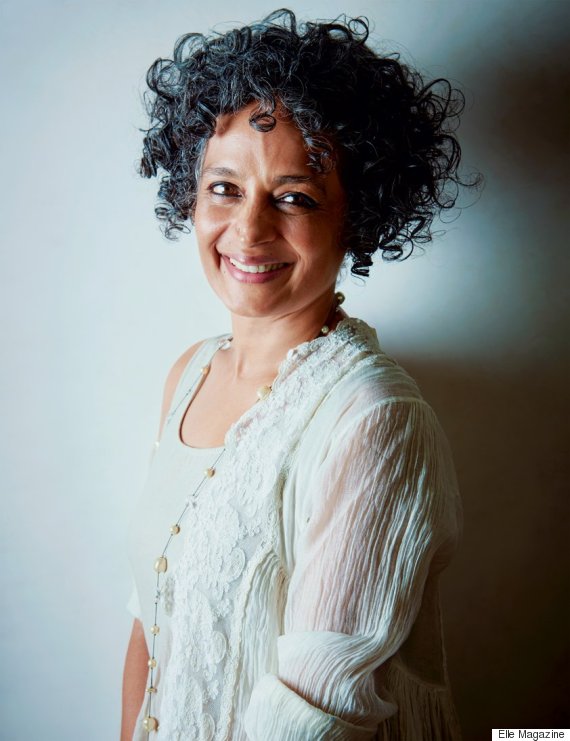
arundhati roy

Are you a disciplined writer?
I'm pretty disciplined. Insanely so right now because I'm working on a new book. I write every single day, at home, at my desk. Sometimes the day goes by and I haven't noticed. Suddenly I look around and it's dark. The only light there is comes from my computer screen. Last week I burnt a boiled egg and the pan it was in. My kitchen filled with smoke. Then this week I jumped up in a panic to take the egg off the fire only to realise there was no egg on the fire. A bit mad all this.
The new novel! We've all been waiting. When will it be published?
Next year, I hope.

Twenty years after The God Of Small Things. What should we expect?
Anything but The God Of Small Things II.
Why did you decide to write it now?
I didn't decide. It decided. I've been circling around it for years. I'm never in a hurry when it comes to fiction. I've done so much travelling and writing in the last 20 years that I feel like sedimentary rock, you know, so many layers of understanding, of things that cannot be expressed in any way other than fiction. You just sit there and all those layers of experience have to break down and become a part of your DNA, and then you sweat it out as prose.
Is your fiction autobiographical?
What counts as autobiographical? What counts as reality? Is something you imagined autobiographical? After all, you did experience it in your imagination... and that can be more real than reality? If you have an imagination that feels the pain or joy of others, is that autobiographical? I don't know. Given the great debates about identity and representation, this is a huge question, of huge consequence to a writer of fiction.

What is your writing process?
I become a little incoherent when I try to talk about it, because I'm not fully aware of what I'm doing. The structural way in which my narrative unfolds is extremely important to me. It's not just, oh here's this fascinating story and let me just...tell it. I don't write like that. But especially right now when I'm in it, I can't really theorise about it, I find it quite hard to explain or understand. I will say that it's very important to sit down and write, but I also think that the book is always there, you know? It's like music playing in your head. There's not a moment when it's not there, when I'm not thinking about in one way or another. It's a kind of obsession, I guess.
I will say that it's very important to sit down and write, but I also think that the book is always there, you know? It's like music playing in your head.

That does seem like an obsession.
When you feel owned by a story rather than you owning a story, you wait for it to let you know how it wants to be told; that engages every faculty of mine, and I am ceaselessly grateful for that. It's a beautiful thing. That doesn't necessarily mean you're writing something amazing--maybe not--but just that there is something in your life that can engage you completely. That's a gift. There is nothing in the world that delights me, engages me and exhausts me more than writing fiction. But most of the time I feel my main job is to concentrate and let the book write itself.

How about non-fiction?
My non-fiction is always written with urgency and a fair bit of anger. Every time I write a political essay I say, ok, I'm not writing another one.
And then you write another one.
Yeah, it's almost like something I always wish somebody else would write, you know. But I write it when I feel unable to contain it any longer, and then it just comes out in a rush. When I'm actually writing it, I can work 20 hours a day, with an insane kind of concentration.
You left home when you were 17. There was conflict with your mum?
It was impossible to live at home. At the time it was traumatic, but in many ways I'm lucky that I left home when I did. My mother is my creator and my destroyer. In her presence I'm chopped liver. She has created an amazing school, she's changed the lives of her students. Generations of them. I admire her for who she is, but I have to be careful to not get burnt by that. We're like two nuclear powers, we oughtn't be in close proximity for too long.
Are you close to her now?
We've signed a peace accord, and it's holding up. But if war breaks out, let me say clearly and unequivocally--I want her to win. I never want to defeat her.

It sounds like an extraordinary relationship.
It is, but it is not cute from any angle. Let's just say she's been very central to who I am, in positive ways, negative ways, every way possible. She's an extraordinary person, but doesn't have any of the motherly qualities women are supposed to have. And I don't know if I admire her for not having them or if sometimes I think, 'Why can't you be a little less weird?' But no, not really...
What kind of qualities?
The other day she called me and said, 'I went somewhere and they asked me if I was Arundhati Roy's mother, and I felt like I'd been slapped!' Half of me was laughing when she said that and the other half was saying, 'Come on, is it that bad?'
Ah, mothers.
She's also been very unwell all her life, you know, she has severe asthma. And someone who has asthma is controlled by their breath. And so was I--controlled by her breath. I grew up terrified that my mother would die on me. I watched every breath she took with terror and relief. I've spent a lot of time with her in hospitals. A few months ago, they told me they were putting her on a ventilator, it was that bad. And then she just bounced back, and now she's running the show again. Her empire is back in her hands. So she's Houdini, basically. An escape artist. My mother needs a book about her. By me. No one else can write it.
So she's Houdini, basically. An escape artist. My mother needs a book about her. By me. No one else can write it.
I'll be reading that. Who are the other women who have shaped your life?
When my mother left my dad, she moved from Assam to Ooty. She had no money and was so ill, she would just lie in bed and not be able to get up. My brother and I were three or four. She used to send us into town with a basket and a note and people would put vegetables and things in it. And then this lady, called Kurushammal, just moved into the house and took care of us. We don't know where she came from. And from then till about four years ago, she was with my mum. I went to see her recently, and we just hugged each other and howled. She did all the "normal" mother things for me. I loved her. She died a few days ago, she was 96. I am so glad I saw her.

arundhati roy
Are you and your brother close?
Extremely. He lives in Cochin. He's in the seafood industry. He's a prawn-broker! But I can't eat prawns. I'm allergic. 

You live quite a self-contained life, no? Does it get lonely?
I am part of a very wonderful and strange community of people who all live alone. That must never be confused with loneliness. I have deep, enduring friendships. We'd walk to the ends of the earth for each other. So yes, I live alone but my life is full of love. My relationship with Pradip, my former husband, and my girls Mithva and Pia, who lost their mother when they were very young, remains wonderful. I live alone because I wouldn't want to inflict my eccentricities on anyone else, nor would I want someone else to suffer the--often serious--consequences of what I write. If I didn't want to live alone, I wouldn't live alone. There's no dearth of...
No dearth of? Finish that sentence.
Oh, ha! Ha!
Why do you fight?
Let's just say there are people who find it easy to sidle up to power, and there are people who naturally have an adversarial relation to it, and I think that battle is what tilts the balance in the world. That's the line behind which I stand. Many people have fought long and remarkable battles to create the freedoms we have. How can we concede those spaces? How can we think that some natural phenomenon has gifted us these freedoms? No! They have been wrested, one by one. I get so annoyed when I hear "cool" young women say 'I'm not a feminist.'
Let's just say there are people who find it easy to sidle up to power, and there are people who naturally have an adversarial relation to it.
Do not get me started on this.
I mean, do they know what battles were fought? Every freedom we have today, we have because of feminists. Many women have fought and paid a huge price for where we are today! It didn't all come to us only because of our own inherent talent or brilliance. Even the simple fact that women have the vote, who fought for that? The suffragettes. No freedom has come without a huge battle. If you're not a feminist, go back to into your veil, sit in the kitchen and take instructions. You don't want to do that? Thank the feminists.
And freedoms can change.
It's wonderful to see the emerging independence of women in India, but then there's this dark undercurrent of conservatism running parallel to this revolution. Remember the women in Afghanistan? When we were growing up, they were doctors and surgeons, they partied and wore cool clothes. And now? We have to be alert to the dangers. We can be set back by centuries in no time at all.
How do you react to criticism?
I'm a very instinctive writer, and criticism of my writing for me is like people telling me my gall bladder's a funny shape or something.
Ha. And your non-fiction?
With my non-fiction, it's not easy to sift intelligent criticism from the knee-jerk idiocy and vitriol that goes around on the net. But I get the cut and thrust of it. People often say, "Arundhati Roy is a controversial writer." It's a way of not dealing with the argument. A more accurate statement would be "Arundhati Roy writes about controversial issues." The controversy is there. Are dams good? Should we be privatising everything? Should the whole of Bastar be handed over to corporates? I write about those things, I weigh in, I take a position, but I'm certainly not creating the controversy.
Have you ever found merit in the criticism of your work?
It cannot and will never be my case that I am above criticism. These are things that ought to be debated, and there may not necessarily be a right and wrong to them. Perhaps the way my work has evolved is in some ways the true measure of my response to criticism. But I haven't been persuaded to change my views on the big things.

Do you have to be very careful about what you say?
We are not a colony any longer, we are supposedly a free country, but can any of us say what Ambedkar said in 1936? Can any of us say, like he once did, 'To the untouchable, Hinduism is a veritable chamber of horrors?' What would happen if we said that? I think we are in a very dangerous place right now, I think it's important to be careful and thoughtful about what you say, but it's very important not to step back. We really must speak our minds. Now is the time. Otherwise it will be too late.
We are not a colony any longer, we are supposedly a free country, but can any of us say what Ambedkar said in 1936?
What is a day in jail like?
Memorable. Despite my bravado, when the gates slammed shut behind me, it was frightening. I went in as a convict, not with a group of comrades as part of a jail bharo andolan. Freedom and incarceration are two separate universes. But one day in jail is no big deal. There are thousands of people in jail right now for crimes they have not committed. Poor people, Dalits, Muslims and in particular, Adivasis. We are a country at war against the poor and downtrodden.
Do you eat beef? I myself enjoy a good steak.
I eat beef. I eat pork. This food fascism in our country must stop.
You also go to the gym every day.
Yeah, every day.
Every single day. 
Every single day.
See, this is a foreign concept to me.
Well I do have the genes of an addict, you know, my father was an alcoholic. I keep meaning to go lay a bottle of good whisky on his grave. Fortunately this may be how his addict's gene is manifested in me.

Have you always been this way about exercise?
I didn't have a tragic childhood, but I had a very disturbing one. I dealt with it by running. I ran and ran and ran. Around the house, around the school playground... I recently met my old PT instructor, Mr Selvapakiam. He would only train the boys in school, but I hung around him and he paid me some attention. I'm not some star athlete. I don't go to the gym to suffer. I am suspicious of people who volunteer to suffer. I go for sheer pleasure.
You are not making any sense.
We are an old gang of friends and trainers, you see. There's just so much love there. It's the high point of my day, and it keeps me sane. It's a place of love and friendship and laughter and sweat.
You used to be an aerobics instructor, no?
Yes, in my broke days. There was me and this other trainer, a beautiful woman called Sushma. She was a weightlifter, so strong and fabulous. All these lalajis would come to our class to see the women in gym gear, and we used to mess with them. Once this one guy got so exhausted, he lay down in the back of the class and I got nervous, I thought he had died. I saw the news report in my mind's eye--Lalaji leching ke liye aaya tha, stretcher mein chala gaya.

Man, you need to be on Twitter. Why aren't you on Twitter?
Because I'm hoarding myself. I'm trying to fold everything I have into a novel. I want to be a secret. I can't disperse myself on Twitter.

Let's talk fashion. You wear a lot of péro and Eka.
I don't think of them as labels, any more than I think of myself as The God of Small Things. I think of them as Aneeth [Arora] and Rina [Singh]. My friends. I've known Aneeth's work for years, long before she called it péro. As soon as I could afford her clothes, I bought them. Some are more than 15 years old and I still wear them--they're my best clothes, Aneeth's and Rina's. I think both of them are part of trying to craft a new aesthetic for us--the modern women of Here.
I want to be a secret. I can't disperse myself on Twitter.
That's a lovely way of putting it.
It's very important. How do you make modernity out of a unique heritage in fabric and style? We're not the kind of women who are about to go around in little black dresses (though I have nothing at all against them), nor do we want to only wear saris and salwar kameez, although I love wearing saris. So how should we dress? What should we wear? Clothes, the way I dress, it's fun, it gives me a great deal of pleasure, and it's political too.
Political how?
When I was studying architecture it was a question that was constantly on my mind, this play between tradition and modernity. What should genuinely modern architecture in this part of the world look like? In my younger years all I ever wanted to do was escape the clutches of tradition and all that it had in store for me. Then you come up against the hideous monster of acceptable modernity and you turn and flee from that too. So what I wear, I think, tells the story of this flux. Style is important. Let nobody say it isn't. Yes, it's a slightly delicious excess, and I'm grateful I can afford it. Fortunately I don't do the jewellery thing... my whole wardrobe wouldn't cost as much as a pair of diamond earrings. My clothes are a lovely indulgence. And I must have some indulgences.

Was it a huge relief to finally have money after not having any for so long?
It was, to a point. But it took me a long time to come to terms with it. I felt extremely guilty and extremely complicated about it.
I was thrilled when I won the Booker, of course I was.
But why? You earned it.
Yes, but you think, there has to be a limit. I didn't have those simple, happy, victorious, joyful feelings. You know, "I'm Miss Universe now, and I'd like to thank my mother and my agent and Jesus Christ." It was a mindfuck for me, for a long time. Sure I needed to earn a little money, but what I got was just... too much. It wasn't something that was ever part of my imagination, you know. That kind of fame, that kind of money. I mean, by my standards. For somebody who used to hire a cycle for one rupee a day to go to work.
You wrote a great novel.
I was thrilled when I won the Booker, of course I was. But I remember, the night I won I had this weird dream that a bony, emerald hand had reached into the water in which I was swimming--I was a fish, swimming with other fish--and the hand lifted me out of the water and a voice said, 'I'll give you anything you want, what do you want?' and I said, 'Put me back!' I was terrified that my life would change... explode. And it did. I knew this militantly political person in me would have to come out, she would have no place to hide. I'd pay a heavy price in my personal life. That happened. But over time I've learnt how to deal with it and what to do with it, so now I'm not traumatised. But I was, I'll admit.
And the fame? Do you find yourself accosted at airports?
Yes, it's always done very respectfully, but it's still exhausting. I don't want to complain about it, but these days there's this obsession with selfies, as if it's everyone's right to have a selfie with you. It's an epidemic. Also there have been moments when I was scared. This JNU thing was happening, and the shouting anchors were shouting about me on TV... it can be dangerous.

Are you anti-national?
I'm on the A-list of anti-nationals.
Are you religious at all?
No, I'm not religious in the normal sense. But I'm not a hardcore Marxist who explains everything through class struggle either. I do believe that's a very important way of analysing society, but I don't believe that that's all there is to it. I think I believe, like Proust, in the possibility of everything. I believe that everything, even inanimate things, have a spirit. The closest I've come to prayer is writing fiction. Just being able to lavish my attention on something and feeling grateful that there is something, that I have something that I can completely concentrate on and adore, that's like a prayer to a higher power.
No, I'm not religious in the normal sense. But I'm not a hardcore Marxist who explains everything through class struggle either.
Does death frighten you?
Not death so much as illness and infirmity. I've spent a lot of time in hospitals, around illness... other people's illnesses. There's a rocking chair here, it's the most sentimental thing in my house. One of my dearest friends gave it to me. She died of cancer. When the cancer reached her brain and we both knew the end was near, I went with her to the hospital, to ask the doctor to tell us how the end would come, and how best to meet it. The doctor told her that her brain would shut down in a couple of weeks' time. So the next day she came home to me for lunch and brought along this beautiful little chair she knew I loved. She said, "This is yours, I want it to be here. And right now I want you to sit in it and read a chapter from your new book to me, while I still have a brain. I want a bit of your book in me when I go wherever I'm going." She died. And her death made death a little less frightening. I thought if she can do it, so can I... but illness is terrifying.

What should we all be afraid of?
Civil war. In 1925, an organisation called the RSS was created. Its only goal was that India should become a Hindu rashtra. Today that organisation is in a position to dictate government policy. Look what has happened in Pakistan when it declared itself to be an Islamic republic. It's been torn apart by various people deciding what is "true Islam" and what is not. India is an even more complex and diverse society. Hindu rashtra will never be accepted in this country. If they push it down our throats, we will fall apart.

What are you reading now?
I'm reading a book called Chernobyl Prayer by Svetlana Alexievich. It's such a beautifully written book, it's been years since I had to look away from a page because it was just too heartbreaking to go on. Give me beautiful prose and I'll follow you anywhere.
Literary favourites?
Shakespeare, Kipling, Rilke... masters of sentences that can be sung. I'm a whore for beautiful prose. Prose that can be chanted. Almost any line of Shakespeare can still give me goosebumps. Or Nabokov. And John Berger, what a beauty. James Baldwin. Toni Morrison.
Essential reading for everyone?
In India I'd say it should be the writings of Dr BR Ambedkar and Jyotirao Phule. I think caste is a cancer in Indian society. And unless we address it, we will remain a rotten society.
I don't agree with much of what he [Kanhaiya Kumar] says, but I love the way he says it.
What do you think of Kanhaiya Kumar?
I don't agree with much of what he says, but I love the way he says it. And I love that when he came out and gave that speech, it was exhilarating. It lifted a fog of fear that had fallen on so many people. I like his spirit. I don't want everyone to march in line and say exactly what I say and believe exactly what I believe, you know. It's what I call a biodiversity of resistance.
What can we do to change the world?
Find out where you fit in. The battles are ongoing.
Is there any hope?
I don't think hope is necessarily moored to reason. Sometimes hope is a small thing. Sometimes I just look forward to the next sentence I write that I can be happy with. There's the macro scenario--climate change, nuclear war and so on... and then there's the micro scenario. When the bleakness of the big picture begins to get to me, I scale down, I become a frog trying to cross a highway full of trucks. It can be done. Look right, look left... Go! Go! Go! And live to fight another day.

National Mission for a Green India (GIM)

Introduction

The National Mission for Green India (GIM) is one of the eight Missions outlined under the National Action Plan on Climate Change (NAPCC). It aims at protecting; restoring and enhancing India’s diminishing forest cover and responding to climate change by a combination of adaptation and mitigation measures. It envisages a holistic view of greening and focuses on multiple ecosystem services, especially, biodiversity, water, biomass, preserving mangroves, wetlands, critical habitats etc. along with carbon sequestration as a co-benefit. This mission has adopted an integrated cross-sectoral approach as it will be implemented on both public as well as private lands with a key role of the local communities in planning, decision making, implementation and monitoring.

Mission Goals

  • To increase forest/tree cover to the extent of 5 million hectares (mha) and improve quality of forest/tree cover on another 5 mha of forest/non-forest lands;
  • To improve/enhance eco-system services like carbon sequestration and storage (in forests and other ecosystems), hydrological services and biodiversity; along with provisioning services like fuel, fodder, and timber and non-timber forest produces (NTFPs); and
  • To increase forest based livelihood income of about 3 million households.

Convergence          

Green India Mission hinges upon convergence with related Missions of the National Action Plan on Climate Change, other complementary National Mission Programmes and schemes for better coordination in developing forests and their fringe areas in a holistic and sustainable manner. The coherent approach involving contribution from converging partners intends to saturate the landscapes with essential need-based interventions at a faster pace. Also the convergence aims at optimizing efficient use of resources and avoidance of contrast activities which can disturb the balance in the ecosystem due to lack of coordination between different schemes.

As a first step towards translation of these efforts into action, Green India mission has issued the Convergence Guidelines of GIM with MNREGS. Efforts are on to finalize convergence guidelines with other complimentary schemes to set out the approach for coordination at field level.

Convergence guidelines of GIM with CAMPA have been framed to ensure a synergized approach which is required to address the challenges being faced in environment, forest and wildlife sector thereby contributing to ecological security in the context of climate change.

Thursday, June 30, 2016

Project Mausam: Maritime Routes and Cultural Landscapes

Project ‘Mausam’ is a Ministry of Culture project to be implemented by Indira Gandhi National Centre for the Arts (IGNCA), New Delhi as the nodal coordinating agency with support of Archeological Survey of India and National Museum as associate bodies.

Project Launch

The unique idea of this project to showcase a Transnational Mixed Route (including Natural and Cultural Heritage) on the World Heritage List has been well appreciated during the Project Launch by India at the 38th World Heritage Session at Doha, Qatar on 20th June, 2014. The Director General UNESCO appreciated India’s initiative in launching this unique project and ambassadors of several countries including China, UAE, Qatar, Iran, Myanmar, and Vietnam expressed great interest in this multifaceted cultural project. (ATTACH VIDEO)

About the Project

Focusing on monsoon patterns, cultural routes and maritime landscapes, Project ‘Mausam’ is examining key processes and phenomena that link different parts of the Indian Ocean littoral as well as those that connect the coastal centres to their hinterlands. Broadly, Project ‘Mausam’ aims to understand how the knowledge and manipulation of the monsoon winds has shaped interactions across the Indian Ocean and led to the spread of shared knowledge systems, traditions, technologies and ideas along maritime routes. These exchanges were facilitated by different coastal centres and their surrounding environs in their respective chronological and spatial contexts, and simultaneously had an effect on them.
The endeavour of Project ‘Mausam’is to position itself at two levels:
  • At the macro level, it aims to re-connect and re-establish communications between countries of the Indian Ocean world, which would lead to an enhanced understanding of cultural values and concerns;
  • At the micro level, the focus is on understanding national cultures in their regional maritime milieu.
The Project scope falls under several themes to be explored through various UNESCO Culture Conventions to which the Government of India is a signatory with the Ministry of Culture and ASI as nodal agency.

Initiatives till date

Preliminary works on this new project has already been initiated. A monthly lecture series has been organized at India International Centre (IIC), New Delhi in collaboration with IGNCA, National Monuments Authority (NMA), New Delhi and IIC. The first international conference, scheduled in February 2015, is being organized with national and international research partners and collaborators. The Research Unit at IGNCA is in the process of collating data from all identified organisations and institutions and a series of national workshops are planned before the international conference in Feb. 2015. IGNCA has set up a webpage for the Project and more information about the project can be sourced at 

Tuesday, June 28, 2016

Aditya - L1 First Indian mission to study the Sun

The Aditya-1 mission was conceived as a 400kg class satellite carrying one payload, the Visible Emission Line Coronagraph (VELC) and was planned to launch in a 800 km low earth orbit.  A Satellite placed in the halo orbit around the Lagrangian point 1 (L1) of the Sun-Earth system has the major advantage of continuously viewing the Sun without any occultation/ eclipses.  Therefore, the Aditya-1 mission has now been revised to “Aditya-L1 mission” and will be inserted in a halo orbit around the L1, which is 1.5 million km from the Earth.  The satellite carries additional six payloads with enhanced science scope and objectives.


Image credit: Udaipur Solar Observatory – PRL (Ground-based)
The project is approved and the satellite will be launched during 2019 – 2020 timeframe by PSLV-XL from Sriharikota.
Aditya-1 was meant to observe only the solar corona.  The outer layers of the Sun, extending to thousands of km above the disc (photosphere) is termed as the corona.  It has a temperature of more than a million degree Kelvin which is much higher than the solar disc temperature of around 6000K. How the corona gets heated to such high temperatures is still an unanswered question in solar physics. 
 Aditya-L1 with additional experiments can now provide observations of Sun's Photosphere (soft and hard X-ray), Chromosphere (UV) and corona (Visible and NIR).  In addition, particle payloads will study the particle flux emanating from the Sun and reaching the L1 orbit, and the magnetometer payload will measure the variation in magnetic field strength at the halo orbit around L1.   These payloads have to be placed outside the interference from the Earth’s magnetic field and could not have been useful in the low earth orbit.

Lagrange Points: Parking Places in Space


A Lagrange point is a location in space where the combined gravitational forces of two large bodies, such as Earth and the sun or Earth and the moon, equal the centrifugal force felt by a much smaller third body. The interaction of the forces creates a point of equilibrium where a spacecraft may be "parked" to make observations.
These points are named after Joseph-Louis Lagrange, an 18th-century mathematician who wrote about them in a 1772 paper concerning what he called the "three-body problem." They are also called Lagrangian points and libration points.   
There are five Lagrange points around major bodies such as a planet or a star. Three of them lie along the line connecting the two large bodies. In the Earth-sun system, for example, the first point, L1, lies between Earth and the sun at about 1 million miles from Earth. L1 gets an uninterrupted view of the sun, and is currently occupied by the Solar and Heliospheric Observatory (SOHO) and the Deep Space Climate Observatory. 

L2 also lies a million miles from Earth, but in the opposite direction of the sun. At this point, with the Earth, moon and sun behind it, a spacecraft can get a clear view of deep space. NASA's Wilkinson Microwave Anisotropy Probe (WMAP) is currently at this spot measuring the cosmic background radiation left over from the Big Bang. The James Webb Space Telescope will move into this region in 2018.
The third Lagrange point, L3, lies behind the sun, opposite Earth's orbit. For now, science has not found a use for this spot, although science fiction has.
“NASA is unlikely to find any use for the L3 point since it remains hidden behind the sun at all times,” NASA wrote on a web page about Lagrange points. “The idea of a hidden 'Planet-X' at the L3 point has been a popular topic in science fiction writing. The instability of Planet X's orbit (on a time scale of 150 years) didn't stop Hollywood from turning out classics like 'The Man from Planet X.'”
L1, L2 and L3 are all unstable points with precarious equilibrium. If a spacecraft at L3 drifted toward or away from Earth, it would fall irreversibly toward the sun or Earth, "like a barely balanced cart atop a steep hill," according to astronomer Neil DeGrasse Tyson. Spacecraft must make slight adjustments to maintain their orbits.
Points L4 and L5, however, are stable, "like a ball in a large bowl," according to the European Space Agency. These points lie along Earth's orbit at 60 degrees ahead of and behind Earth, forming the apex of two equilateral triangles that have the large masses (Earth and the sun, for example) as their vertices.
Because of the stability of these points, dust and asteroids tend to accumulate in these regions. Asteroids that surround the L4 and L5 points are called Trojans in honor of the asteroids Agamemnon, Achilles and Hector (all characters in the story of the siege of Troy) that are between Jupiter and the Sun. NASA states that there have been thousands of these types of asteroids found in our solar system, including Earth’s only known Trojan asteroid, 2010 TK7.
L4 and L5 are also possible points for a space colony due to their relative proximity to Earth, at least according to the writings of Gerard O'Neill and related thinkers. In the 1970s and 1980s, a group called the L5 Society promoted this idea among its members. In the late 1980s, it merged into a group that is now known as the National Space Society, an advocacy organization that promotes the idea of forming civilizations beyond Earth.
If a spacecraft uses a Lagrange point close to Earth, there are many benefits to the location, the Jet Propulsion Laboratory's Amy Mainzer told Space.com. 
Mainzer is principal investigator of NEOWISE, a mission that searches for near-Earth asteroids using the Wide-field Infrared Survey Explorer (WISE) spacecraft that orbits close to our planet. While WISE is doing well with its current three-year mission that concludes in 2016, Mainzer said, a spacecraft placed at a Lagrange point would be able to do more.
Far from the interfering heat and light of the sun, an asteroid-hunting spacecraft at a Lagrange point would be more sensitive to the tiny infrared signals from asteroids. It could point over a wide range of directions, except very close to the sun. And it wouldn't need coolant to stay cool, as WISE required for the first phase of its mission between 2009 and 2011 — the location itself would allow for natural cooling. The James Webb Space Telescope will take advantage of the thermal environment at the sun-Earth L2 point to help keep cool.
L1 and L2 also “allow you to have enormous bandwidth” because over conventional Ka-band radio, the communication speeds are very high, Mainzer said. “Otherwise, the data rates just become very slow,” she said, since a spacecraft in orbit around the sun (known as heliocentric orbit) would eventually drift far from Earth.
Reference Editor Tim Sharp contributed to this article.

Importance of NSG membership

Membership of the NSG means:
1. Access to technology for a range of uses from medicine to building nuclear power plants for India from the NSG which is essentially a traders’ cartel. India has its own indigenously developed technology but to get its hands on state of the art technology that countries within the NSG possess, it has to become part of the group.
2. With India committed to reducing dependence on fossil fuels and ensuring that 40% of its energy is sourced from renewable and clean sources, there is a pressing need to scale up nuclear power production. This can only happen if India gains access to the NSG. Even if India today can buy power plants from the global market thanks to the one time NSG waiver in 2008, there are still many types of technologies India can be denied as it is outside the NSG.
3. India could sign the Nuclear non proliferation treaty and gain access to all this know how but that would mean giving up its entire nuclear arsenal. Given that it is situated in an unstable and unpredictable neighbourhood India is unlikely to sign the NPT or accede to the Comprehensive Test Ban Treaty (CTBT) that puts curbs on any further nuclear tests.
4. With access to latest technology, India can commercialize the production of nuclear power equipment. This, in turn will boost innovation and high tech manufacturing in India and can be leveraged for economic and strategic benefits.
For example, India has signed a civil nuclear energy co-operation pact with Sri Lanka. Currently, this entails training people in peaceful uses of nuclear energy, including use of radioisotopes, nuclear safety, radiation safety, nuclear security, radioactive waste management and nuclear and radiological disaster mitigation. Should India get access to advanced nuclear technologies, it can start building updated versions of its own fast breeder reactor and sell it to countries such as Sri Lanka or Bangladesh. Bangladesh is currently looking at buying Russian reactors for power generation.
5. Having the ability to offer its own nuclear power plants to the world means spawning of an entire nuclear industry and related technology development. This could give the Make in India programme a big boost.
6. Should India get membership to the NSG, it can block Pakistan from its membership as entry into the grouping is by consensus only. This is one of the reasons why China is pushing to include Pakistan as well as pointing out that India as a non signatory to the NPT cannot be a member. It comes down to a power game—keep India out and deny it access to various technologies. India’s contention is that its nuclear technologies are indigenously developed and it has a clean non proliferation record unlike Pakistan whose non proliferation record was tainted with the revelations that its nuclear scientist A.Q Khan sold nuclear technologies to countries such as North Korea. China’s non proliferation record too is tainted with allegations that it has helped Pakistan on the sly, but given its economic clout the country is unlikely to attract sanctions.

Friday, June 17, 2016

Weakening the watchdog

Appointing MLAs as Parliamentary Secretaries has been usual in the past. Along with Delhi government, several other states have been following this. However, with President of India recently declining assent to Delhi govt’s bill on appointment of parliamentary secretaries, the issue has come to the fore once again.
Background:
The Delhi government had in March last year appointed 21 of its MLAs as parliamentary secretaries in various ministries to speed up public work.
  • Following criticism by members of the opposition, who called it unconstitutional, the government passed a bill was which intended to provide security cover for those legislators appointed as parliamentary secretaries.
  • Through the bill, the Delhi government had sought an amendment to the Delhi Members of Legislative Assembly (Removal of Disqualification) Act, 1997. The bill aims to exclude the post of parliamentary secretary from the office of profit and exempt the post from disqualification provisions.
  • The bill was forwarded by lieutenant governor Najeeb Jung to the centre, which in turn was sent to the President with its comments.
What’s the issue now?
At the time of their appointment, the government had said that parliamentary secretaries will not receive any remuneration or perks from the government. But later on, they were allowed use of government transport for official purposes and space in minister’s office. Hence, few people criticized this move and called it unconstitutional.
Who is a parliamentary secretary?
A Parliament Secretary is similar to a Minister of State who assists a Minister in his or her duties.
Why President did not give his assent to the Bill?
The President takes note of Section 15 of the government of NCT of Delhi Act, 1991. It says a person shall not remain an MLA if he or she holds any office of profit under the Centre or government of a state or UT. Also, according to the president, parliamentary secretaries come under the purview of `office of profit’ criteria. Besides, the Lt Governor had said the office of parliamentary secretary is defined as an “office of profit if one looks at the statutes of Delhi” and that as per the GNCT Act, the city can haveonly one parliamentary secretary attached to the office of the Chief Minister.
Constitutional provisions:
Experts argue that the post of parliamentary secretary is in contradiction to Article 164 (1A) of the Constitution which provides for limiting the number of Ministers in the State Cabinets to 15% of the total number of members of the State Legislative Assembly. But, the number ofCabinet Ministers in Delhi cannot exceed 10% of the total 70 seats — that is seven — as perArticle 239AA of Constitution.
Why appointing MLAs as Parliamentary Secretaries is not a good move?
  • The idea of modern republics is that no particular organ of state should have a concentration of powers. Different institutions act as a check on the actions of others. However, this move weakens the power of legislative bodies by governments, and thus weakens the principle of separation powers.
  • The idea is that every legislator should be able to carry out legislative duties without any obligation to the government of the day. The latest move is in contradiction with this principle.
  • This move raises questions over the ability of the Assembly to exercise its oversight role over the government. An argument has been made that these parliamentary secretaries will be able to aid the government in being more responsive to citizens’ needs. That argument, however, misses the point of separation of powers. The role of legislators is not to help the government do its job better, but to ensure that it functions in a proper manner. That is, the legislator exercises the role of a watchdog over the government on behalf of citizens and not as an agent of the government.
How Delhi government defends its move?
The Delhi government has based its defence on exemptions. The Constitution specifies that state Legislative Assemblies have the power to enact laws and keep certain offices out of the preview of Office of Profit. The Delhi government argues that as Parliamentary Secretaries are not eligible for any remuneration or perks from the government the post should be exempt from the office of profit.
How is ‘Office of Profit’ defined?
The concept of office of profit finds place in Articles 102 and 191 of the Constitution, which state that an MP or MLA will be disqualified if he or she occupies such an office. The Constitution also recognises that there may be other cases where exceptions may be required and allows Parliament and State legislatures to make exemptions by passing a law. In several cases, courts have examined this issue and concluded that the key question is whether occupation of such office will make a legislator beholden to the executive.
In general, a person is considered to hold an office of profit if four conditions are met:
  1. He holds an office.
  2. The office is one of profit, that is, it carries some benefits.
  3. The office is under the control of the Central or the State government.
  4. The office is not that of a Minister or exempted by an Act of Parliament or State legislature.
Can MLAs be disqualified even if they haven’t received remuneration?
In the Jaya Bachchan vs Union Of India case, the Supreme Court in May 2006 had dismissed actress-turned-politician Jaya Bachchan’s petition challenging her disqualification as Rajya Sabha MP by President A P J Abdul Kalam on the recommendation of the Election Commission for holding an office of profit.
It said that the law on this issue is settled since 1954 and what is material is not whether the person actually received any remuneration or pecuniary gains, but whether the office he or she holds is itself of profit.
Similar cases:
Because a Parliament Secretary often holds the rank of Minister of State, the Calcutta High Court, in June 2015, quashed the appointment of 24 Parliamentary Secretaries in West Bengal dubbing it unconstitutional.
  • Similar action was taken by the Bombay High Court in 2009 for the appointment of two Parliamentary Secretaries in Goa and by the Himachal Pradesh High Court in 2005 for the appointment of eight Chief Parliamentary Secretaries and four Parliamentary Secretaries in the State.
  • In May 2015, the Hyderabad High Court stayed the appointment of Parliamentary Secretaries in Telangana. The matter is sub judice in Punjab and Haryana.
What happens if this bill is not approved?
The President’s decision is a major setback to the Kejriwal government and leaves the AAP MLAs a few steps from possible disqualification. In the event of disqualification of the AAP MLAs, by-election to nearly one–third of the seats currently held by the ruling party will be necessitated. Such a development will follow only after the EC completes its proceedings on a petition seeking the disqualification of the MLAs.
What can be done now?
The legislator can escape disqualification only if the office is declared -by law made by Parliament, state legislature or UT -as a post that does not attract loss of membership. The fate of the MLAs will now be decided by the Election Commission that is considering a petition seeking their disqualification.
Conclusion:
The role of legislators is critical in a democracy. They are elected by citizens, and have the task of ensuring that the government is acting in the best interests of the public. In this, they are expected to exercise their independent judgements on what constitutes public and national interest. They act as a bulwark against autocratic actions of the executive. Therefore, it is imperative that their independence is protected. Actions that impinge on such independence, such as excessive appointments to executive positions, the anti-defection law and MPLADS, should be reversed. Otherwise, there is a risk of a slow erosion of the institution of legislatures, which could put at risk the very existence of our republic. Our Supreme Court has recognised separation of powers as part of the basic structure of the Constitution, and can therefore strike down even amendments to the Constitution that infringe upon this principle.

Staying power of the pass-fail system


Once again, it is that time of the year when the examination results season may be just ending and the admissions season is in progress, and marked by a cacophony of two contradictory voices — often from the same people — that rose to deafening levels from April to May when the results of various school boards were declared. The first voice celebrated those who succeeded and did wondrously well. Newspaper articles were published on which sections of students did better than the other. Did girls do better than the boys? Did school system ‘X’ do better than school system ‘Y’? Pictures of individual students who topped the examinations were published and their parents, teachers and schools eulogised. Once the general ‘results fever’ subsided, this shrill voice was echoed by private schools which claimed to have taught some of the toppers, with their posters appearing in every possible place, from roadside electric poles to walls.
In general, this celebration of success in an examination goes on for the whole year, till the next results season when the old faces are replaced with new ones to valorise.
Pressure of expectations
More importantly, the second voice is one of lamentation as many students, wilting under stress and pressure, burn out and even commit suicide in this season, simply because they could not fulfil their parents’ expectations.
The loss of these young, and often bright, people must make us ponder. They have moved up all the way from nursery class to high school to fulfil their parents’ ambitions of seeing them grow into engineers, doctors or managers graduating from the so-called top-level institutions in the country. These children must have seen themselves only as exam-cracking “achievers” in order to make their parents happy. They lost out on their childhood play and free time; no pranks with their friends and no experience of the simple joy of just being a carefree child. This loss would have led to a narrow vision of human life guided by the all-important value of “success”; which is just defined as getting a top job. Period. These children, deprived of social development and trapped in an artificially developed world, choose death over struggle when that world suffers a rude shock with exam results that are less than expected.
There is very little recognition that the first voice I talked about creates a powerful environment wherein the trait of parents imposing their ambitions on the children becomes dominant. When they do not turn out to be as successful as their parents want them to, they fade away. This problem has two sides to it: the first is the examination-oriented Indian education system, and the second is competitive and cruel parents.
The ‘crushing weight of exams’
About 80 years ago, the Zakir Hussain report on National Basic Education noted that the “system of examinations prevailing in our country has proved a curse to education”. It pinpointed the malady by saying that a bad system is made worse by awarding examinations a place much beyond their utility. The problem, however, is much older than stated in the Zakir Hussain report.
For this, one has to go back as early as 1904 to the Indian Educational Policy issued by the then Governor General. This colonial document had a section titled “The abuse of examinations” and noted that “[e]xaminations, as now understood, are believed to have been unknown as an instrument of general education in ancient India”. It also claimed that examinations did not have a prominent place even in the Despatch of 1854, commonly known as Wood’s Despatch. The Hunter Commission report of 1882-83, which left examinations and promotions to the next class up to standard eight entirely to the schools, did not recommend any province-level or board exemptions. Still, the educational policy of 1904 noted that examinations had “grown to extravagant dimensions, and their influence has been allowed to dominate the whole system of education in India, with the result that instruction is confined within the rigid framework of prescribed courses, that all forms of training which do not admit of being tested by written examinations are liable to be neglected”. It further noted that the system was adopted on the precedence of English education which itself has “finally condemned” it; however, in India, it was proving to be “disastrous in its influence” on education. The policy recommended reforms that included abandoning public examination at the primary level, “more equitable tests of efficiency”, and “to relieve the schools and scholars from the heavy burden of recurring mechanical tests”.
The Indian Educational Policy of 1913 declared victory and stated that “the formerly crushing weight of examinations has been appreciably lightened”. It further declared that the “principal objects of the school final examination are adaptability to the course of study and avoidance of cram”.
All this shows that the devastating effects of this “curse to education” have been known quite well for over 100 years. There is no commission or committee report after Independence which does not acknowledge the burden of rote learning and the examination system on its students and its futility in assessing their real abilities. They all recommend examination reforms. The recent attempts, after Right to Education (RTE) stipulation, of no pass-fail and no board examinations till completion of elementary education in favour of a continuous and comprehensive evaluation (CCE) are well known.
However, the public education system has completely failed to implement these reforms and the private schools have never paid much attention to them. We have now reached a stage where no one in the country knows how the CCE can be implemented, and how we can measure progress of the child without pass-fail systems. Therefore, there has been a concerted effort to discard this half-hearted foraging into unknown territory as soon as the present government came to power at the Centre. The result is that many States have gone back to their familiar pass-fail system and board examinations at the end of eighth standard if not earlier.
Nexus of forces
The question that stares us in the face is, how is it that we haven’t cleansed our education system of a curse that has been well known for over a hundred years? There is never a single factor behind the persistence of such problems; it always has to be a nexus of forces. Some of the factors that lie within the education system are often mentioned. The lack of seriousness, of resources, teachers untrained in new methods, etc. form the routine list. One reason rarely mentioned is the inconsistency between the prevailing grade-wise curriculum and school structure on the one hand and the idea of progress on the learning continuum inherent in the CCE on the other. The CCE does not suit our authoritarian school organisation, administration and syllabus organisation.
But it seems that the biggest force behind the persistence of this curse and useless examination system is a social one which is grossly under-examined. We are a caste-based and strictly hierarchical society. In earlier times, this hierarchy had the iron-clad stability of the caste system. That determined the place, function, work and life of an Indian even before his/her birth. There are attempts now, which range from constitutional rights to political struggle, to break that mould. It may not have been dismantled yet, but is under tremendous pressure ever since the freedom movement began.
But social hierarchies involve privileges, prestige and goods of life that are cherished by all. None is ready to let go of the privileges one has. As a result, the attempts to maintain the old hierarchy as well as the ways to challenge it look toward education. Education, therefore, becomes a means of fierce competition either to remain in one’s position of privilege or to rise in the hierarchy. It completely stops being a self-motivated way of forming an authentic self and gaining an understanding of the world, and is reduced to a means to beat/best the neighbour. A more open and thoughtful system of education will challenge the hierarchies which are so dear to a caste-minded Indian. The result is that the authoritarian system of pass-fail stays.
The stand of intellectuals
One wonders why the intellectuals in Indian society, and who understand the ills of this education system and the implied curse of examinations, don’t make a beginning to dismantle it. The answer perhaps lies in the often noticed phenomenon of the very people who write scathing papers and offer opinion on the ills of the current examination system, hold seminars and give keynote addresses on it in conferences, taking leave and cancelling all their engagements to be at hand when their own children are to appear in the standard 10 and 12 board examinations. Interpreting this contradiction as a simple lack of commitment to ideals is a superficial understanding even if it has an element of truth. The malady is deeper. In spite of being convinced of the “truth” of their analysis of the education system and the ills of examinations, they see the possibility of privileges their children will get through success in these very examinations; and the dangers of losing the positions achieved by themselves.
To face this situation one requires courage of conviction which scholar Alberuni noted a thousand years ago, albeit in the context of religion, that Indians don’t have. In the context of theology Alberuni notes: “at the utmost, they [Indians ] fight with words, but they will never stake their soul or body or their property in religious controversies”. Not putting at stake their soul, body and property in religious disputes may be considered a welcome openness; but it seems this tendency is applicable to all ideas that might bring change. Indians don’t stake their property and position on ideas that may collide with the existing system. Unfortunately, no change in the system is possible without there being a critical number of people in society who are ready to pay the price to make a beginning. We don’t seem to have that critical number yet. And till we reach that number, our children will continue to commit suicide and their parents will continue to disown the responsibility to push them to do it. And we will all continue to blame the rigid system without noticing that its roots are in our own souls.

Rohit Dhankar is Professor and Director Academic Development, Azim Premji University, Bangalore and Academic Adviser, Digantar, Jaipur.

Saturday, June 11, 2016

India’s only double coconut tree artificially pollinated


                           The palm species bears largest seed known to science


Scientists at the Indian Botanical Garden in West Bengal’s Howrah district have carried out artificial pollination of the only double coconut tree in India, which bears the largest seed known to science.
One of the rare and globally threatened species of palm, the double coconut (Lodoicea maldivica) tree was planted at the botanical garden in 1894 and the artificial pollination is a result of decades of work by scientists of the Botanical Survey of India (BSI).
“The tree took almost a hundred years to mature and when it started flowering, we started looking for this particular palm species in this part of world. We collected some pollen from palms from Sri Lanka but could not successfully pollinate it. Finally, with the help of pollen from another tree in Thailand, the pollination process was successful,” BSI Director Paramjit Singh told The Hindu.
Longest surviving palm
The Double Coconut tree not only bears the largest seed known to science — weighing around 25 kg — but this unique species is also the longest surviving palm which can live for as long as 1,000 years, he says. The palm tree also bears the largest leaf among palms and one leaf can thatch a small hut.
“Successful pollination means that we can have another Lodoicea maldivica in the country. In fact we have two fruits and it might take them another couple of years to mature,” said S.S. Hameed, BSI scientist who has been working on the pollination project since 2006.
This species of palm is diecious (where male and female flowers are borne on different plants). “Fortunately at the Botanical Garden, we had the female plant which can fruit and produce seeds,” Mr. Hameed said. The Indian Botanical Garden which serves as the repository 12,000 trees from 1,400 different species is careful in nurturing the palm.
The palm tree is located in the large palm house of the Botanical Garden which has the largest collection of palms in South East Asia with around 110 palm species.
This rare tree can be found in only two of the 115 Seychelles islands and is also called Coco de Mer (coconut of the sea), says Mr. Hameed
Legend
Legend bestows the seed with the power to bring good fortune to its owners. “There has also been a tradition of making kamandals [drinking vessels] from the double coconut by bisecting the shell. It was believed that those who consume water from these kamandals will be protected from poisoning,” Mr. Hameed said. Subsequently, sadhus started using Kamandals and it got its place in religious rituals.

CBIT

Transparency forms the bedrock of climate change actions, CBIT (Capacity building initiative for transparency fund) is an outcome of the UNFCCC's Paris agreement in 2015 and expected to address the issue of transparency
Objectives:
# To help developing countries monitor and report the progress on their climate actions
# Strengthening of national institutions of participating members in transparency related activities with respect to the Nationally Determined Contributions
Design:
# The fund will be set up by the GEF, with financial support from the developed nations like US, UK, Canada etc
# World Bank has been requested to act as the trustee for the fund, who was also a trustee in the initial hand holding of GEF
Significance:
# Many developing countries lack the necessary capacity to monitor and report their progress on the front of INDCs
# This fund helps developed countries to take on board the developing countries in developing their domestic capacities leading to transparent mechanisms in reporting the progress