Sunday, December 14, 2014

The Central Reserve Police Mess / RAHUL PANDITA

For 15 days, since November 15, more than 2,000 troops from six battalions of the Central Reserve Police Force (CRPF) had been venturing out to conduct SADO — Search and Destroy Operation(s) — in Chhattisgarh’s Sukma district. The troops, roughly divided into ten groups, would traverse villages that are considered Maoist strongholds: Polampalli, Kankerlanka, Puswada, Jaggawaram, Korapad, Kanrajgubbal, Rangaiguda, Degalmetta, Ramaram, Pidmel, and Chintagufa. Since they had no intelligence inputs, the troops were asked to engage Maoists if they ever came in contact.
There is a very little possibility of such chance encounters unless the Maoists themselves want to engage the CRPF. In their strongholds, the Maoists have no dearth of human intelligence through their sympathisers. In fact, several arrested Maoists have revealed to the security agencies how their squads had passed less than 100 metres away from CRPF troops without being detected. The CRPF has, in the last few months, tried desperately to win over the local population in these areas through civic action programmes. Their men distribute items like transistors, cycles, and saris among the people. But in Maoist strongholds such as in Sukma, many adivasis do not accept them. On Independence Day this year, some of these items were handed over forcibly to adivasis in several villages. But, according to a CRPF officer, many of them threw away these items at the periphery of the village and ran away. “The people here are angry because they see their near and dear ones dying of malaria, or diarrhoea, or complications during pregnancy,” explained the officer. “The government has not diagnosed the problem and is behaving rather like a quack,” he said.
Gorillas, not Guerrillas
The operation that ultimately led to the death of 14 CRPF personnel on December 1 was to end a day before, but was at the last hour extended by one day. On the night of November 30, about 800 troops were asked by their commanders to “take harbour” on a hillock named Hill 406, south of Kasalpada village. The villagers knew about the presence of such large number of troops. By the evening, says a soldier who was present there, the gathering had turned into a mela (fair). The troops lit a fire and chatted loudly in groups. “Had the Maoists attacked during the night, there would have been mayhem,” the soldier said.
At 6.30 the next morning, about 200 troops among this group were asked to move towards Kasalpada village and stay put on the outskirts of the village. It is the heart of Maoist territory, and the troops halted in an open field. “We are told that we need to fight the guerrillas (Maoists) like guerrillas,” said a CRPF officer, “but by the time they halted outside Kasalpada, our troops had turned into gorillas.” The basic requirements of guerrilla warfare, said the officer, are: surprise, mobility, small-team formations, quick action, closely-knit group, specific task, training and motivation, and effective command. But none of these was met, he said. The Maoists were closely watching the troop movement, so there was no surprise. There was restricted mobility — the troops only went as far as a few miles every day. The troops were from six different battalions and were not acting on any specific input. Several of them had already contracted malaria and longed to go on leave.
Just before 9 a.m., the commandant of the CRPF’s 223 Battalion, Sanad Kamal, who was also the acting commander of the group, received a radio message from the CRPF’s Inspector-General (Operations) in Chhattisgarh, H.S. Sidhu. He asked Kamal to join him for a meeting at a spot, 400 metres away. Before he left with nine men, reveal eyewitnesses, his juniors asked him if they could secure Kasalpada. But Kamal just asked them to wait.
After he was gone for an hour, the deputy commandant of the 223 Battalion, B.S. Verma, sent a message to Kamal on the radio, asking him if they could leave the area. “No, just hold ground,” he was told. In the meantime, the troops had broken into small groups. Some took out utensils and began to prepare Maggi noodles under a tree. Some smoked in another corner. A few veered closer towards the village.
Shock and awe
The Maoists, numbering 50-60, attacked the group at 10.30 a.m. Oblivious to the CRPF troops, the Maoists had positioned their snipers on top of large tamarind trees. They led the attack with such accuracy that two officers and several others among the 223 BN died very early on. The rest of the troops, without any command or control, began firing indiscriminately in all directions, leading to complete chaos. As a result, the CoBRA commandos, who took position on one side, could not even pinpoint locations from where Maoists were firing. The CRPF troops fired about 7,000 rounds of bullets in response to a few hundred fired by the Maoists.
“They (Maoists) were so agile,” recounts an injured soldier, “I saw one of them taking off his chappals, climbing on a tree, fire a few shots, get down stealthily and then immediately change location.” They shot with precision while the CRPF troops exhausted all their ammunition. Later, some of them just stood in daze, almost ready to surrender to the Maoists if they had come closer, said a CoBRA commando.
The attack lasted for an hour after which the Maoists looted whatever weapons they could lay their hands on. The CoBRA troops recovered 6 bodies of soldiers beneath a tree. The Maoists had lured them one by one, showing them a glimpse of themselves, and as they took aim, the Maoist snipers hit them with precision. “Also, I won’t be surprised if some CRPF men died of bullets fired by their own colleagues,” said the CoBRA commando.
The IG finally arrived at 2.30 p.m., four hours after the attack had begun. The commando recalls that he just came, shouted “ Bharat Mata ki jai ,” and then told his men: “ Jo hua so hua .”
Then began the long walk back to the camp. The troops took away string cots from villagers to carry the injured and the dead. It took them seven hours to walk a distance of seven kilometres through the dense jungle. “We were so scared that the Maoists might attack again,” said a CRPF soldier.
They reached the camp at 9.30 p.m. Two injured soldiers could not make it. They died on the way.
The other injured personnel are now being treated at the civil hospital in Jagdalpur. More than 70 other CRPF personnel, suffering from malaria, are also admitted there. But the hospital is in a very bad shape. Succumbing to media pressure, the hospital authorities removed civilian patients from their beds, offering them to the soldiers. “It is like living in a latrine, if you ask me,” said a CRPF soldier undergoing treatment there.
“One thing I tell you,” he said, “it is better to be a Maoist in Chhattisgarh than be a CRPF jawan .”

rahul.p@thehindu.co.in

Life insurance cover under Jan Dhan comes with riders

Keen to push through its financial inclusion plan, the government has finalised the life insurance cover to be provided under the Pradhan Mantri Jan Dhan Yojana. But unlike expectations, the cover has several riders, meaning that not all those who have opened an account under the scheme would be eligible for life insurance.
For starters, the Rs 30,000 life insurance cover would be limited to just one account holder per family. “The person should normally be the head of the family or an earning member of the family and should be in the age group of 18 to 59,” the guidelines state.
While the beneficiary will have to mandatorily exit the life insurance scheme at the age of 60 years, the cover is at present available only for a period of five years till 2019-20, after which it will be reviewed.
In addition, the eligibility criteria state that life insurance would be available only to those people opening a bank account for the first time between August 15, 2014 and January 26, 2015.
Further, the person must have a valid RuPay Card and biometric Card linked to the bank account or in the process of being linked to the bank account.
The Centre has also excluded various categories of people from the scheme, including Central and state government employees, people whose income is taxable under the Income Tax Act, 1961 or TDS is being deducted from the income, and their families.
“Persons who are included in the Aam Aadmi Bima Yojana covering 48 occupations defined under the Scheme, and their families” have also been excluded. Further, other eligible account holders who have life cover on account of any other scheme of the Bank against the account will have to choose between the two life covers.
Prime Minister Narendra Modi had launched the scheme on August 28, this year with the intent of financially empowering the people by opening bank accounts for two persons in every household.
Additionally, they are to be given a RuPay debit card, accidental insurance cover of Rs 1 lakh and an overdraft facility.
The government has targeted 7.5 crore households under the scheme. At present, 9.04 crore accounts have been opened with total deposits of Rs 7,006 crore. However, 6.68 crore accounts continue to be dormant.  Life Insurance Corporation of India is responsible for the life insurance cover through a special fund for the purpose which has an initial corpus of Rs 100 crore from the Social Security Fund.
Eligibility criteria
* Insurance would be available only to those people opening a bank account for the first time between August 15, 2014 and January 26, 2015.
* While the beneficiary will have to mandatorily exit the scheme at the age of 60 years, the cover is at present available only for five years till 2019-20 after which it will be reviewed.

- See more at: http://indianexpress.com/article/business/economy/life-insurance-cover-under-jan-dhan-comes-with-riders/#sthash.x6zdySlr.dpuf

No space for another export-led China: Raghuram Rajan

TERMING the global economic outlook as “mediocre”, Reserve Bank of India Governor Raghuram Rajan said on Friday that it would be better for India to focus on its domestic market than emulate the export-led growth path adopted by China and other Asian countries in the past.
In the backdrop of the government’s concerted push for the Make in India programme, he added the ‘Make For India’ sub-text, suggesting production for the Indian market.
Addressing a seminar organised by industry chamber Ficci weeks ahead of the government’s first full Budget, Rajan also called for an increase in household savings rate and even advocated for tax benefits for individuals to save more.
“The income tax benefits for an individual to save have been largely fixed in nominal terms till the recent Budget, which means the real value of the benefits have eroded. Some budgetary incentives for household savings could help ensure that the country’s investment is largely financed from domestic savings,” he said.
On the government’s Make in India programme, he said there was a danger in assuming that this means a focus on manufacturing and an attempt to follow the export-led growth path that China followed. “The world as a whole is unlikely to be able to accommodate another export-led China,” said Rajan, adding that India should not have export-focussed manufacturing.
“India is different, and developing at a different time, and we should be agnostic about what will work,” said Rajan. His advice comes at a time when the government has pitched hard for reviving manufacturing by improving India’s ranking in the World Bank’s Ease of Doing Business index. He, however, lauded the government’s intent to bring the cost of doing business down, adding that infrastructure must improve.
Under pressure from the government to cut policy rates to ring in a low interest rate regime, Rajan said it was not the regulator’s job to boost the Sensex but to ensure that underlying fundamentals of the economy and the financial system are sound.
The RBI Governor also said India should not be railroaded into compromising its interest to attract FDI. Citing an example, he said, “The requirements to patent a medicine in India are perfectly reasonable, no matter what the international drug companies say — we should ensure policies are transparent and redress quick.” Rajan said if it is made easier for young Indian companies to do business, it will also make it easier for foreign companies to invest, for, after all both are outsiders to the system. “This means a transparent and quick legal process to deal with contractual disputes, and a proper system of bankruptcy to deal with distress,” he said.
Calling India an emerging economy that “weathered the initial squalls of the ‘taper tantrums’ of the summer of 2013”, Rajan said that it should focus on four aspects — Make in India, Make for India, ensure transparency and stability of the economy and work towards a more open and fair global system.
- See more at: http://indianexpress.com/article/business/economy/make-in-india-should-not-merely-focus-on-manufacturing-raghuram-rajan/#sthash.tsDCt3j3.dpuf

Saturday, December 13, 2014

Gond Art

Gond art is a tribal art named after the largest tribe of central India. The art was nearly lost during Mughal era and British rule, thereafter. It started making a comeback in 1980s after Jagdish Swaminathan, the former head of Bharat Bhavan, discovered Jangarh Singh Shyam, a gond artist whose experimental work earned him international recognition. 
Following are the salient features of Gond Art:
1. Inspiration behind this art is almost always nature and social customs.
2. It is represented through a repetitive patterning of dots, dashes, ovals, fishscales, among others. Each artist uses this patterning to create his/her own 'signature' style. The nuances of the Gond art, though, don't start and end with the patterning.
3. The art is visible in two forms: colour and black-white.
4. As seen in other tribal art forms, it is primitive art and its visuals depict engrossing folk stories and legends.
5. Its most popular theme - digna - is painted on houses during weddings and other festive occasions.
6. The art can now also be spotted on pen stands, mousepads, tees, keychains, etc.
Some experts attribute the art's revival to its evolution. While motifs such as imaginary animals and nature still dominate the Gond world, there are artists who are providing a new twist. 
Slowly but surely, Gond art is assimilating the contemporary.

Stem cells

Stem cells are undifferentiated biological cells which can potentially develop into many different cell types during early life and growth and found in multicellular organisms. In adult organisms they act as a repair system for the body, replenishing adult tissues. In a developing embryo, stem cells differentiate into specialized cells and organs.
Adult stem cells in humans are obtained from bone marrow, adipose tissue (lipid cells) and blood. They can also be obtained from umbilical cord blood just after birth. Stem cells can also be obtained from the inner cell mass of a blastocyst, an early-stage embryo. This embryonic source has been widely criticized as it destroys the embryo. Instead attempts have been made to derive stem cells from amniotic fluids as it does not harm the embryo.
Stem cell therapy has been determined to be useful against conditions like diabetes, arthritis, heart ailments etc. and also neurodegenerative diseases like Parkinson’s disease, Alzheimer’s disease etc. Restoring damaged bodily functions such as damaged vision, hearing and teeth as well as baldness can also be carried out by this therapy. Bone marrow transfer is also considered a crude form of stem cell therapy.
However, there have been numerous controversies surrounding stem cell therapy. In addition to the ethical dilemma of killing embryos, critics have argued that stem cell therapy may lead to increased commodification of pregnancy for stem cell procurement as well and is a precursor to human cloning. Although, these concerns are well-founded stem cell therapy needs to be promoted, under strict supervision, as it hold the key to the treatment of some of the most potent disease

The 'colour' of intelligence / Devangshu Datta

recently created a stir by auctioning off his medal. The 86-year-old co-discoverer of the molecular structure of deoxyribonucleic acid or received the Nobel for Physiology in 1962, along with and Francis Crick. Tragically, Rosalind Franklin, who also made a major contribution, died in 1958.

Watson's achievements are gigantic. He has held positions at Harvard, at Cold Spring Harbor Laboratory and headed the Human Genome Project. His personal account, The Double Helix, remains a best-seller, and so do his textbooks on molecular biology.

But his career has also been tainted by recurrent accusations of racism and sexism. He has a talent, if it may be so described, for making quotable statements on charged subjects. For example, he once said a pregnant woman should "hypothetically" have the right to abort if tests showed the foetus "may have a tendency to become homosexual".

He has also famously speculated on links between libido and skin colour: "That's why you have Latin lovers. You've never heard of an English lover. Only an English Patient." He has argued in favour of eugenics and genetic screening to "cure stupidity".

In 2007, Watson was on tour promoting his book, (an extremely readable and irreverent tome), when he spoke to Sunday Times. He said "I am inherently gloomy about Africa. All our social policies are based on the fact that their is the same as ours - whereas all the testing says not really". He continued that "people who have to deal with black employees find this (equal intelligence) is not true". Those remarks (which he subsequently withdrew) led to the cancellation of the tour and enforced retirement from Cold Harbor.

Although not in financial need, Watson felt ostracised by the scientific community and decided to auction his medal. Alisher Usmanov, billionaire co-owner of Arsenal FC, bought the medal for $4.8 million and promptly returned it. Watson is said to have donated a large part of the money to Cold Harbor, the University of Chicago, Indiana University and Cambridge.

Watson's racism, and his advocacy of eugenics reflect attitudes that were mainstream when he was a young man. Given the colonial history of the 19th and 20th centuries, the racism may have been historically inevitable.

Francis Galton (1822-1911), who was Charles Darwin's cousin and a pioneering statistician, coined "eugenics". Galton did studies on the inheritable nature of intelligence and the environmental effect on it. He advocated giving intelligent people incentives to marry each other and thus, produce bright progeny.

The darker side is forbidding marriage and procreation rights to "unsuitable" people with lower intelligence, criminal tendencies and so on. Nazism indulged in the extermination of "undesirables". Apartheid in South Africa and Segregation in southern American states created highly discriminatory environments and punished "miscegenation". India's sterilisation programmes during the Emergency also disproportionately targeted specific socio-economic classes.

Among other Nobel Prize winners, Winston Churchill (unsurprisingly) and William Shockley were pro-eugenicists. Shockley was a co-developer of the transistor and one of the pioneers of Silicon Valley. He was an abrasive, paranoid man who alienated subordinates and eventually, his children. Shockley believed that the "less intelligent" should be prevented from having children in order to prevent the spreading of bad genes.

Shockley also felt intelligence correlated to colour, a suggestion that is often backed by allusions to racial differences in American IQ scores. (Blacks and Hispanics score lower than non-Hispanic whites, who score lower than Indians and Koreans). A controversial book, The Bell curve: Intelligence and Class Structure in American Life by Richard J Herrnstein and Charles Murray (1994) discussed some of those racial differences. But other studies show that if statistical controls are used for school-teaching standards, socio-economic strata, family environment and so on, racial differences tend to disappear.

This debate will continue to rage around the world though it may be ranged around correlations of intelligence with colour, caste, religion, or "racial purity" in various places. The nature of intelligence and how it can be measured, is in itself contentious. It will take more than scientific counter-factuals to make racists change ingrained attitudes.

Friday, December 12, 2014

String of Pearls Versus Iron Curtain

BIMSTEC

Third BIMSTEC (Bay of Bengal Initiative for Multi-Sectoral Technical and Economic Cooperation) Summit was held from 1 March to 4 March 2014 in Nay Pyi Taw, Myanmar.
The Third BIMSTEC summit was attended by the heads from six countries and Special Envoy of the Prime Minister of Thailand, namely 
Prime Minister of India
Prime Minister of Bangladesh
Prime Minister of Nepal
President of Sri Lanka
Prime Minister of Bhutan
President of Myanmar
During the summit, enhancing regional cooperation in energy sector, the Third BIMSTEC Energy Ministerial Meeting will be held in Nepal in 2014 and also the Fourth BIMSTEC Energy Ministerial Meeting will be held in 2015 in Bhutan.
Highlights of the summit
The members recognised the threat that terrorism poses to peace, stability and economic progress and agreed for closer cooperation in combating all forms of terrorism and transnational crimes.
The members agreed to explore collaborative initiatives amongst the Member States towards addressing the adverse impacts of climate change in the BIMSTEC region.
The members decided to move forward towards finalization of the draft Agreement on Trade in Goods with agreed General Rules of Origin and Product Specific Rules. It was also decided to work in the direction of signing an agreement on dispute settlement procedures and the Agreement on Cooperation and Mutual Assistance in Customs Matters under the Framework Agreement on the BIMSTEC Free Trade Area.
The members agreed to set up the BIMSTEC Network of Policy Think Tanks and agreed to cooperate and coordinate for organizing activities like workshops and seminars, which includes audio-visual programmes to create public awareness on BIMSTEC.
Earlier during the second BIMSTEC Ministerial Meeting on Poverty Alleviation summit in Nepal in January 2012 the Poverty Plan of Action was adopted and in this summit the heads agreed to implement the Poverty Plan of Action. Sri Lanka is going to host the Third Ministerial Meeting on Poverty Alleviation during the first half of 2014.
The following three pacts were signed
• Memorandum of Association on the Establishment of the BIMSTEC Permanent Secretariat.
• Memorandum of Understanding on the Establishment of the BIMSTEC Cultural Industries Commission (BCIC) and BIMSTEC Cultural Industries Observatory (BCIO).
• Memorandum of Association among BIMSTEC Member Countries Concerning Establishment of a BIMSTEC Centre for Weather and Climate.

About BIMSTEC
Bay of Bengal Initiative for Multi-Sectoral Technical and Economic Cooperation (BIMSTEC) was established in 1997 in Bangkok. It was a new sub regional grouping, named BISTEC (Bangladesh, India, Sri Lanka and Thailand Economic Cooperation).Myanmar (1997) and Sri lanka (1998) joined the group who were observers earlier and they joined the group later.
The First BIMSTEC Summit was held in 2004 in Bangkok and the Second Summit was held in 2008 in New Delhi.
The main purposes of BIMSTEC are to create
•    An enabling environment for rapid economic development
•    Accelerate social progress in the sub-region
•    Cooperate in projects that can be dealt with most productively on a sub-regional basis and which make best use of available synergies.
Source: http://www.jagranjosh.com/current-affairs/third-bimstec-summit-2014-held-in-myanmar-1394015079-1

Universal rights and universal violations / K.G. Balakrishnan

In 1948, the United Nations General Assembly adopted the Universal Declaration of Human Rights (UDHR), which stands as a beacon for the international community on the standards it should set for the defence and promotion of human rights. The Declaration was drafted over a period of two years on the initiative of the United Nations Commission on Human Rights, through members from various nationalities and political backgrounds, including the noted Indian freedom fighter, educator and reformist, Dr. Hansa Jivraj Mehta.
It was in keeping with the Universal Declaration of Human Rights and the Paris Principles that countries across the world, including India, established their respective National Human Rights Institutions (NHRIs). In India, the National Human Rights Commission (NHRC) was established by The Protection of Human Rights Act, 1993.
Widespread violations
However, despite this wide array of human rights institutions, there continue to occur throughout the world widespread violations of human rights. There is therefore some sting, but more than a grain of truth in the cynic’s lament that “the only thing universal about human rights is their universal violation.”
As we mark the 66th anniversary of the adoption of UDHR this year, disclosures of mass human rights violations have called into question the commitment of governments in guaranteeing the protection of fundamental rights and highlighted the need for greater accountability.
This year, globally, we have witnessed continuing human rights violations such as executions, amputations, and lashings by terrorist groups, assassination of captured belligerents by governments, mistreatment, violations, and crimes committed during conflicts, among other egregious rights abuses.
Still, a prominent number of countries paid mere lip service to democracy while mocking the rights central to democratic rule. This calls for deep introspection regarding the mounting challenges that confront individuals.
Needless to state, governments which defend human rights are steadier, more committed, and able to contribute to and reinforce international peace and harmony while countries which are unsuccessful in upholding and promoting human rights will eventually face economic deficiency and international seclusion.
The true test of “good governance” is the degree to which it delivers on the promise of civil, cultural, economic, political and social rights. Thus, the key benchmark for judging effective governance is whether or not public institutions are effectively guaranteeing rights such as right to health, housing, food, education, and justice, besides ensuring effective safety in the country.
Human rights problems in India
In India, the bulk of human rights problems that come forth for the consideration and intervention of the NHRC relate to atrocities by the police and security forces, including extrajudicial killings, torture, rape, and corruption at all levels of government.
The world’s largest democracy is also dogged by separatist violence, life-threatening prison and police custody conditions, sex trafficking, environmental destruction and a general environment of impunity. Hundreds of millions of people live in poverty, and women, children (especially the girl child), religious minorities, Dalits, Adivasis, and members of the LGBT community face discrimination and violence. Persons with disabilities often have no recourse to decent employment and/or adequate treatment.
One can hardly deny the fact that a large number of abuses of human rights occur as a consequence of a mindset of ‘superiority’ and ‘privilege.’ This is often a consequence of upbringing, as individuals are conditioned to compare themselves to people of different identities and made to believe that they are ‘different’ and ‘superior.’
In addition, issues of sustainable livelihood as well as social and political participation of vulnerable groups exist as a major problem. Administrative authorities have failed to guarantee rights to the common people. People belonging to vulnerable groups are particularly unable to have equal access to their rights.
NHRIs across the world have been set up to constantly review and uphold the available safeguards for human rights protection. They do so through the range of powers accorded to them including monitoring human rights violations, advising their governments on pertinent human rights concerns, establishing and maintaining relations with other regional and international organisations, promoting human rights education, while exercising their quasi-judicial powers. In order to exercise these powers, NHRIs have been provided a clearly defined and broad-based mandate, encompassing all human rights — civil, political, social, cultural, and economic. Thus, they are uniquely placed to complement efforts of governments in upholding respect for human rights.
The NHRC is responsible for these activities in India. It has the powers of a civil court while looking into cases of human rights violations. After completion of its enquiry in a case, the Commission recommends to the concerned authority to initiate proceedings against those responsible for human rights violations. While in almost all cases decided so far by the Commission, concerned government authorities have complied with its decisions, the largely non-binding nature of the Commission's recommendations sometimes evokes the sentiment that perhaps such bodies are ineffectual. This state of mind needs to be changed.
There needs to be a concerted move towards consolidating the rights which have been won through painstaking efforts over the last few centuries. There is a need for individuals, communities and even governments to stand up against human rights abuses.
For this, the nature and quality of national-level legislations, policies and enforcement mechanisms will be crucial factors in times to come. The responsibility of the State to ensure universal access to human rights, guarantee a life of dignity, and equal access to various public goods and services are further underscored by international human rights conventions, to many of which India is a signatory.
Our efforts for the development of our country will have to be premised on the objective of securing human dignity and guaranteeing fundamental human rights to all. No police station, commission, or court can monitor every nook and corner of the country to prevent human rights abuses. It is ultimately up to the citizens of this country to treat each other as equals. Each one of us needs to inculcate a human rights culture in his/her neighbourhood. We also need to remember our duties as enshrined in Article 51A of the Constitution. To this end, let us draw inspiration from the UDHR and renew our commitment to actualising its venerated vision for all humanity.

(K.G. Balakrishnan is Chairperson, National Human Rights Commission and former Chief Justice of India.)

Source: http://www.thehindu.com/todays-paper/tp-opinion/universal-rights-and-universal-violations/article6680647.ece

A fertile mess / Ashok Gulati

The fertiliser subsidy is budgeted at Rs 72,970 crore for 2014-15. There are also pending bills of Rs 30,000-35,000 crore that need to be cleared on account of this subsidy. Together, it amounts to more than Rs 1 lakh crore, more than 10 per cent of the Central government’s tax revenue and a substantial pressure on the fisc.
Almost two-thirds of this subsidy comes from the unduly low price of urea, which is priced at Rs 5,360 per metric tonne (about $86 per MT at an exchange rate of Rs 62 to the dollar). Globally, prices hover around $300 per MT, although country-specific prices vary widely. In China, for example, the price is $265 per MT, in Pakistan $362 per MT, in Bangladesh $207 per MT, in Indonesia $148 per MT, and in the Philippines $462 per MT. The Indian urea price is perhaps the lowest among large economies. This has led to the misuse of urea, which is being diverted to non-agri uses and smuggled to neighbouring countries. There are no firm estimates of this, but insider guesstimates vary between 10-20 per cent of the urea distributed in the country.
Capture
With the implementation of the nutrient-based scheme (NBS), the prices of di-ammonium phosphate (DAP) and muriate of potash (MoP ) have gone up to almost four times the price of urea. As a result, farmers are overusing urea.
Against the generally desirable N:P:K (nitrogen, phosphorus and potassium) use ratio of 4:2:1, in Punjab and Haryana, the ratio was 62:19:1 in 2012-13. This reduces the grain to fertiliser response ratio, leading to much lower returns from fertiliser applications.
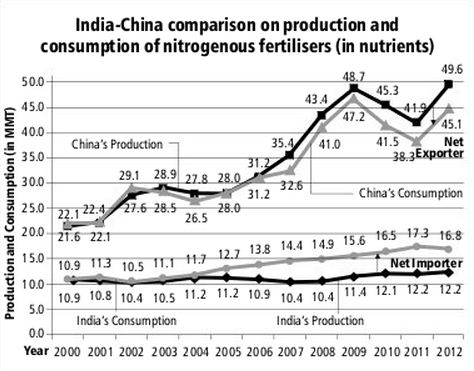
The rising subsidies and delays in the payment of these subsidies to specific plants have created an environment of uncertainty in the fertiliser industry. As a result, domestic investment in the fertiliser industry has lagged and imports have surged. For example, between 2000 and 2012, while Indian domestic production of nitrogenous fertilisers increased marginally from 10.9 million metric tonnes (in nutrients) to 12.2 MMT, China moved from 22 MMT to 50 MMT (see graph).
Capture1
India has landed its fertiliser sector in a mess: rising subsidies and imports, lagging investment, highly imbalanced use of nitrogen, phosphorus and potassium, and diversion of urea to other countries and non-agricultural uses. This is largely a result of administered pricing and subsidy policies.
How can the Indian fertiliser sector  be brought on track? Raising urea prices by, say, 200 per cent seems an obvious choice. But if it was so simple it could have been done long ago. Several committees have recommended a price increase but this has not been accepted by successive governments. Politically, it does not seem feasible  that urea prices could be raised by 200 per cent in a single shot or even over a three- to five-year period unless accompanied by a substantial increase in the MSPs of basic staples like wheat and rice. Take the case of Pakistan and China. While their urea prices are way higher than India’s, they also offer much higher MSPs for crops. In Pakistan, the MSP for wheat is $320 per MT and in China, it is $385 per MT ,against India’s $226 per MT. The fertiliser cost in Punjab accounts for about 7 per cent of the MSP of wheat. If one adjusts for this, the Indian farmer is at a much disadvantaged situation.
If the price of urea is raised by more than 200 per cent, taking it from $86 per MT to, say, $265 per MT — which is the price Chinese farmers are paying — but the MSP of wheat is also raised from $226 per MT to $385 per MT (what the Chinese farmer gets), or to $320 per MT, which his Pakistani counterpart gets, the Indian farmer would be more than happy. So, there is a way to make the price increase politically palatable. But given the National Food Security Act, 2013, which promises wheat and rice at Rs 2 to 3 per kilogramme, this MSP rise will lead to an explosive growth in food subsidy and a further distortion in cropping patterns, skewed in favour of wheat and rice. India may end up worse off.
Another option is to simply transfer the cash equivalent of the current fertiliser subsidy to farmers. This works out to roughly Rs 5,000 per hectare (Rs 1 lakh crore subsidy divided by gross cropped area of about 20 crore ha). Farmers below the 4 ha holding size can be given cash at this rate and those above that holding size at Rs 4,000 per ha. Then the entire fertiliser sector can be deregulated, with imports flowing freely at zero import duty. Direct cash transfers can be conducted via Jan Dhan Yojana bank accounts and linked to the UID and Aadhaar. Politically, this is feasible and will lead to savings of at least Rs 10,000 crore in the fertiliser subsidy by simply stopping the diversion of urea to other uses and smuggling to other countries. It will also signal to farmers that they use nitrogen, phosphorus and potassium in a balanced manner, raising the productivity of fertiliser use. The only condition imposed on beneficiary farmers should be that they get their soil tested every three years.
What would happen to our fertiliser industry under this brave new world of total decontrol? The probability is high that it would expand and prosper, provided urea plants are given gas at a uniform price (maybe a pooled price of import parity and domestically produced). It will incentivise them to be more energy efficient, get the best technologies and compete with those in China or elsewhere. There could be mergers and acquisitions within the urea industry, but overall, the industry will be liberated and unshackled from myriad controls. Industry captains today feel they are ready to walk this path to freedom. Is the government also ready?

The writer is the Infosys chair professor at Icrier

- See more at: http://indianexpress.com/article/opinion/columns/a-fertile-mess/99/#sthash.rjQFR5Os.dpuf